




01. Edit your dunn rankin inventory online
Type text, add images, blackout confidential details, add comments, highlights and more.

Type text, add images, blackout confidential details, add comments, highlights and more.

Draw your signature, type it, upload its image, or use your mobile device as a signature pad.

Send dunn rankin reward preference inventory via email, link, or fax. You can also download it, export it or print it out.
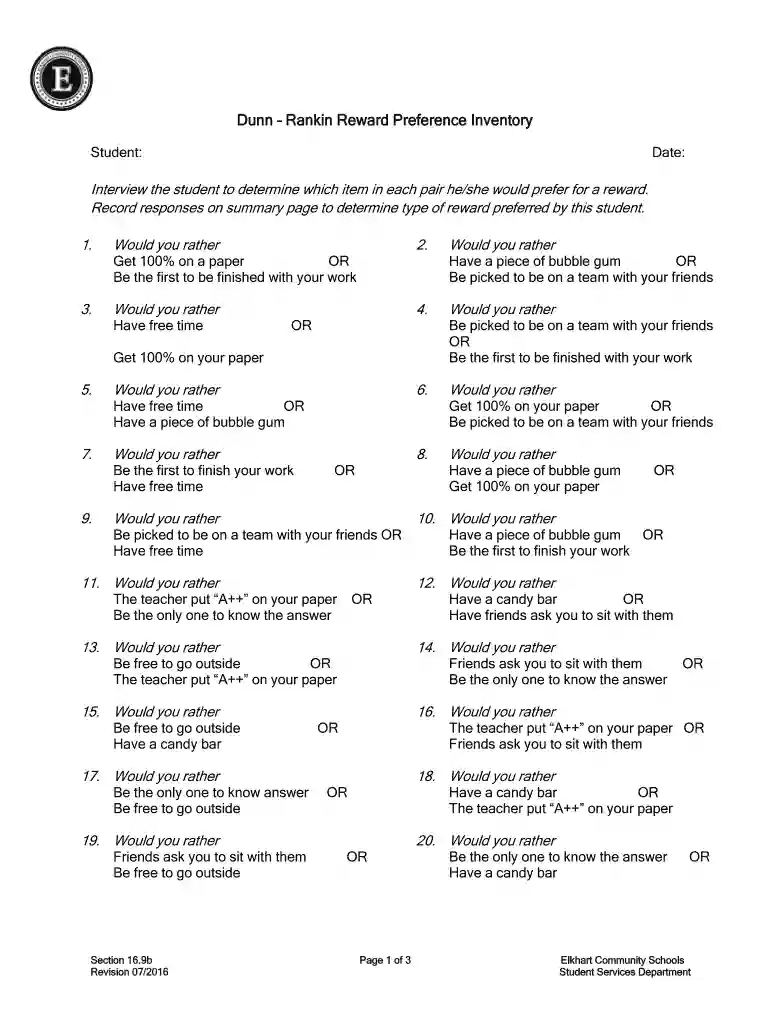
The Dunn – Rankin Reward Preference Inventory is a structured tool used to measure student preferences for different types of rewards. It functions by presenting students with a series of paired choices, effectively capturing their preferred incentives. Options typically include a variety of reward types such as academic achievements, social interactions, and tangible items. The results are organized into categories like Adult Approval, Peer Approval, Tangibles, Competition, and Independence, helping educators and researchers understand what motivates students most effectively.
To utilize the Dunn – Rankin Reward Preference Inventory effectively, follow a systematic approach:
Preparation: Ensure you have a printed or digital version of the inventory ready. Familiarize yourself with the different reward categories and choices presented.
Administration: Conduct interviews with students where they are asked to select their preferred reward from each pair. Create a comfortable environment to encourage honest and thoughtful responses.
Recording: Carefully note each student's choices to ensure accurate data collection. Use standardized scoring sheets or software designed for this inventory.
Analysis: Once all data is collected, analyze the results to identify primary reward preferences. Consider cross-referencing with other variables such as academic performance or behavioral observations for deeper insights.
To acquire the Dunn – Rankin Reward Preference Inventory:
Follow these step-by-step instructions to complete the Dunn – Rankin Reward Preference Inventory:
Introduction: Explain the purpose of the inventory to the students. Make sure they understand that there are no right or wrong answers and that their preferences are valuable.
Conducting the Interviews: Present each pair of reward choices to the student. Allow them time to consider their responses fully.
Data Collection: For each choice a student makes, record the selection accurately. Use a pre-designed form or digital tool to organize responses.
Scoring: After data collection, score the inventory by assigning points or ranks to the chosen preferences. Compile the data to derive insights into individual or group trends.
The Dunn – Rankin Reward Preference Inventory is widely used among:


Consideration of state-specific regulations is prudent when implementing the Dunn – Rankin Reward Preference Inventory:
Consider these practical examples:
At DocHub, your data security is our priority. We follow HIPAA, SOC2, GDPR, and other standards, so you can work on your documents with confidence.
by ME Landschulz 1978 Cited by 1 A study to test the validity of The Dunn-Rankin Reward Preference Inventory (DRRPI). The DRRPI shows a students ranked order of preference of five reward
On the basis of a number of comments I received from both strangers and friends and also my own assessment, I think we had a successful session. I particularly.
by GP Cartwright 1969 Cited by 5 The procedures including the use of the experimental Dunn-Rankin Reward Preference Inventory are described. Results include a general conclusion that


