




01. Edit your form online
Type text, add images, blackout confidential details, add comments, highlights and more.

Type text, add images, blackout confidential details, add comments, highlights and more.

Draw your signature, type it, upload its image, or use your mobile device as a signature pad.

Send it via email, link, or fax. You can also download it, export it or print it out.
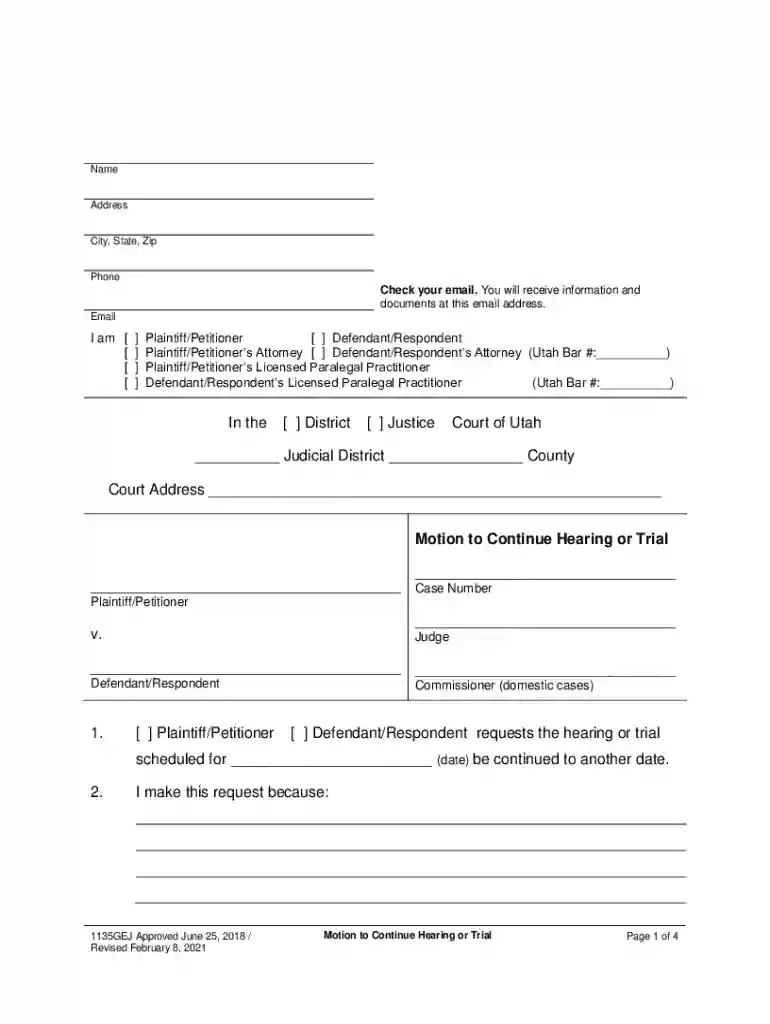
The "Motion to Continue Hearing or Trial - Commissioner" is a legal document used to formally request additional time before a scheduled hearing or trial. Typically, this motion is filed when a party needs more time to prepare their case, gather evidence, or resolve issues that may affect their readiness for the trial. This form is particularly relevant in Utah state courts, where it helps ensure that all parties have a fair opportunity to present their cases. In this context, the "commissioner" refers to a court official who oversees certain judicial proceedings, particularly those involving family law or probate cases.
Preparation: Begin by collecting relevant information about the hearing or trial, such as the case number, names of the parties involved, and the originally scheduled date.
Filling Out the Form: Enter all necessary details accurately, including the name of the court, the commissioner assigned to the case, and your reasons for seeking a continuance. Be specific about why additional time is required.
Reason for Request: Clearly articulate the reasons for the continuance. This might include needing more time to gather evidence, awaiting the availability of a key witness, or any other justification that supports your request.
Filing the Motion: Submit the completed form to the appropriate court. This can often be done in person, by mail, or electronically, depending on the court's filing procedures.
Notification: Ensure that all parties involved in the case are properly notified, adhering to the court's rules on serving documents.
Response Timeframe: Await confirmation from the court. The other parties will be given a specific timeframe to respond to your motion.
Requesting a continuance can be strategic for several reasons:
While the form is commonly used in Utah courts, different states may have varying guidelines regarding its use:
Understanding these nuances can be pivotal when preparing your motion to ensure compliance and increase the likelihood of approval.
Though similar in purpose, the "Motion to Continue Hearing or Trial" can have different interpretations or requirements across various jurisdictions:
Staying informed about these state-specific differences is vital for individuals or attorneys when handling such motions across multiple states.
The motion serves legal purposes by:
Understanding certain legal terms can aid in effectively managing the motion:
Recognizing these terms provides better insight into the process involved and enhances your ability to navigate the legal system effectively.
At DocHub, your data security is our priority. We follow HIPAA, SOC2, GDPR, and other standards, so you can work on your documents with confidence.
A party can ask to reschedule (continue) an upcoming hearing or trial by filing a Motion to Continue Hearing or Trial. It is up to the commissioner or judge
entered, after trial or further briefing. A preliminary injunction may be dismissed, or further proceedings for permanent injunction may be set by the court
by DC Kaplan 1955 Cited by 6 The statute further provides for the right of the court to grant a continuance on its own motion and constrains it from granting a motion for a continuance


