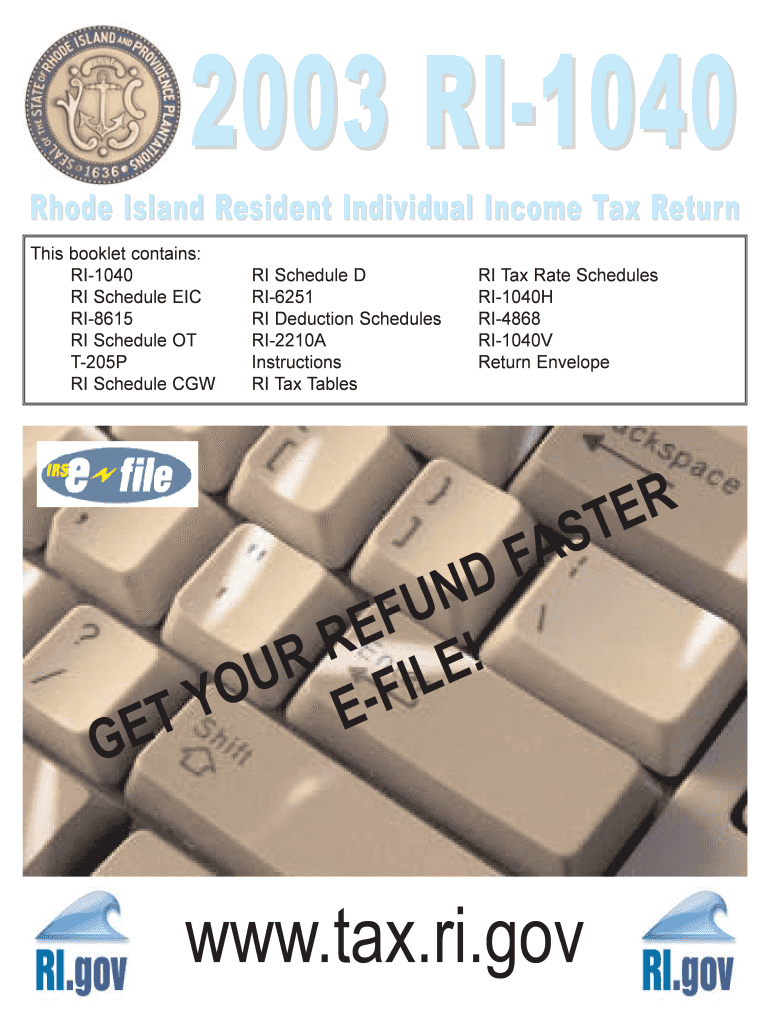







Definition and Meaning of the 2003 RI-1040
The 2003 RI-1040 form is the Rhode Island Resident Individual Income Tax Return, designed specifically for the fiscal year 2003. This document serves as a comprehensive tool for residents of Rhode Island to report their income, deductions, credits, and other relevant tax information to the state government. Being both a form and an instructional booklet, it provides detailed guidelines on completing the tax return accurately. The RI-1040 is similar to the federal income tax return but tailored to accommodate state-specific tax laws and regulations. In 2003, this form was fully essential for taxpayers residing in Rhode Island for tax compliance.
Steps to Complete the 2003 RI-1040
-
Personal Information: Begin by entering your personal details, including name, address, and Social Security number. Ensure accuracy in these fields to avoid processing errors.
-
Income Reporting: List all sources of income, such as wages, rental income, and dividends. Use federal documents like the W-2 and 1099 forms to ensure consistency.
-
Deductions and Credits: Detail any deductions, including charitable contributions and mortgage interest. Also, apply credits you qualify for, such as the Property Tax Relief Credit.
-
Calculate Tax Due: Using the tax tables provided in the booklet, determine the tax you owe or the refund due. This involves matching your taxable income to the state’s tax brackets.
-
Finalize and Sign: Review for errors, sign the form, and date it. Unsigned forms may be returned, causing delays.
-
Filing and Payment: Submit the completed form with any necessary payments to the Rhode Island Division of Taxation by the deadline. Keep a copy for your records.
Important Terms Related to the 2003 RI-1040
- Taxable Income: The portion of income subjected to state tax, calculated after deductions and exemptions.
- Property Tax Relief Credit: A credit for eligible homeowners and renters aimed at alleviating property tax burdens.
- Exemptions: Specific amounts deducted from total income for each dependent, reducing taxable income.
- Adjusted Gross Income (AGI): Total income minus specific deductions like educator expenses and student loan interest.
- Withholding: The income tax employers deduct from employee wages to prepay state taxes.
State-Specific Rules for the 2003 RI-1040
Rhode Island's tax regulations in 2003 included unique provisions specific to state residents. For example:
- Property Tax Relief: To qualify, residents needed to meet certain income thresholds and property tax payment criteria.
- Tax Brackets: They reflected the state's economic priorities, affecting how much various income levels were taxed.
- Extensions and Penalties: Late filing could result in penalties, though the state allowed extensions under particular circumstances.
Required Documents for the 2003 RI-1040
- W-2 Forms: Provided by employers, these reflect wages and tax withholdings.
- 1099 Forms: Document additional income sources not covered by wages, such as freelance work.
- Previous Year's Tax Return: Often required for comparison and accuracy.
- Receipts for Deductions: Proof of deductible expenses like tuition or property tax paid.
Filing Deadlines and Important Dates
- Tax Year End: December 31, 2003.
- Filing Deadline: Typically April 15, 2004, although extensions were available for valid reasons.
- Extension Request Deadline: Filers needed to submit requests before the original deadline.
Penalties for Non-Compliance
Failure to submit the 2003 RI-1040 on time or with accurate information could result in:
- Fines: Monetary penalties based on the duration and degree of non-compliance.
- Interest: Extra charges on unpaid taxes.
- Legal Action: Persistent non-compliance could lead to more severe penalties, including legal proceedings.
Examples of Using the 2003 RI-1040
Consider a self-employed individual who moved to Rhode Island mid-year:
- Income Reporting: They must report earnings from both part-year residency and self-employment.
- Deductions: May claim home office and business expenses specific to their Rhode Island residence.
- Credits: Eligibility for state-specific credits, such as property tax relief, should be explored.
How to Obtain the 2003 RI-1040
Obtaining the form was straightforward:
- Download: The form could be downloaded from the Rhode Island Division of Taxation’s official website.
- Mail Requests: Physical copies were available upon request via mail.
- Public Libraries and Post Offices: Printed forms were often accessible at these locations for public convenience.
Key Elements of the 2003 RI-1040
The form consists of multiple sections vital for accurate tax filing:
- Top Section: Personal and filing status information.
- Middle Section: Detailed income and deductions lists.
- Bottom Section: Tax calculation and signature lines.
- Supplementary Schedules: Additional forms for particular deductions or credits, such as Schedule W for wages tax withheld.
By covering these critical details, taxpayers could navigate the 2003 RI-1040 efficiently, ensuring compliance and maximizing potential benefits.