







Definition & Meaning
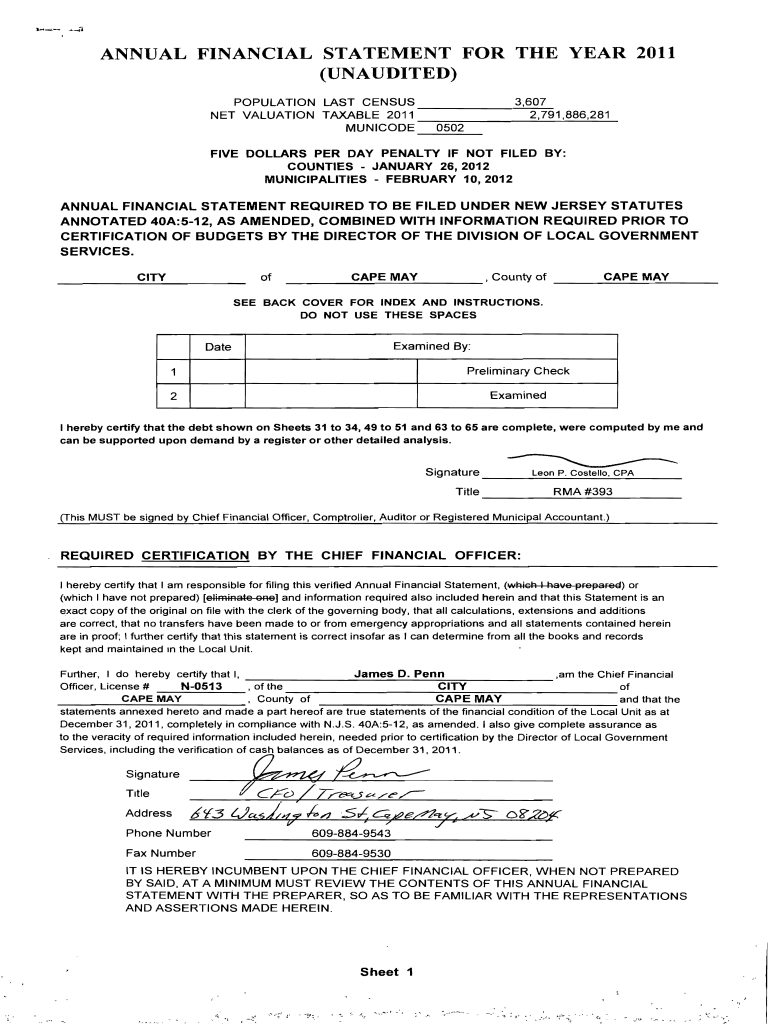
The Annual Financial Statement for the Year 2011 provides a detailed overview of a municipality's financial health as of December 31, 2011. It contains critical data on revenues, expenditures, and balances across multiple funds, such as current, trust, and utility funds. The document is typically unaudited and is often used to assess the financial condition of the city or town, including debt service requirements and compliance with local government regulations.
Key Elements of the ANNUAL FINANCIAL STATEMENT FOR THE YEAR 2011
- Revenues and Expenditures: Details the income and spending throughout the year, offering insights into budget management.
- Fund Balances: Provides an overview of the balances in various funds to assess financial stability.
- Debt Service Requirements: Includes information on outstanding debts and the municipality's ability to meet these obligations.
- Compliance Certifications: Lists required certifications to ensure adherence to state laws and regulations.
Steps to Complete the ANNUAL FINANCIAL STATEMENT FOR THE YEAR 2011
- Gather Financial Data: Collect all relevant financial transactions and records up to December 31, 2011.
- Organize Information by Fund: Categorize revenues, expenditures, and balances into current, trust, and utility funds.
- Review Debt Obligations: Include detailed information on debt service requirements and compliance with local guidelines.
- Compile Population Statistics: Update demographic data to reflect the latest census information relevant to financial analysis.
- Draft Statements: Prepare comprehensive statements that reflect the financial condition accurately.
- Verification and Approval: Ensure that all figures are correct before submitting for any required approvals.
State-Specific Rules for the ANNUAL FINANCIAL STATEMENT FOR THE YEAR 2011
- New Jersey Regulations: Specific to the City of Cape May, New Jersey mandates may include particular reporting standards and formats that must be followed.
- Certification Requirements: Different states may require different forms of certification and compliance affirmations.
- Submission Guidelines: Rules on how and where to submit the document may vary by state, particularly regarding electronic versus paper submissions.
Who Typically Uses the ANNUAL FINANCIAL STATEMENT FOR THE YEAR 2011
- Local Government Officials: For budget analysis and future financial planning.
- State Auditors: To ensure compliance with legal and financial regulations.
- Public Stakeholders: Including residents and local business owners who are interested in the city’s financial health.

Legal Use of the ANNUAL FINANCIAL STATEMENT FOR THE YEAR 2011
- Transparency and Accountability: Ensures that the city is transparent about its financial activities and accountable to its residents.
- Financial Audits: Used in audits to verify whether the city is compliant with financial and legal obligations.
- Policy Formulation: Aids in shaping policies related to financial management and expenditure.
Examples of Using the ANNUAL FINANCIAL STATEMENT FOR THE YEAR 2011
- Budget Reassessment: Used by local officials to reassess and adjust future city budgets based on past expenditures.
- Debt Restructuring: Analyzed by financial advisers when considering refinancing or restructuring municipal debt.
- Community Meetings: Presented during public forums to discuss municipal financial health and future projects.
Required Documents
- Transaction Records: Detailed documentation of all financial transactions within the fiscal year.
- Debt Statements: Information on all outstanding debts and repayment schedules.
- Compliance Certifications: Documents proving adherence to relevant state and local laws.
- Population Data: Recent statistics relevant to demographic trends and their impact on municipal services.
Examples of Using the ANNUAL FINANCIAL STATEMENT FOR THE YEAR 2011
- Budget Reassessment: Used by local officials to reassess and adjust future city budgets based on past expenditures.
- Debt Restructuring: Analyzed by financial advisers when considering refinancing or restructuring municipal debt.
- Community Meetings: Presented during public forums to discuss municipal financial health and future projects.
Form Submission Methods (Online / Mail / In-Person)
- Online Submission: Some states may allow or mandate electronic filing for convenience and efficiency.
- Mail Submission: Traditional method for submitting paper forms, though ensuring timely delivery is critical.
- In-Person Submission: Possible for municipalities requiring immediate or on-the-spot verifications and submissions.
Important Terms Related to ANNUAL FINANCIAL STATEMENT FOR THE YEAR 2011
- Net Valuation Taxable: Refers to the total taxable value of property within the city limits.
- Utility Funds: Specific funds used to manage revenues and expenditures related to city utilities, such as water and electricity.
- Audit Trail: A record of all amendments and reviews of the financial statement for future reference.
Filing Deadlines / Important Dates
- Typically, the Annual Financial Statement for the Year 2011 must be completed and filed shortly after the end of the fiscal year, by a date specified by local or state regulations. It is crucial to confirm the deadline specific to the jurisdiction in question to avoid penalties.




