




01. Edit your form online
Type text, add images, blackout confidential details, add comments, highlights and more.

Type text, add images, blackout confidential details, add comments, highlights and more.

Draw your signature, type it, upload its image, or use your mobile device as a signature pad.

Send it via email, link, or fax. You can also download it, export it or print it out.
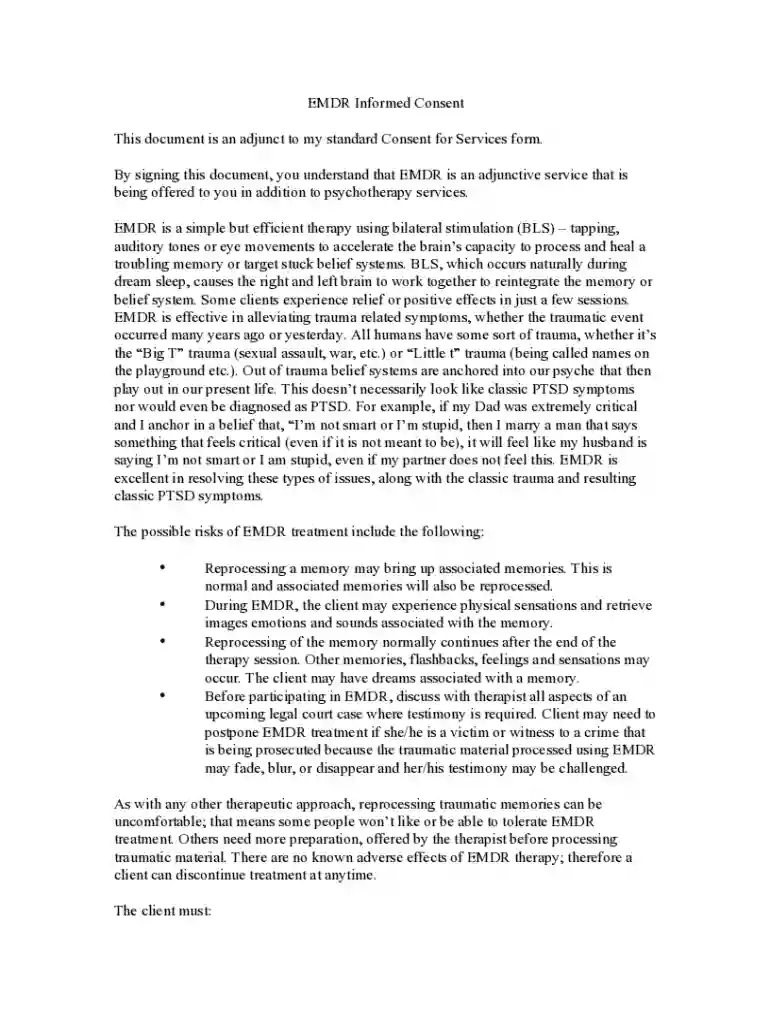
The EMDR Informed Consent Form is a crucial document in the realm of psychotherapy, specifically for those undergoing Eye Movement Desensitization and Reprocessing (EMDR) therapy. This therapy is used to help clients process and recover from traumatic memories through bilateral stimulation techniques. The form serves to explain the procedure, benefits, and risks associated with EMDR treatment, ensuring that clients are fully informed before consenting to participate.
The form encompasses several essential components:
Typically, this document is provided by the therapist or the mental health institution offering EMDR services. Clients can request this form during their initial consultation or download it from the therapy provider's website if available.
The form is primarily used by psychotherapists trained in EMDR therapy. It is also utilized by the clients who are intending to undergo EMDR as part of their psychotherapy treatment. The form is crucial for ensuring both parties understand the terms, procedures, and implications of the therapy.


This form holds legal significance, as it documents that the client has been informed about the EMDR process and consents to proceed. It is critical for maintaining ethical standards and legal compliance in therapeutic practices. Clients are encouraged to keep a copy for their records.
While the form generally follows a standard structure, certain states may have specific regulations regarding its use and the practice of EMDR therapy. It's essential for therapists and clients to be aware of any state-specific requirements that might affect compliance.
Consider a scenario where a client suffering from PTSD seeks EMDR therapy. The therapist provides the informed consent form, which the client reviews, signs, and submits. This ensures that the client is aware of and agrees to the therapy's nature and implications, empowering them in their treatment journey.
With the rising trend of digital documentation, many therapists offer the form in both paper and digital versions. The digital format allows for convenient electronic submission and storage, while a paper copy may be preferred in settings where digital access is limited or for personal preference.
Therapists often use various document management software, such as DocHub, to handle the EMDR informed consent form. Platforms like DocHub allow easy editing, signing, and sharing of documents, facilitating a more efficient workflow for both therapists and clients.
At DocHub, your data security is our priority. We follow HIPAA, SOC2, GDPR, and other standards, so you can work on your documents with confidence.
Apr 28, 2024 An example of informed consent is when a patient signs a consent form after a doctor has thoroughly explained a surgical procedure and itsSee more
Dear participant,. This survey aims to collect information about the effect of EMDR on pain in Rheumatoid Arthritis patients within the scope of the research
Apr 1, 2025 Informed Consent: The primary objective is to ensure that clients understand what they are agreeing to. This includes the nature of the


