




01. Edit your form online
Type text, add images, blackout confidential details, add comments, highlights and more.

Type text, add images, blackout confidential details, add comments, highlights and more.

Draw your signature, type it, upload its image, or use your mobile device as a signature pad.

Send it via email, link, or fax. You can also download it, export it or print it out.
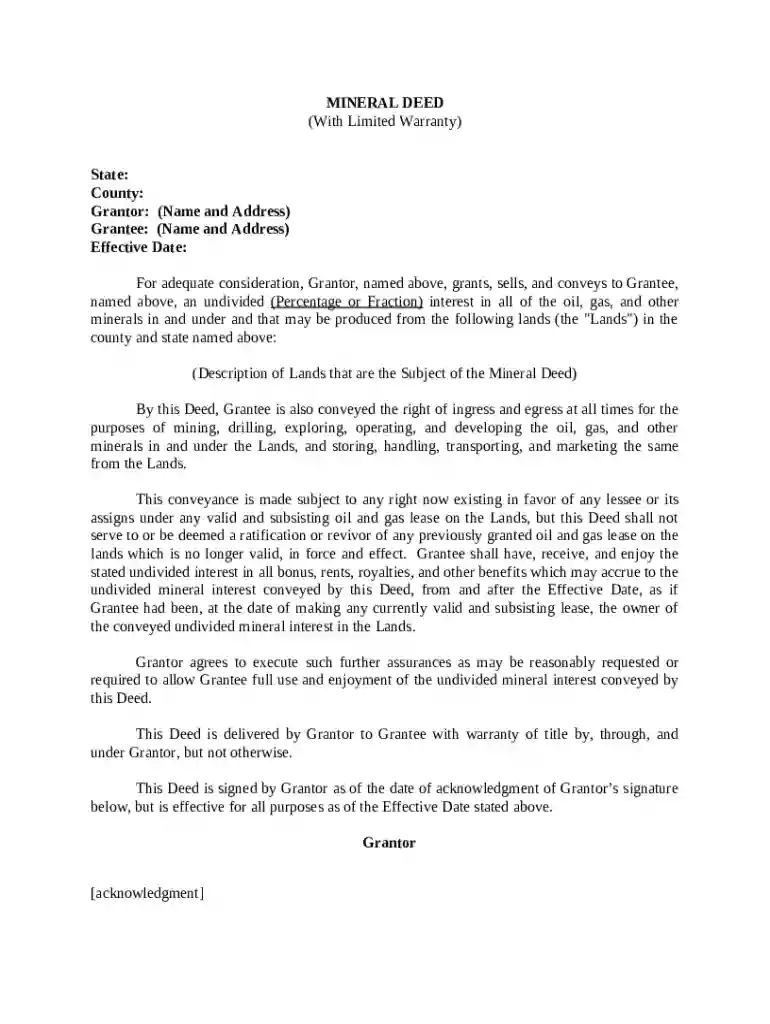
A mineral deed is a legal document that facilitates the transfer of ownership rights of mineral interests from one party, known as the grantor, to another party, the grantee. These mineral interests often pertain to resources such as oil, gas, and other valuable minerals beneath a specified tract of land. The deed defines the grantee's rights to exploit these resources, laying out the scope of ownership and any limitations placed on those rights. In some cases, the mineral deed may come with a limited warranty, ensuring the grantee's interest against any claims arising from the grantor's period of ownership but not extending to issues predating that period.
Gather Necessary Information: Collect details of the grantor, grantee, and property in question, ensuring all data is accurate and up to date.
Draft the Mineral Deed: Prepare the document with all required elements, including legal descriptions, warranty terms, and any conditions or reservations.
Notarize the Deed: Have the deed signed by both parties in the presence of a notary public to authenticate the agreement.
File with Local Authorities: Submit the completed and notarized deed to the county recorder or similar local authority where the property is located to officially record the transaction.
Mineral deeds play a crucial role in transactions involving natural resources, ensuring that legal ownership and usage rights are clearly defined. They can be used in several scenarios, including:
Mineral rights and the execution of mineral deeds can be subject to state-specific regulations. Factors that may vary include:
Mineral deeds are widely used in multiple contexts:
The Internal Revenue Service (IRS) may require reporting any income derived from mineral rights transactions. Owners should be aware of the following:
Mineral deeds are useful for a range of entities, including:


At DocHub, your data security is our priority. We follow HIPAA, SOC2, GDPR, and other standards, so you can work on your documents with confidence.
by LH Burney 2001 Cited by 25 This article examines the influence of the one-eighth royalty provision on interpreting mineral and royalty deeds, which are notoriously difficult to interpret.
The Mineral Land Records System (MLRS) is an online platform delivering state-of-the-art mineral and land records transactions, tracking, mapping, and more
In order to preserve the environment and protect the public health and water quality; to eliminate and control causes of disease, infection,


