




01. Edit your form online
Type text, add images, blackout confidential details, add comments, highlights and more.

Type text, add images, blackout confidential details, add comments, highlights and more.

Draw your signature, type it, upload its image, or use your mobile device as a signature pad.

Send it via email, link, or fax. You can also download it, export it or print it out.
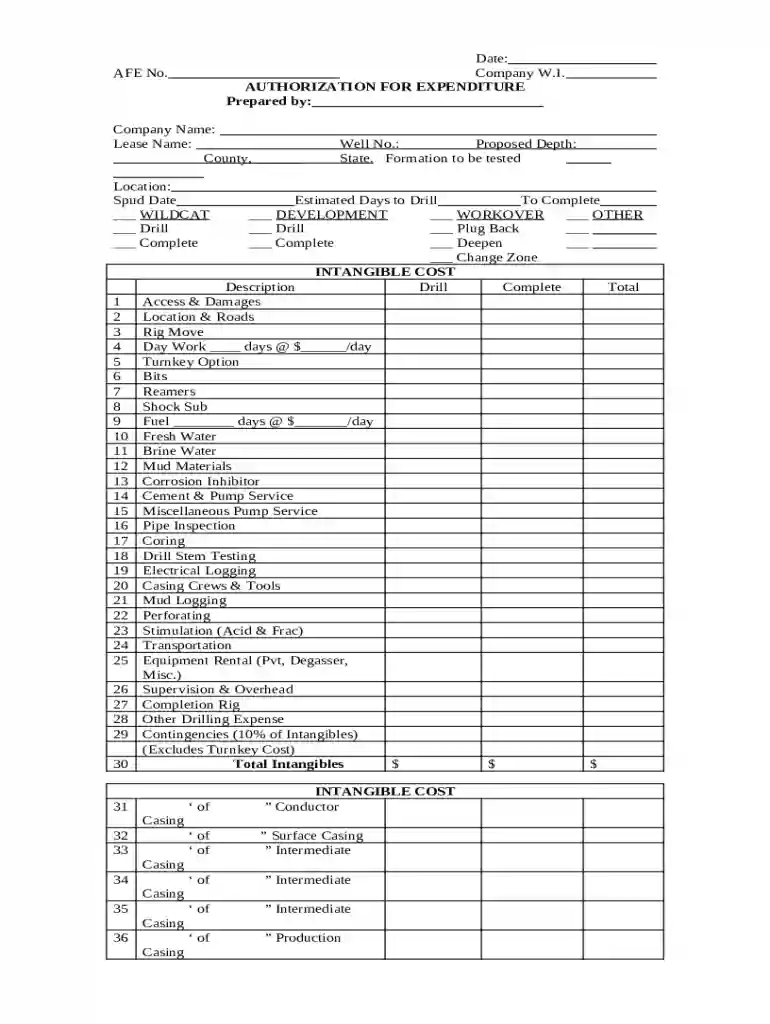
An Authorization for Expenditure (AFE) is a financial document used by companies, especially in the energy sector, to outline, approve, and track anticipated costs related to a major project like drilling wells. It provides a detailed estimate of all expected expenditures, both tangible and intangible, necessary for completing a project. Tangible costs might include physical items like equipment or construction materials, while intangible costs could cover services such as labor or consulting fees. The AFE serves as a budgetary guide and ensures that all stakeholders, including joint operators, are informed and in agreement about the financial commitments involved.
AFEs function as both a budgeting tool and a control mechanism to ensure project costs remain within approved financial parameters. To use an AFE effectively, companies begin by preparing a detailed cost assessment for a project. This includes listing all project phases, from initial planning and resource acquisition to execution and completion. AFEs should be used to manage changes in project scope or costs, as any significant deviation typically requires a revised or new AFE to be approved by key stakeholders. This ensures fiscal responsibility and transparency throughout the project lifecycle.
Identify Project Scope:
Estimate Costs:
Compile Supporting Documentation:
Review and Approval:
Monitoring and Reporting:
Project Details:
Cost Breakdown:
Approval Section:
Risk and Contingency Plans:
AFEs are primarily used by companies in industries with high capital projects, such as oil and gas, mining, construction, and utilities. Within these companies, they are crucial for project managers, financial analysts, and executives responsible for overseeing project budgets and financial compliance. Joint venture partners and external auditors may also rely on AFEs to ensure transparency and accountability in shared projects. Understanding the nuances of an AFE can also benefit investors and stakeholders who need to assess project viability and financial prudence.


The legal use of an AFE is grounded in ensuring financial accountability and adherence to agreed-upon budgets and project scopes. Legally, signing an AFE indicates acceptance of financial responsibility, and it often forms part of contractual agreements between stakeholders. It’s legally binding and can be used as evidence in disputes over project costs or scope. Consequently, transparency and accuracy in AFEs are not only financially prudent but also legally necessary to prevent liabilities.
While AFEs are generally standardized, specific regulations and compliance requirements can vary by state. These differences may impact how AFEs are prepared or reported, especially in industries with state-specific environmental regulations or labor laws. For instance, different states might have varying requirements for reporting drilling activities or environmental assessments, impacting cost estimates and authorizations. Companies should ensure they familiarize themselves with relevant state laws to maintain compliance and avoid legal penalties.
Consider a drilling project in Texas where the AFE details both the direct and indirect costs, from machinery purchases to environmental assessments. The AFE includes expected costs for obtaining permits, drilling operations, and post-drilling site restoration. Additionally, a company might use an AFE to plan a construction project in California, predict expenses for materials, labor, and safety measures, and adjust for California's stringent building codes. These examples demonstrate the AFE’s versatility and necessity in capturing the comprehensive cost outlook.
Intangible Costs:
Tangible Costs:
Contingency:
Joint Operator:
Understanding these terms is essential for effectively creating and utilizing an AFE, ensuring that all stakeholders have a clear understanding of the financial aspects involved.
At DocHub, your data security is our priority. We follow HIPAA, SOC2, GDPR, and other standards, so you can work on your documents with confidence.


The Capital Expenditure Authorization (CEA) Process begins when a department or school identifies the need for a specific project or capital equipment purchase.Jump to
Form 4116 is used to organize data for entry into the Texas Health and Human Services Commission (HHSC) accounting system for HHSC authorized expenditures.
Dec 21, 2011 Signature Authorization, to authorize the provider to enter your self-selected PIN on your return. Depending on the provider and the


