






Definition and Meaning of the Form
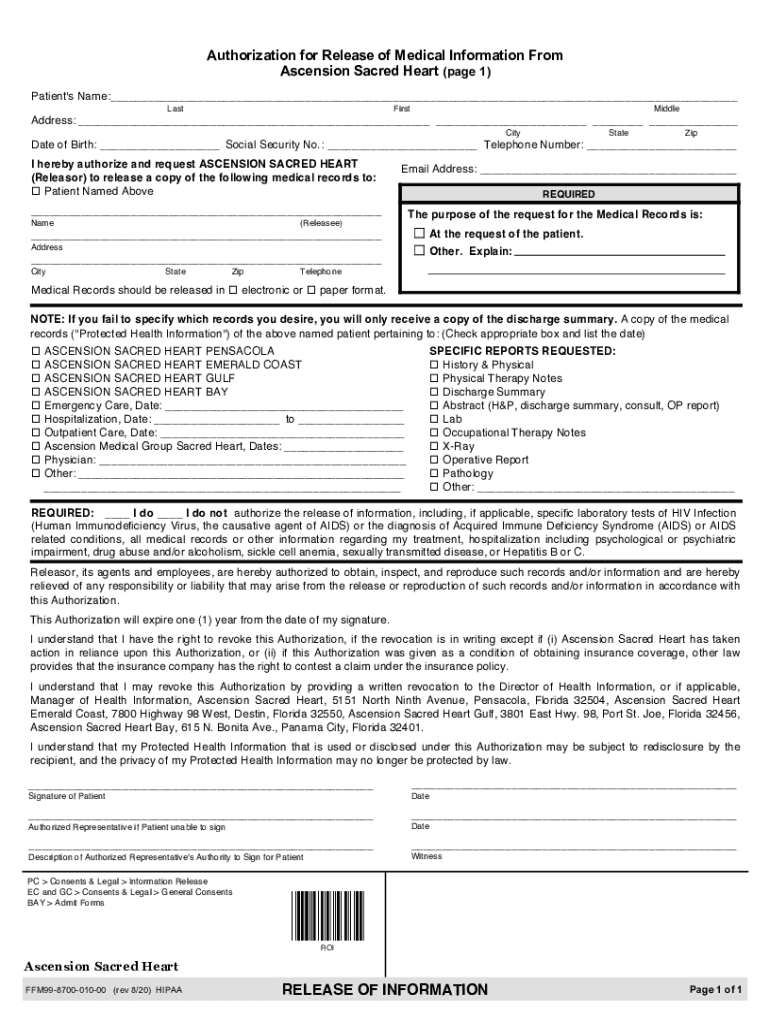
The "authorization for release of medical information from Ascension Sacred Heart" is a formal document allowing patients to give consent for their medical records to be shared with a designated party. It is instrumental in facilitating the secure and legal exchange of personal health information between healthcare providers, insurance companies, legal entities, or individuals. By signing this authorization, a patient explicitly outlines which medical details can be disclosed and to whom.
Subsections:
- Purpose of Authorization: It is primarily used to ensure that patient privacy is maintained while allowing the transfer of crucial medical information for purposes such as continuing care, insurance claims, or legal processes.
- Patient Identification: The form includes sections to accurately record the patient's details, ensuring correct identification and preventing accidental data breaches.
Steps to Complete the Authorization Form
Filling out the "authorization for release of medical information from Ascension Sacred Heart" requires careful attention to ensure clarity and compliance. Here is a step-by-step guide:
- Patient Details: Provide full name, date of birth, and any identifying information required.
- Recipient Information: Specify the person or entity authorized to receive the medical information.
- Purpose: Clearly state the reason for the release, whether it's for medical treatment, legal reasons, or insurance purposes.
- Information Scope: Detail which parts of the medical record the patient authorizes to be shared.
- Expiration Date: Indicate when the authorization will expire or if a specific event triggers its expiration.
- Signature: The patient must sign and date the form to give valid consent.
Key Elements of the Form
The form is comprised of several critical components to ensure it meets legal and practical requirements.
- Consent Section: Clearly states what information can be shared and acknowledges the patient's understanding.
- Revocation Rights: Outlines the patient's right to revoke authorization and the procedures for doing so.
- Confidentiality Clause: Details how the information will be used and safeguarded by the recipient.
- Provider Information: Identifies Ascension Sacred Heart as the originating entity for the records.
Legal Use and Compliance
Using this form legally involves adherence to healthcare privacy laws such as HIPAA in the United States.
Legal Requirements:
- Patient's Consent: It must be voluntary and based on informed decisions.
- Limited Information Release: Only the information specified in the form can be shared.
- Recordkeeping: Copies of the authorization should be retained for accountability and future reference.
How to Obtain the Form
The authorization form can typically be obtained directly from Ascension Sacred Heart’s administrative offices or their website.
Procedures:
- Online Access: Many institutions offer downloadable versions of their forms on their official websites.
- In-Person Request: Forms can be picked up from the office for those preferring physical copies.
Important Terms Related to the Authorization
Understanding relevant terminology is crucial for correctly completing and utilizing the form.
- PHI (Protected Health Information): Refers to any information about health status, provision of healthcare, or payment for healthcare that can be linked to an individual.
- Revocation: The patient's right to withdraw their consent to share information at any time.
- Minimal Disclosure: The principle of sharing the least amount of information necessary to achieve the intended purpose.
Examples of Using the Form in Practice
Real-world scenarios help illustrate how the "authorization for release of medical information from Ascension Sacred Heart" is used.
- Medical Continuity: A patient transferring to another healthcare provider may use the form to ensure the new provider receives necessary medical history.
- Insurance Claims: The form allows insurance companies to access required information to process claims efficiently.
- Legal Proceedings: Attorneys might request medical records to support a case, requiring patient authorization.
State-Specific Rules
While the authorization form is guided by federal laws like HIPAA, there are nuances based on state regulations.
Examples of Variations:
- Consent Age: In some states, patients over a specific age can independently authorize the release of their records.
- Additional Requirements: Certain states might necessitate additional forms or notarizations under specific circumstances.
Who Typically Uses the Authorization Form
Understanding who commonly completes and submits these forms provides insight into its utility.
- Patients: The primary users, ensuring their records are shared as needed.
- Healthcare Providers: Physicians and hospitals requiring documentation to share medical records legally.
- Legal Representatives: Attorneys seeking information for case preparation.
- Insurance Companies: Utilize the form to verify claims and manage policyholder information.