






Definition & Meaning
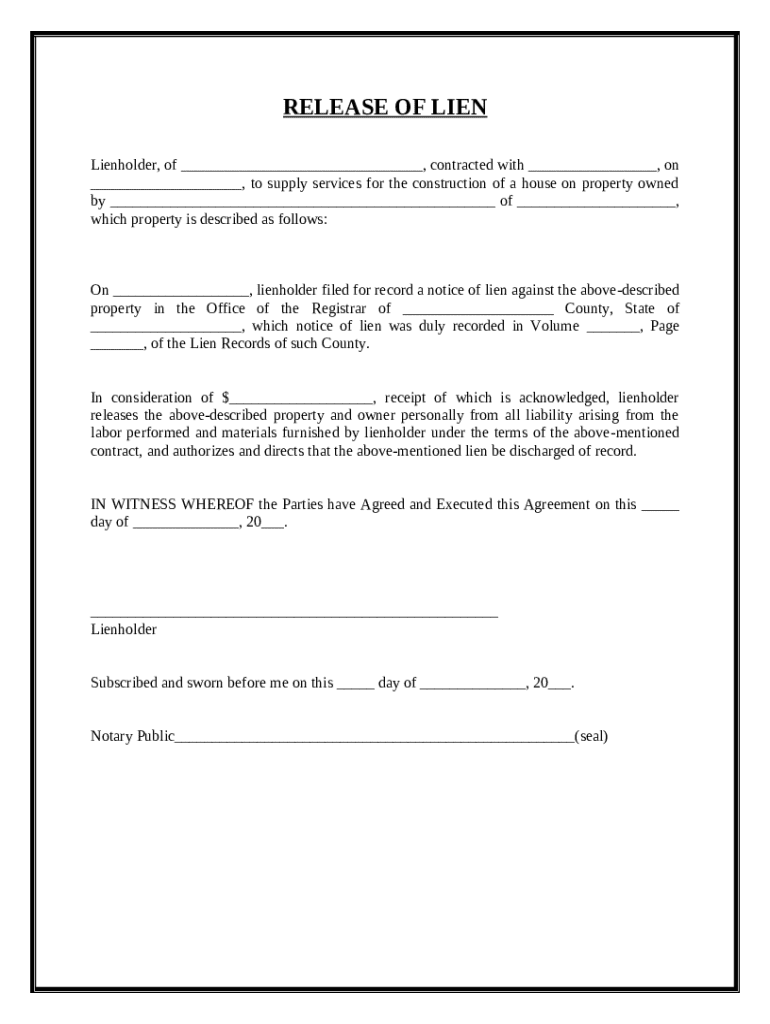
The Release of Lien is a legal document commonly used in the United States to officially remove a lien claim from a property. A lien, typically filed by contractors or service providers, is a legal right or interest that a lender or service provider has in the debtor's property, granted until the debt is satisfied. The Release of Lien acknowledges that a property owner has fully paid for services or materials provided for construction or improvements, thereby freeing the property from any related claims.
Liens are often a part of construction and real estate transactions, such as in home remodels, where contractors might file a lien to secure payment. A Release of Lien effectively clears the title of the property, ensuring it is free of any encumbrances. This legal instrument is crucial during property sales or refinancing as clear title guarantees that the property is free from claims that may affect the buyer.
How to Use the Release of Lien
To use a Release of Lien effectively, it is essential to follow a structured approach ensuring all legal requirements are met. The property owner, upon full payment of the obligations to the lienholder, should request a completed Release of Lien from the service provider. This document should then be notarized to verify the authenticity of signatures involved, thus providing legal credence.
Once notarized, the Release of Lien should be filed with the local county office where the initial lien was recorded. This filing updates public records to reflect that no outstanding claims exist against the property. By following these steps, one ensures that the lien is legally removed, and the property's title is cleared.
Steps to Complete the Release of Lien
Completing the Release of Lien involves several detailed steps that must be diligently followed:
-
Verification of Payment: Ensure that full payment has been made to the lienholder as per the agreement.
-
Preparation of Document: The lienholder, typically a contractor or lender, fills out the Release of Lien document, which includes details like the property description, amount paid, and parties involved.
-
Notarization: The document must be signed in the presence of a notary public to verify the identities of the parties and the authenticity of the document.
-
Submission: File the notarized form with the county recorder's office where the lien was originally filed.
-
Confirmation: After filing, obtain a confirmation or receipt as proof that the lien has been officially released.
These steps are crucial for legally removing the lien and any potential encumbrances attached to the property.
Important Terms Related to Release of Lien
Understanding the terminology associated with the Release of Lien ensures clarity and avoids potential disputes:
- Lienholder: The person or entity that has the legal right to hold a lien against the property.
- Debtor: The property owner who is responsible for fulfilling the financial obligation that prompted the lien.
- Encumbrance: A legal claim or liability attached to the property title, potentially affecting its transferability.
- Notarization: The process of officially certifying the authenticity of signatures on the document.
Familiarity with these terms helps stakeholders understand their roles and responsibilities within this context.
Legal Use of the Release of Lien
The legal use of a Release of Lien is fundamental to protecting property rights and ensuring financial obligations are met without disputes. It serves to document the satisfaction of debt and assures that the property can be sold or refinanced free of any encumbrances, which might otherwise discourage potential buyers or lenders.
Moreover, in the context of real estate transactions, a Release of Lien provides evidence that the property is cleared of any prior claims, thus safeguarding both buyers and financial institutions involved. It is a key tool for legal compliance in property dealings, protecting against future litigation over alleged unpaid debts.
State-Specific Rules for Release of Lien
While the basic principles of a Release of Lien are consistent across the United States, specific state rules and regulations may vary. For instance, some states may require additional documentation, different filing procedures, or specific deadlines by which the lien must be released following satisfaction of the debt.
- California: Requires a Conditional or Unconditional Waiver before the lien can be fully released.
- Texas: Mandates strict adherence to prompt filing after payment to avoid penalties.
Understanding and complying with these state-specific regulations is essential for appropriately handling lien releases.
Examples of Using the Release of Lien
Practical scenarios illustrate the application of a Release of Lien in real-world situations:
-
Construction Projects: After a home renovation, the contractor received full payment and issued a Release of Lien, allowing the homeowner to sell their property without liens.
-
Refinancing: A homeowner paid off a construction loan, received a Release of Lien, and successfully refinanced with a new lender who required clear title.
These examples highlight the importance and necessity of properly executing and filing a Release of Lien to ensure property transactions proceed unencumbered.
Penalties for Non-Compliance
Failing to comply with the processes and requirements related to the Release of Lien can result in significant penalties. Property owners might face legal actions if a lien is wrongfully maintained, affecting their ability to sell or finance the property. Additionally, lienholders not releasing a lien after payment can be subject to legal penalties and damages imposed by court rulings.
These penalties emphasize the importance of timely and accurate completion of the Release of Lien to avoid legal complications. By understanding and adhering to the rules and timelines, parties ensure a smooth and legally compliant property transaction process.