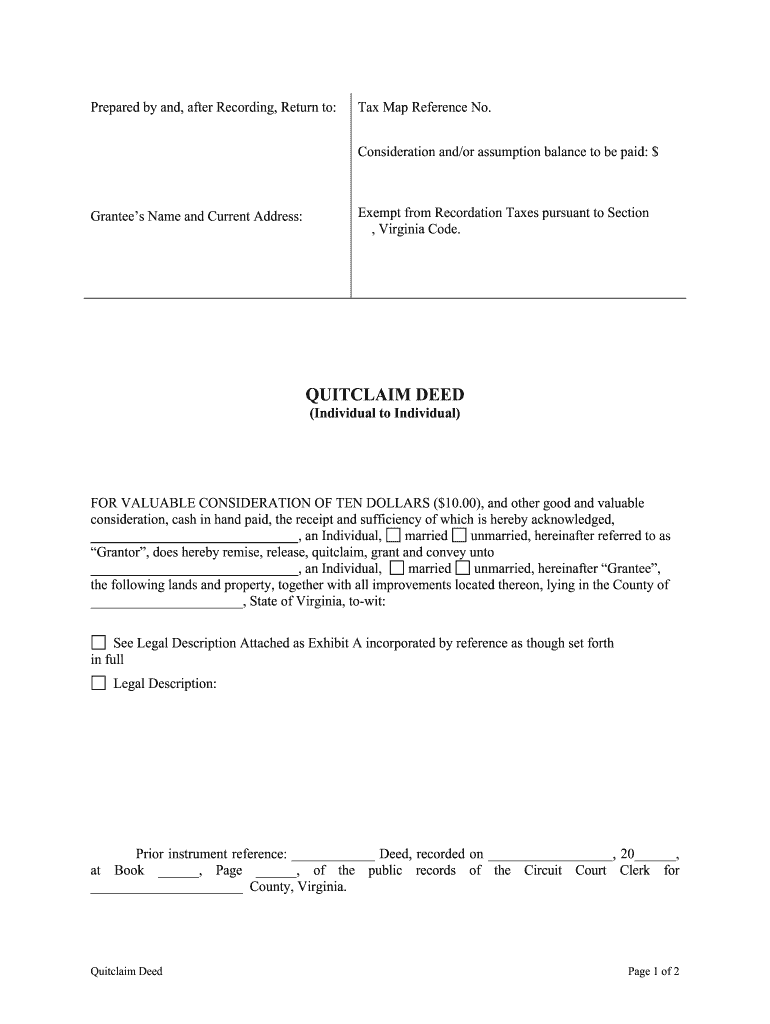







Definition & Meaning
The quitclaim real estate form is a legal document used in the United States for transferring interest in real property from one party (the grantor) to another (the grantee). Unlike other types of deeds, it offers no guarantees about the quality of the title or the grantor's legal ownership. This type of form is often used among family members, in divorce settlements, or between trusted parties where the history of the property's title is well-known. Its main function is to release or "quit" any claim to the property, hence the name "quitclaim."
How to Use the Quitclaim Real Estate Form
Using a quitclaim real estate form involves several steps to ensure the transfer is legally binding. Here's how it typically works:
- Identify the Parties: Clearly list the grantor and grantee. Ensure correct and full legal names are used to avoid disputes later.
- Property Description: Include a detailed description of the property being transferred, often including the parcel number or address.
- Signing the Document: The grantor must sign the form in the presence of a notary public. Some states may also require the grantee's signature.
- Record the Document: Once executed, the form should be filed with the recorder's office in the county where the property is located to make the transfer official and public.
Steps to Complete the Quitclaim Real Estate Form
Completing a quitclaim real estate form is straightforward but requires accuracy.
- Fill Out Personal Information: Enter the full legal names of the grantor and grantee.
- Describe the Property: Include all legal descriptions and identifiers, such as lot number and block number.
- Sign the Document: Ensure all appropriate signatures appear where necessary; notarization may be required.
- File with County: Visit the local county recorder's office with the completed form to officially document the change in ownership.
Subsection: Notarization and Witnessing
- Notarization is critical in many jurisdictions to validate the authenticity of the signatures.
- Some states may require witnesses in addition to a notary.
Important Terms Related to Quitclaim Real Estate Form
Several legal terms are crucial for understanding the implications of a quitclaim deed.
- Grantor: The person or entity transferring the property.
- Grantee: The person or entity receiving the property.
- Consideration: Often a nominal amount, this is the value exchanged for the transfer.
- Legal Description: A formal description that uniquely identifies the property.
Detailed Explanation of Consideration
- In many transactions, this term may only symbolize the transfer (e.g., "for the sum of one dollar") and does not reflect the true market value of the property.
Legal Use of the Quitclaim Real Estate Form
The legal use of a quitclaim deed is subject to state laws, which can determine specific requirements for execution and recording.
- Divorce Settlements: Commonly used to transfer property from joint to single ownership.
- Family Transfers: Useful in transferring real estate between relatives without a formal sales transaction.
- Corrections: Used to correct title errors or misspellings in previously recorded documents.
Subsection: Limitations
- Limited in providing warranty of the title to the grantee.
- Not suitable for buyers who require assurance of clear title.
State-Specific Rules for the Quitclaim Real Estate Form
Each state has its own set of rules governing the use of a quitclaim deed.
- Virginian Rules: Exemptions apply to transfers that are nominally monetary or familial.
- California Differentials: Requires disclosures about the implications of accepting a quitclaim deed.
Real-World Scenarios
- In Michigan, a quitclaim deed between spouses may be processed without recording taxes.
- Florida requires certain disclosure statements during the transfer process.
Required Documents for Quitclaim Real Estate Form
To complete a quitclaim deed, gather certain documents for submission:
- Identification: Government-issued IDs for the grantor and possibly the grantee.
- Existing Deed: The current deed to ensure all legal descriptions match.
- Property Tax Information: May be required for recording and verification purposes.
Edge Cases
- Verification of marriage certificates in cases of spousal property transfers.
- Proof of estate if property transfer is part of a will execution.
Key Elements of the Quitclaim Real Estate Form
There are fundamental components that every quitclaim deed must contain.
- Names of the Parties: Legal names of involved parties.
- Transfer Language: A clear statement of the intent to transfer property rights.
- Signature Lines: Areas for grantor's signature and, if necessary, grantee and witnesses.
Additional Components
- Acknowledgment section for notarization.
- Real estate tract map or locator information to assist with property identification.
Examples of Using the Quitclaim Real Estate Form
Examples illustrate practical uses of the form:
- Family Transfer: Parents transferring property to a child as a gift.
- Business Reorganization: Transferring property from individual ownership into a business entity.
Implications
- Understanding tax implications is vital; consulting a tax advisor regarding transfer consequences is advised.