






Key Elements of the FIRST PRIME REALTY GROUP DOCUMENT CHECKLIST
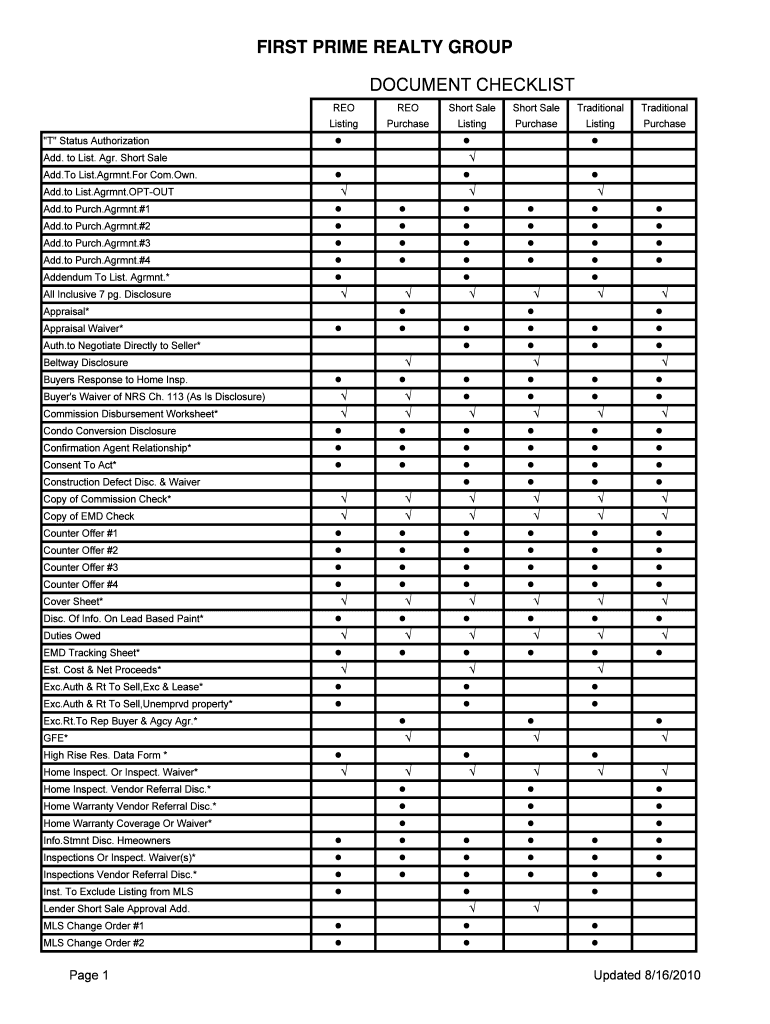
The FIRST PRIME REALTY GROUP DOCUMENT CHECKLIST is a vital tool for real estate transactions, ensuring that agents have all necessary documents organized and ready for any compliance checks. It is divided into different categories to streamline tasks:
-
Required Documents: This section lists the mandatory forms needed for standard real estate transactions. These might include terms of service agreements, property disclosure forms, and buyer's brokerage agreements.
-
Applicable Documents: These are forms that may be needed depending on the specific nature of the transaction, such as short sales or REO agreements. Real estate agents are advised to check these items based on the transaction context.
-
Not Required Documents: These forms are occasionally used based on special circumstances defined by state laws or unique transaction requirements, offering clarity for agents who might otherwise be uncertain about their need.
Steps to Complete the FIRST PRIME REALTY GROUP DOCUMENT CHECKLIST
Completing the checklist efficiently can significantly reduce transaction turnaround times. Here is how to navigate the process:
-
Review the Transaction Type: Determine if the transaction involves REO, short sales, or traditional listings, as this dictates which sections of the checklist apply.
-
Gather Required Documents: Start by collecting documents marked as 'Required.' This step is critical to ensure compliance and prevent any procedural delays.
-
Evaluate Additional Needs: For transactions that involve complexities like short sales, review the 'Applicable Documents' and gather those as necessary.
-
Organize and Verify: As documents are gathered, organize them in the order specified by the checklist and cross-verify each form's completion status to ensure thoroughness.
Practical Examples of Using the FIRST PRIME REALTY GROUP DOCUMENT CHECKLIST
Real-world usage of the checklist can vary based on the transaction dynamics:
-
Short Sale Transactions: In these cases, additional documentation might be necessary to establish the seller’s financial hardship. Real estate agents would use the 'Applicable Documents' list more frequently here.
-
REO Properties: Agents dealing with bank-owned properties might need documentation such as bank sale approvals that are not typically required in consumer-to-consumer sales.
-
Traditional Sales: For a straightforward transaction, only the core required documents might be necessary, simplifying the checklist's role to just ensuring completeness.
How to Obtain the FIRST PRIME REALTY GROUP DOCUMENT CHECKLIST
Accessing the checklist in its most current form is crucial for ensuring accuracy and compliance:
-
From an Agency's Internal Resources: Many realty groups will provide the checklist as part of their standard operating procedures. Checking with the agency’s admin office can be the first step.
-
Online Portals: Many realty groups have adopted digital platforms where agents can download templates and forms, often updated in real-time.
-
Legal and Professional Associations: Professional boards or associations often provide members with these resources, ensuring they have access to legally-compliant and current forms.
Software Compatibility for the FIRST PRIME REALTY GROUP DOCUMENT CHECKLIST
Utilizing technology to manage these documents can greatly enhance efficiency:
-
Digitization: Platforms like DocHub allow the checklist to be converted into a fillable digital format, which streamlines the entry and editing process.
-
Integration with Professional Tools: Many real estate software solutions integrate with accounting software such as QuickBooks, and document management systems, making the checklist easier to manage alongside financial and transactional data.
-
Security Features: When handled digitally, ensuring robust encryption and access control is pivotal, often provided through platforms that support document signing and secure sharing.
Required Documents for the FIRST PRIME REALTY GROUP DOCUMENT CHECKLIST
Each transaction type requires certain documents, broken down into categories within the checklist:
-
Listing Agreement: This form is essential for starting the listing process, laying out the terms and conditions agreed upon between the seller and agent.
-
Seller's Disclosure Form: A legal requirement in most states, it outlines any known issues with the property that could affect its value or safety.
-
Agreement to Purchase: A binding document between buyer and seller, often needing amendments based on financing and inspection contingencies.
Legal Use of the FIRST PRIME REALTY GROUP DOCUMENT CHECKLIST
Real estate transactions are deeply rooted in legal compliance, with the checklist serving a pivotal role:
-
Ensuring Compliance: The checklist helps agents stay within legal bounds by providing a structured approach to document management and ensuring that no critical legally-required form is omitted.
-
Mitigation of Risks: By following the checklist, agencies can minimize disputes and legal challenges arising from missing or incorrectly completed forms.
-
Audit Track Record: Completed checklists provide a verifiable track record of compliance, beneficial during audits or legal reviews.
State-Specific Rules for the FIRST PRIME REALTY GROUP DOCUMENT CHECKLIST
Real estate laws can vary significantly between states, affecting checklist applicability:
-
State Variances: While the checklist offers a generic framework, states such as California or New York might have additional forms or disclosures required by law.
-
Adjusting for Compliance: Real estate agents must adapt the checklist by consulting state resources or legal advisers to ensure local compliance is met.
Understanding these elements can empower real estate professionals to effectively utilize the FIRST PRIME REALTY GROUP DOCUMENT CHECKLIST for successful and compliant transactions.