






Definition and Purpose of the FA-4113V; Response and Counterclaim
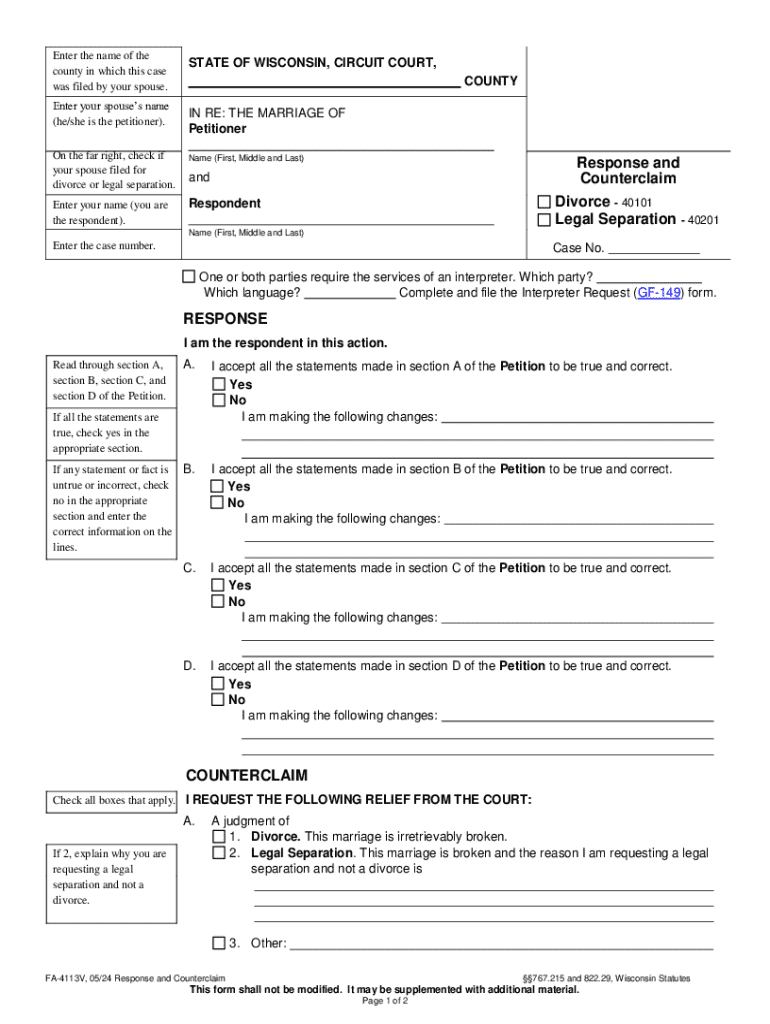
The "FA-4113V; Response and Counterclaim" is a legal document utilized primarily within the Wisconsin Circuit Court pertaining to divorce or legal separation cases. The form allows respondents to officially accept or contest the claims outlined by the petitioner. Furthermore, it provides an avenue for them to request specific relief from the court. This document is a crucial part of the legal process, ensuring all parties have the opportunity to present their case and personal circumstances comprehensively.
Steps to Complete the FA-4113V; Response and Counterclaim
-
Review the Petition: Begin by thoroughly reviewing the original petition filed by the petitioner. Understanding the claims being made is essential.
-
Respond to Claims: Indicate whether you agree or disagree with each statement present in the petition. Provide explanations or additional details where disagreements arise.
-
Request Specific Court Relief: Clearly outline any specific relief or actions you are requesting from the court, such as custody arrangements or asset division.
-
Complete Personal Information: Ensure all necessary personal information is correctly filled out, including contact details and any other required data.
-
Attach Additional Documentation: If needed, supplement the form with any additional documentation that supports your claims or responses.
-
Sign and Date: Confirm all sections have been completed accurately, sign, and date the document before submission.
Who Typically Uses the FA-4113V; Response and Counterclaim
This form is predominantly used by individuals responding to a divorce or legal separation petition within Wisconsin. Typically, these include spouses who are legally contesting aspects of the petitioner's claims or seeking to establish counterclaims. Legal professionals often assist in its preparation to ensure accuracy and compliance with legal standards.


Important Terms Related to the FA-4113V; Response and Counterclaim
- Petitioner: The individual who originally files the divorce or separation petition.
- Respondent: The individual replying to the petitioner's claims.
- Counterclaim: A claim made to offset another claim, typically presented by the respondent.
- Relief: Court-ordered action or decision sought by a party in a legal proceeding.
Key Elements of the FA-4113V; Response and Counterclaim
- Acceptance or Contention of Claims: This segment details the respondent's position on each assertion made by the petitioner.
- Request for Relief: Outlines what the respondent is seeking in terms of court orders, financial settlements, or child custody arrangements.
- Personal Information: Includes necessary personal data to ensure the form is processed correctly.
- Supporting Evidence: Respondents can provide evidence or documentation to support their claims.
State-Specific Rules for the FA-4113V; Response and Counterclaim
In Wisconsin, this form must adhere to specific procedural guidelines. Respondents should be familiar with state laws governing family court matters to ensure compliance. It is advisable to get support from a legal professional familiar with Wisconsin law to navigate potential challenges effectively.
Examples of Using the FA-4113V; Response and Counterclaim
An example scenario could include a respondent who disagrees with the petitioner's proposed child custody arrangement presented in the divorce filing. Using this form, the respondent can present their preferred custody arrangement, supported by factual reasoning and any relevant documentation that justifies the change.
Form Submission Methods
The FA-4113V; Response and Counterclaim can typically be submitted in multiple ways:
- Online: Some jurisdictions might offer electronic filing systems where documents can be uploaded directly.
- Mail: Traditional submission by mailing the completed form to the appropriate court address.
- In-Person: Direct handover to the court clerk's office, ensuring the form is promptly recorded.
Penalties for Non-Compliance
Failure to submit the FA-4113V; Response and Counterclaim in a timely and correct manner can result in default judgments, where the court may automatically rule in favor of the petitioner. It underscores the importance of adhering to deadlines and procedural requirements stated by the court.