
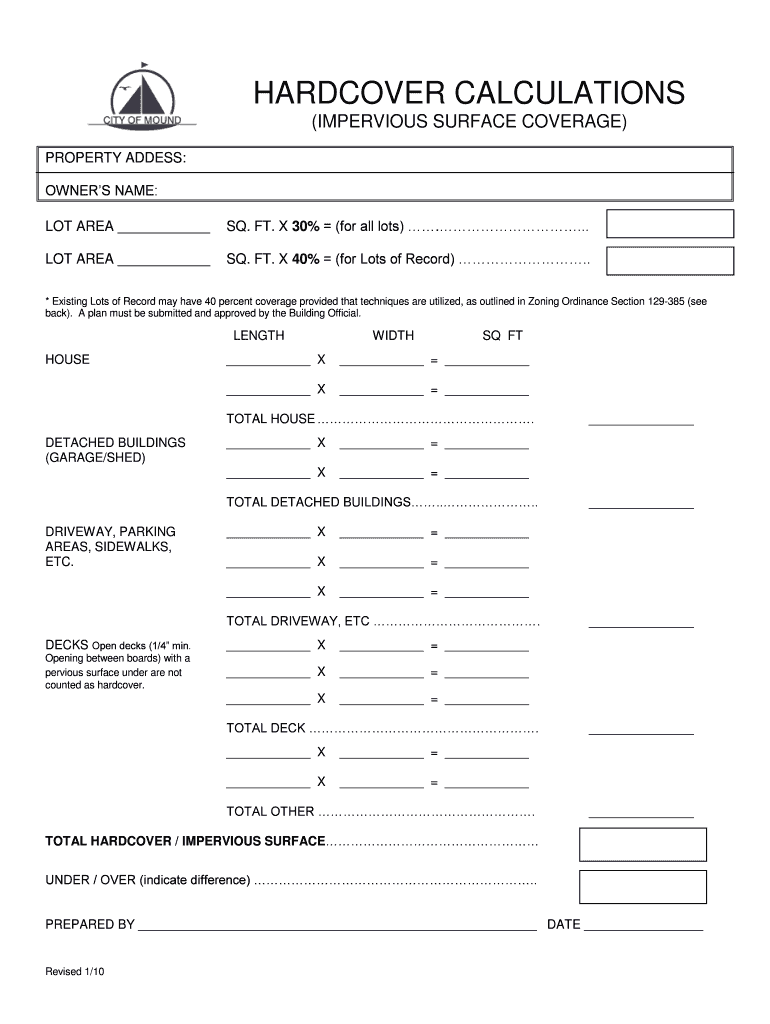







Definition & Meaning
Hardcover calculations are a specific set of mathematical processes used to determine the impervious surface area of a property. This quantification is essential for ensuring compliance with zoning ordinances that restrict the maximum percentage of land that can be covered by structures without allowing water to pass through. These calculations typically include surfaces like rooftops, driveways, patios, and other permanent, non-porous structures. Understanding hardcover calculations is critical for property owners and developers as it influences both construction plans and environmental impact considerations.
How to Use the Hardcover Calculations
Using hardcover calculations involves assessing all impervious surfaces on a property to ensure they comply with local regulations. The process begins by measuring each element, such as the house, garage, and paved areas, then summing these measurements to obtain a total coverage area. This figure is divided by the total lot size to determine the percentage of coverage. It's important to refer to specific zoning rules that may dictate different coverage limits based on property location and type.
Step-by-Step Process
- Measure each impervious surface: Include roofs, walkways, driveways, and mailboxes.
- Calculate total impervious area: Summarize measurements for an aggregate total.
- Determine lot size: Measure the entire property boundary.
- Calculate percentage coverage: Divide total impervious area by total lot size, then multiply by 100.
- Check compliance: Compare against local zoning guidelines.
Steps to Complete the Hardcover Calculations
Calculating hardcover areas requires precision and accuracy, as incorrect assessments could lead to non-compliance issues. Start by gathering accurate measurements of all impervious surfaces:
- Gather tools: Use measuring tape, survey maps, and software for precise dimensions.
- Calculate each area separately: Measure and note each impervious structure.
- Total calculation: Add all measurements to find the total hardcover area.
- Compare with allowable limits: Match your findings with local zoning laws to ensure compliance.
Practical Example
Consider a residential property with a total area of 10,000 square feet. If the total impervious area is calculated to be 3,000 square feet, then:
- Hardcover percentage = (3,000 sqft / 10,000 sqft) x 100 = 30%
- Compliance is met if local zoning allows up to 30%.
Important Terms Related to Hardcover Calculations
Familiarity with certain terms improves understanding:
- Impervious Surface: Any material that significantly prevents water infiltration.
- Lot Coverage: The portion of a lot covered by structures, expressed as a percentage.
- Zoning Ordinance: Regulations governing land use, including maximum coverage limits.
Key Definitions
- Driveway Coverage: Driveway area contributing to total coverage.
- Building Footprint: The outline of the total building area on the ground.
- Aggregate Area: Total compiled measurement of all impervious surfaces.
Key Elements of the Hardcover Calculations
Understanding the essential components that influence the calculations ensures accuracy:
- Surveys and Maps: Professional tools for accurately plotting property dimensions.
- Local Zoning Laws: Rules that dictate impervious surface thresholds.
- Structural Components: Identify all surfaces contributing to impervious totals, such as decks and patios.
Legal Use of the Hardcover Calculations
Hardcover calculations serve as a compliance tool for fulfilling legal requirements:
- Zoning Compliance: Ensures that properties adhere to specific coverage limits to minimize flood risk and maintain aesthetic values.
- Environmental Impact: By regulating impervious coverage, communities can minimize environmental disruptions like increased runoff and flooding.
Compliance Assurance
Property developers and owners regularly employ these calculations, often consulting legal or land-use experts to confirm that their plans align with:
- Local zoning laws: Specific maximum coverage rules.
- Environmental regulations: Laws designed to protect watersheds and natural habitats.
State-Specific Rules for the Hardcover Calculations
Regulations can vary significantly between states, influencing calculation methods:
- California: Emphasizes reduction of runoff through stricter limits.
- Florida: Considers hurricane impact and integrates buffering zones to mitigate flood risk.
- Texas: Often requires water retention solutions in impermeable surface design.
Informing Development
Understanding and adhering to these state-specific variations is critical for developers and property owners seeking permits or planning new construction.
Examples of Using the Hardcover Calculations
Illustrating diverse scenarios aids in comprehending application:
- Residential Compliance: A suburban homeowner needing to pave extra area checks that they stay below 30% coverage.
- Commercial Property Development: A business proposes expansion but must adhere to city limits of 50% impermeable cover.
- Subdivision Planning: Developers design residential neighborhoods considering local zoning to avoid plan rejections.
Through these illustrative examples, the practical application and necessity for accurate hardcover calculations become evident, enabling careful planning and sustainable development.




