Injury Evaluation Form 2026

Get Form
Injury Evaluation Form Preview on Page 1

Here's how it works

01. Edit your form online
Type text, add images, blackout confidential details, add comments, highlights and more.

02. Sign it in a few clicks
Draw your signature, type it, upload its image, or use your mobile device as a signature pad.

03. Share your form with others
Send it via email, link, or fax. You can also download it, export it or print it out.

Definition & Meaning

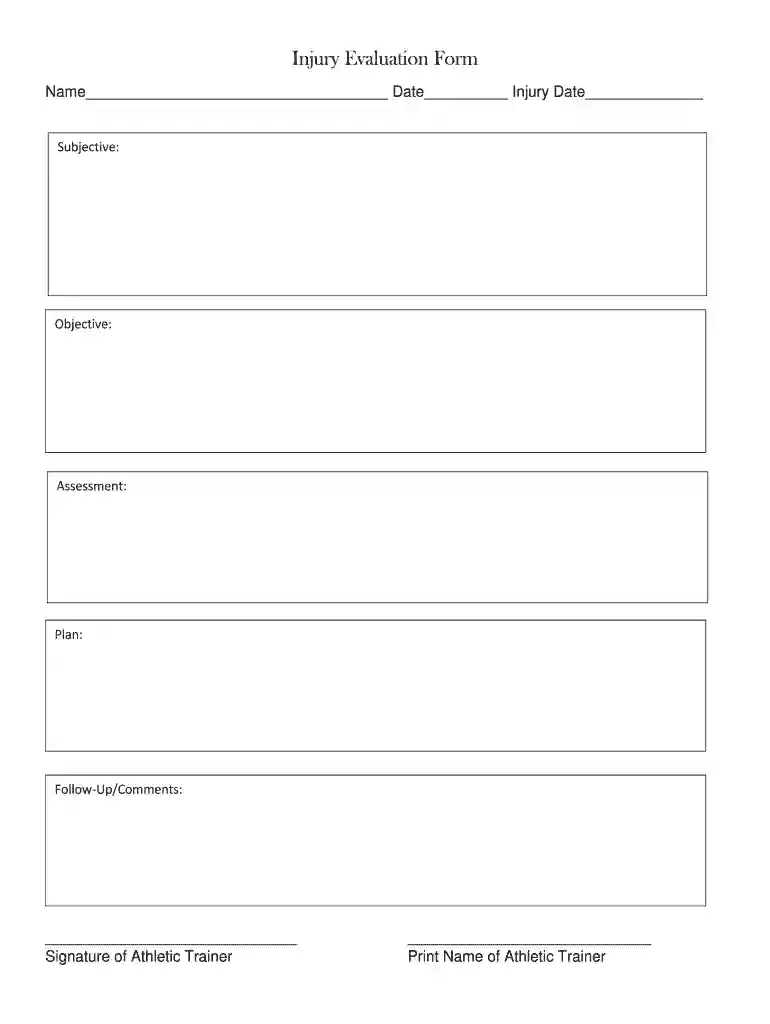
An Injury Evaluation Form serves as a critical document used by athletic trainers, healthcare providers, and sports organizations to document and assess injuries sustained by athletes. This document is specifically designed to capture detailed information about the injury, helping in the assessment and planning of treatment strategies. By thoroughly documenting the circumstances and specifics of an injury, this form aids professionals in delivering appropriate care and ensuring that recovery plans are clearly outlined and communicated.

Key Purposes of the Injury Evaluation Form

  • Record comprehensive injury details for accurate clinical assessment.
  • Support communication between healthcare providers and sports staff.
  • Serve as a legal document to substantiate the nature and extent of injuries for insurance or legal purposes.
  • Facilitate data collection for research or organizational injury prevention programs.

Key Elements of the Injury Evaluation Form

The Injury Evaluation Form is structured to include several critical sections that encompass the entire evaluation process. These sections are designed to ensure that all pertinent information is captured efficiently.

Components of the Form

  • Athlete Information: Captures personal details such as name, age, sport, and the date of injury. It provides a reference to track the injured person's medical history and progress.
  • Subjective Evaluation: Includes the athlete's account of how the injury occurred and their symptoms, providing insight into potential impact points and pain levels.
  • Objective Evaluation: Documents observable signs including swelling, bruising, range of motion, and strength testing to provide a factual basis for assessment.
  • Assessment: The trainer's professional judgment about the injury type and severity based on the collected data.
  • Plan: Outlines recommended treatments, rehabilitation exercises, and follow-up appointments necessary for recovery.
  • Signatures: Confirms the involvement and agreement of all parties, including trainers and, if applicable, the athlete or guardian.

Steps to Complete the Injury Evaluation Form

Completing an Injury Evaluation Form requires a methodical approach to ensure accuracy and comprehensiveness. Each step helps to systematically gather all relevant information required for a thorough evaluation.

  1. Collect Athlete Details: Fill in the athlete's personal information to ensure accurate identification.
  2. Conduct Subjective Evaluation: Interview the athlete to understand symptom details and history from their perspective.
  3. Perform Objective Examination: Observe and record physical symptoms, conduct physical tests, and note any limitations representative of the injury.
  4. Develop Assessment: Analyze findings to provide a professional conclusion about the injury severity and type.
  5. Formulate a Treatment Plan: Specify any immediate first-aid measures, long-term rehabilitation needs, and follow-up requirements.
  6. Review and Sign Off: Ensure all parties involved review the form, followed by signatures from the involved personnel to confirm the validity of the evaluation.

Who Typically Uses the Injury Evaluation Form

The Injury Evaluation Form is a versatile tool used by various professionals in the sports and healthcare sectors. Its utility spans across different roles, each requiring precise injury documentation.


decoration image ratings of Dochub

Common Users

  • Athletic Trainers: Primary users responsible for initial injury assessments and planning rehabilitation strategies.
  • Healthcare Providers: Doctors and physiotherapists use this data to inform treatment plans and provide continuity of care.
  • Coaches and Sports Staff: Utilize the form to modify practice routines and exercise plans to accommodate injured athletes.
  • Insurance and Legal Professionals: Use evaluations to assess claims and respond to legal inquiries related to sports injuries.
decoration image

How to Obtain the Injury Evaluation Form

Accessing an Injury Evaluation Form can typically be done through a few straightforward channels. Having quick access ensures that the documentation process starts promptly, minimizing delays in care.

Ways to Access the Form

  • Through Institutional Resources: Many sports organizations provide pre-designed forms specific to their sport's requirements. Trainers and sports medics can often find electronic templates in their internal systems.
  • Online Templates: Several platforms offer downloadable templates in various formats, compatible with DocHub and other document management systems.
  • Custom Forms: In case specific elements need to be tailored to unique institutional needs, adaptation of existing templates can be facilitated by document management tools.

Legal Use of the Injury Evaluation Form

The Injury Evaluation Form not only aids in documenting medical information but also serves legal and regulatory purposes. Ensuring correct and complete documentation is critical for compliance and protection in various scenarios, particularly in the sporting industry.

Legal Significance

  • Regulatory Compliance: Helps adhere to regulations such as HIPAA, ensuring patient privacy and record-keeping standards are maintained.
  • Insurance Claims: Essential for processing claims accurately, detailing the nature and implications of injuries for relevant stakeholders.
  • Legal Protection: Documents serve as evidence in case of disputes regarding injury severity, treatment protocols, or alleged negligence.

Software Compatibility

DocHub provides seamless document management solutions by offering compatibility with various formats that can be used to create and manage the Injury Evaluation Form efficiently.

Supported Platforms

  • DocHub Interface: Use with PDF for direct editing, form-filling, and digital signing.
  • Compatibility with Cloud Services: Import and export forms using integrations with Google Drive, Dropbox, and OneDrive.
  • Third-Party Software: Compatible with standard formats that can be synced with tools like Microsoft Word or Adobe Acrobat for further editing or storage.

State-Specific Rules for the Injury Evaluation Form

While an Injury Evaluation Form generally maintains a standard structure, there may be variations based on state regulations or specific organizational policies. It's important to understand these nuances to ensure compliance with all applicable requirements.

Considerations for State Variations

  • State Laws: Consider state-specific health regulations that might affect how injury data is collected and documented.
  • Sport-Specific Requirements: Some states mandate additional reporting for concussion protocols or special attention to youth athletes.
  • Modification Needs: Customization might be necessary to incorporate specific legislative requirements or local organizational practices.

Examples of Using the Injury Evaluation Form

Practical examples showcase how the Injury Evaluation Form can be efficiently applied in real-world settings, highlighting its importance and utility.

Real-World Scenarios

  • High School Sports: An athletic trainer uses the form during a football game to evaluate a player's knee injury, documenting each assessment step for future treatment planning.
  • Rehabilitation Centers: Physical therapists use these forms to track an injured athlete’s progress, adjusting rehabilitation plans progressively based on documented evaluations.
  • Professional Teams: Comprehensive injury records assist team doctors in collaborating with external specialists for second opinions or advanced diagnostic procedures.

These examples underscore the form’s versatility, contributing to effective injury management and aiding in the continuous delivery of athlete care.

be ready to get more

Complete this form in 5 minutes or less

Get form

Got questions?

We have answers to the most popular questions from our customers. If you can't find an answer to your question, please contact us.
Contact us
An Injury Report is a formal document used to record details about an individuals injury, accident, or incident. It serves as a critical tool for documenting workplace injuries, facilitating timely reporting, initiating investigations, and ensuring compliance with legal and regulatory requirements.
The OSHA 300A form is a year-end summary of workplace injuries and illnesses. OSHA Forms 300 and 301 provide detailed, case-specific records used to generate that summary.
Whats an Injury Evaluation? Our injury evaluations begin with a thorough review of your completed medical history questionnaire, as well as your current symptoms, concerns, and goals. Next, your clinician will perform a complete musculoskeletal exam as appropriate for your condition.
The injury history and the symptoms are the key elements of the subjective evaluation. A detailed injury history is the most important portion of the evaluation. The remainder of the evaluation will focus on confirming the information taken from the patients history.
The evaluation can provide information on how far the plaintiff has come in treatment and how much more treatment they would realistically need. We would look at the progress theyve made, the severity of the injury, and use our professional judgment to determine what additional help they would need in the future.

Security and compliance

At DocHub, your data security is our priority. We follow HIPAA, SOC2, GDPR, and other standards, so you can work on your documents with confidence.

Learn more
ccpa2
pci-dss
gdpr-compliance
hipaa
soc-compliance

People also ask

Photos can be very useful, especially if they show exactly what caused your accident or the injuries you suffered. On their own, they may not cover everything, but they can be strong when used with other proof like medical notes, witness statements and official reports.

Related links