







Definition & Meaning
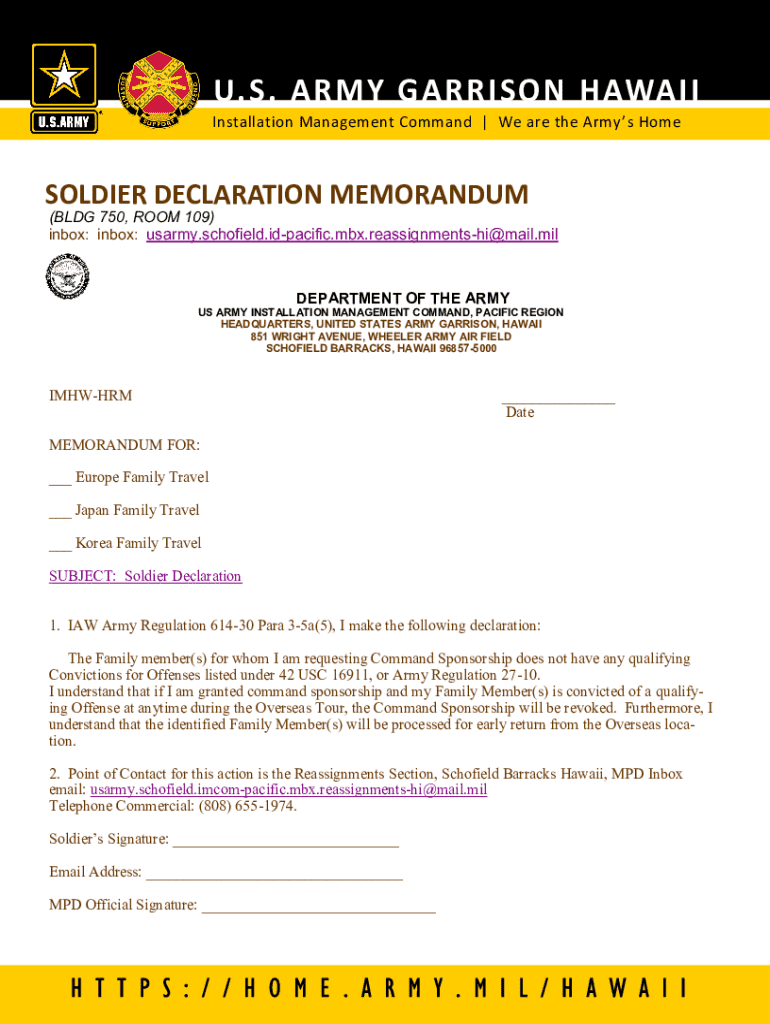
The Soldier Declaration Memorandum is a formal document used within the U.S. Army, particularly at places like the U.S. Army Garrison Hawaii, to streamline the process of securing Command Sponsorship for military family members. This memorandum acts as a formal declaration by a soldier regarding the legal standing of their family members, ensuring they do not have any disqualifying convictions under Army regulations. This process is essential in maintaining transparency and compliance with military policies, aiding in the smooth transition and accommodation of family members during an overseas posting.
How to Use the Soldier Declaration Memorandum
To effectively utilize the Soldier Declaration Memorandum, soldiers must accurately fill out the form by providing all required information about their family members. The primary steps include verifying that family members do not have any relevant convictions that might affect their eligibility for Command Sponsorship. Once completed, this memorandum is submitted through the appropriate military channels for approval. This process ensures that all declarations are formally recognized, allowing family members to be officially sponsored and integrated into military life overseas.
Steps to Complete the Soldier Declaration Memorandum
Completing the Soldier Declaration Memorandum involves several detailed steps:
-
Access the Form: Obtain the Soldier Declaration Memorandum form from the appropriate military office or online resources provided by the Army.
-
Provide Personal Information: Include the soldier's personal details, such as name, rank, and service number.
-
List Family Members: Detail each family member requiring Command Sponsorship, including full names and relationships to the soldier.
-
Declare Legal Status: For each family member, declare any convictions in accordance with Army regulations. A lack of disqualifying convictions must be clearly stated.
-
Sign and Date: The soldier must sign and date the memorandum, affirming the accuracy of the information provided.
-
Submit the Form: Forward the completed memorandum to the designated officer or unit responsible for processing Command Sponsorship requests.
Key Elements of the Soldier Declaration Memorandum
The Soldier Declaration Memorandum comprises several critical components:
-
Soldier's Identification Section: This includes personal identification details of the soldier.
-
Family Member Details: Information regarding each family member for whom sponsorship is requested.
-
Legal Declarations: Statements confirming the absence of qualifying legal convictions for listed family members.
-
Verification Signature: The soldier's signature endorses the truthfulness of the declarations made within the document.
-
Submission Record: An area to note when and to whom the form was submitted for processing, ensuring traceability.
Legal Use of the Soldier Declaration Memorandum
The legal implications of the Soldier Declaration Memorandum are significant. This document serves as a binding affirmation regarding the legal status of the soldier's family, ensuring that only qualified individuals receive Command Sponsorship. Should a family member incur a disqualifying conviction during the overseas tour, the memorandum specifies that sponsorship can be revoked. This provision helps maintain the integrity of military operations and community standards, reflecting the form's crucial role in upholding military law and organizational policies.
Who Typically Uses the Soldier Declaration Memorandum
The primary users of the Soldier Declaration Memorandum are U.S. Army personnel stationed overseas or planning to relocate as part of their service. Soldiers who wish to bring family members on overseas assignments rely on this memorandum to formalize and justify their request for Command Sponsorship. Additionally, administrative and legal officers within the military system reference this form to ensure compliance with Army regulations and to evaluate the terms and eligibility of such requests.


Required Documents
To complete the Soldier Declaration Memorandum, soldiers may need to gather and attach various supporting documents, such as:
-
Personal Identification: Copies of personal identification documents for the soldier and family members, such as IDs or passports.
-
Legal Records: Official documentation clarifying the legal status of family members, if applicable.
-
Proof of Relationship: Documentation, such as birth certificates or marriage licenses, confirming familial relationships.
-
Previous PCS Orders: Any prior Permanent Change of Station (PCS) orders might be necessary for contextual background.
Penalties for Non-Compliance
Failure to comply with the requirements of the Soldier Declaration Memorandum can result in several penalties:
-
Revocation of Sponsorship: If it is later discovered that family members have disqualifying convictions, their Command Sponsorship may be revoked.
-
Disciplinary Action: Soldiers may face disciplinary action for providing false declarations or omitting critical information regarding family legal status.
-
Repatriation Costs: The soldier may be responsible for any costs associated with repatriating family members if their sponsorship is rescinded due to non-compliance.
These penalties underline the importance of accuracy and honesty when completing the memorandum, ensuring commitment to military integrity and legal obligations.




