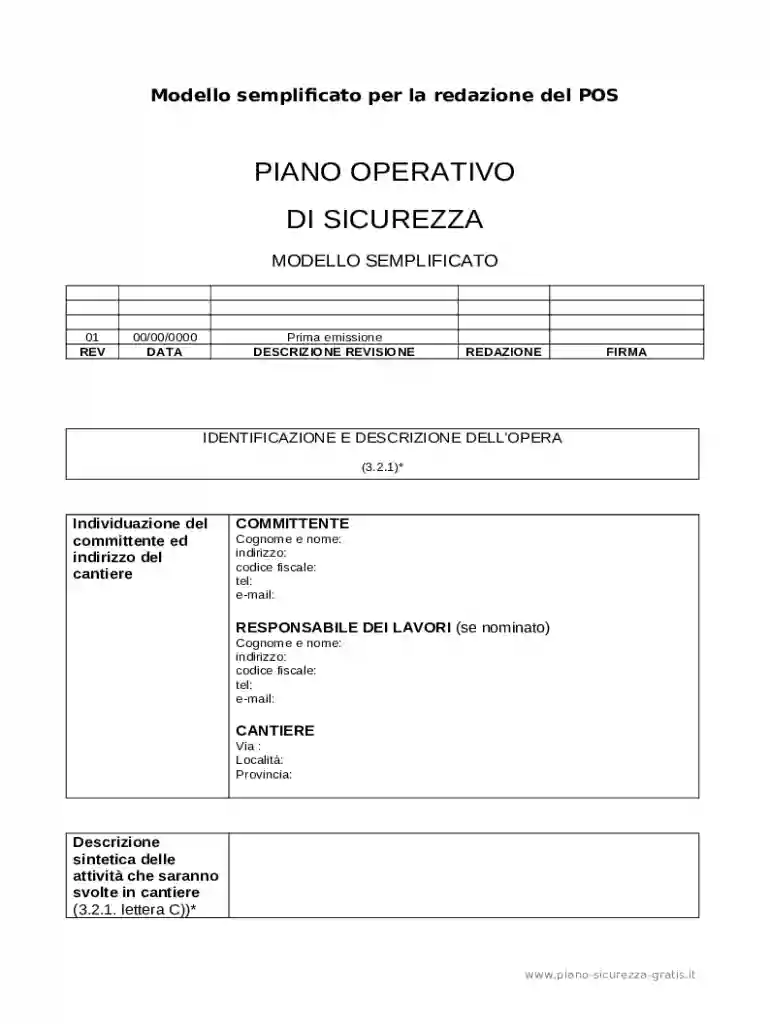
Piano-sicurezza-gratis itarticoliPOSModello semplificato per la redazione del POS 2026

Get Form
piano-sicurezza-gratis itarticoliPOSModello semplificato per la redazione del POS Preview on Page 1

Here's how it works

01. Edit your form online
Type text, add images, blackout confidential details, add comments, highlights and more.

02. Sign it in a few clicks
Draw your signature, type it, upload its image, or use your mobile device as a signature pad.

03. Share your form with others
Send it via email, link, or fax. You can also download it, export it or print it out.

Definition and Importance of the Simplified Operational Safety Plan (POS)

The Simplified Operational Safety Plan, often abbreviated as POS, is a critical document used in the construction industry to outline the safety protocols and responsibilities on a construction site. It serves as a concise guide to ensure compliance with safety regulations and promote a safe working environment. The document typically includes essential information such as the client's identification, the project description, the assigned roles for responsible personnel, and the safety measures to be applied.

Key Components of a POS

  • Client Identification: Details about the project owner or the commissioning entity.
  • Project Description: An overview of the construction project which provides context for the safety measures implemented.
  • Roles and Responsibilities: Identification and assignment of key roles including the site manager and safety officer.
  • Safety Measures and Protocols: Descriptions of safety practices and emergency procedures to be followed.
  • Worker Training Requirements: Outline of necessary training for workers to ensure compliance with safety standards.

Steps to Complete the POS

Maintaining a structured approach is crucial when completing the POS to guarantee all relevant safety aspects are covered. Following these steps can streamline the process:

  1. Gather Project Information: Start by collecting all necessary information about the project, including detailed plans and client data.
  2. Assign Roles: Clearly designate and document the roles and responsibilities for site staff, highlighting the positions of site manager and safety officer.
  3. Develop Safety Measures: Collaborate with experienced personnel to draft comprehensive safety protocols tailored to the project.
  4. Worker Training Documentation: Ensure that all training sessions are documented, and qualifications verified, to certify adherence to safety requirements.
  5. Review and Approval: Submit the completed POS for review and obtain necessary approvals from all stakeholders before commencing construction.

Utilization of the Simplified POS

The primary users of this document are construction professionals who need a streamlined method to communicate safety expectations and responsibilities. It is particularly useful for:

  • Construction Companies: To maintain standardized safety practices across multiple projects.
  • Site Managers: For efficient coordination and supervision of safety measures.
  • Safety Officers: To verify compliance and ensure that all safety procedures are effectively implemented.

Why Utilize a Simplified POS?

Using a simplified POS helps ensure that safety requirements are met consistently and efficiently, minimizing the risk of accidents and legal non-compliance. It provides a clear framework for all site activities related to safety.

Legal Aspects and Compliance

The legal framework surrounding the use of a POS in construction is crucial for compliance with occupational health and safety regulations. This document ensures that all parties are aware of their legal obligations and helps prevent potential litigation due to negligence or oversight in safety practices.

Important Legal Considerations

  • Regulatory Compliance: The POS must align with federal, state, and local safety regulations.
  • Documentation and Archiving: Correctly documenting and archiving the POS is essential for resolving any future safety disputes.
  • Worker's Rights: Ensuring that all workers are informed of their rights and safety protocols.

Key Elements of the POS Document

A POS is comprehensive, containing multiple pivotal sections that collectively encompass the safety strategy for a construction project.

Major Sections

  • Emergency Procedures: Specific actions to be undertaken in case of emergencies.
  • Risk Assessment: Identification and documentation of potential hazards and mitigation strategies.
  • Regular Audits: Planned audits to monitor safety compliance and make necessary adjustments.

Variants and Alternatives

While the POS is a preferred document for many for its simplicity and comprehensiveness, there are alternative approaches and documents that may complement or substitute in different contexts, depending on the project scale and requirements.

POS Variants

  • Comprehensive Safety Plans: For larger and more complex projects requiring detailed safety documentation.
  • Specific Hazard Plans: Focusing on particular risks pertinent to specialized construction activities.

Examples of POS in Practice

Different construction projects implement the POS in varying ways, adapting its flexibility to meet specific site conditions and requirements.

Case Study Examples

  • High-Rise Buildings: Tailored emergency evacuation plans incorporated into the general POS framework.
  • Infrastructure Projects: Integration of environmental protection measures into standard safety procedures.

By thoroughly understanding and effectively utilizing the Simplified Operational Safety Plan, construction stakeholders can ensure diligent safety practices, promote a secure workplace, and maintain legal compliance.

be ready to get more

Complete this form in 5 minutes or less

Get form

Got questions?

We have answers to the most popular questions from our customers. If you can't find an answer to your question, please contact us.
Contact us
QUANDO RICHIESTO e per le aziende operanti nel settore spettacoli musicali, cinematografici e teatrali e nelle manifestazioni fieristiche. Il POS Semplificato il documento che il datore di lavoro dellimpresa esecutrice redige, in riferimento al singolo cantiere.
.piano-sicurezza-gratis.it lunico sito dal quale potrete compilare e scaricare il piano operativo di sicurezza gratuitamente, senza installare alcun software e senza obbligo di registrazione.
Il tuo POS a partire da 100,00 POS Piano Operativo di Sicurezza redatto da personale qualificato, il documento rilasciato personalizzato sulla tua impresa e sulle lavorazioni che andrai a svolgere.
Come detto, il POS per la sicurezza nei cantieri redatto a cura di ciascun datore di lavoro delle imprese esecutrici ai sensi dellart. 17 del D. Lgs. 81/08 (riferimento per la redazione del documento di valutazione dei rischi) per il singolo cantiere interessato.
Il Piano Operativo di Sicurezza (POS) viene redatto da ciascun datore di lavoro delle imprese esecutrici (articolo 96, comma 1, lettera g) del D. Lgs. 81/2008 s.m.), in riferimento al singolo cantiere interessato, sia di opere pubbliche che private.

Security and compliance

At DocHub, your data security is our priority. We follow HIPAA, SOC2, GDPR, and other standards, so you can work on your documents with confidence.
Learn more
ccpa2
pci-dss
gdpr-compliance
hipaa
soc-compliance
be ready to get more

Complete this form in 5 minutes or less

Get form

People also ask

Costo Piano Sicurezza Cantiere: Prezzi Medi Da A Redazione PSC per lavori fino a 3.000 euro 175,00 350,00 Redazione PSC per ristrutturazioni parziali, con lavoro fino a 40.000 euro 500,00 950,00 Redazione PSC per appalti con lavori stimati maggiori a 250.000 euro 900,00 1.700 1 more row
Quando si deve fare il POS? Il POS sempre obbligatorio nelle le imprese che operano, anche in subappalto, allinterno di cantieri, compresi quelli temporanei o mobili. Inoltre il Piano Operativo di Sicurezza deve essere redatto per ogni cantiere.