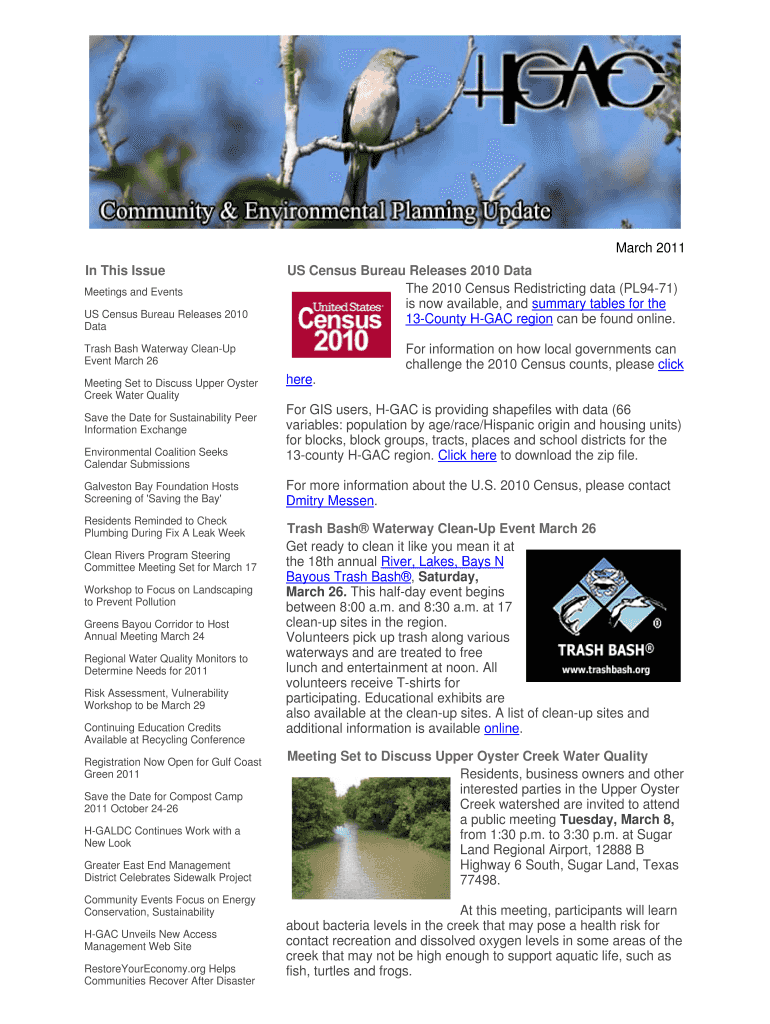







Understanding March 2011 In This Issue US Census Bureau Releases 2010 Data
March 2011 marked a pivotal period with the release of the 2010 Census data by the U.S. Census Bureau. This comprehensive document reported on demographic shifts and trends across the nation, offering valuable insights for various stakeholders, including policymakers, researchers, and the general public. The data's implications extended beyond raw numbers to affect funding, representation, and planning decisions at multiple levels of government.
Function and Purpose of the 2010 Census Data
The primary function of the 2010 Census data was to provide an accurate count of the U.S. population, which is essential for determining representation in Congress, distributing federal funds, and guiding community planning. The data's purpose encompassed:
- Reapportionment of Congressional seats based on population shifts.
- Allocation of federal funding for infrastructure, education, and community services.
- Support of community initiatives such as urban development and public health programs.
Accessing the 2010 Census Data
To obtain the March 2011 issue, which includes the 2010 Census data, interested parties could access it through the U.S. Census Bureau's website. The platform provided various search tools and download options to ensure users could find specific datasets relevant to their needs. Users can:
- Visit the Census Bureau's official site.
- Navigate to the data release section.
- Select specific datasets or download comprehensive reports.
Key Elements to Consider
Understanding the March 2011 issue involves recognizing several key elements of the 2010 Census data:
- Population totals for states, counties, and cities, crucial for resource allocation.
- Demographic details: age, sex, race, and ethnic distribution.
- Housing characteristics and occupancy rates.
Legal and Official Use
Data from the 2010 Census carries legal importance as it underlines policy and budgetary decisions. Users include:
- Government agencies that rely on demographics to implement programs.
- Researchers and analysts interested in socio-economic issues.
- Businesses that assess market potentials.
Who Utilizes the 2010 Census Data?
The data is vital for a wide array of users:
- Federal and State Governments: For resource distribution and legislative purposes.
- Academic Institutions: For studies and forecasts related to population trends.
- Businesses: Market research and strategic planning benefit from demographic data.
Important Terms and Definitions
Several terms are central to understanding the dataset:
- Reapportionment: Redistribution of seats in the House of Representatives.
- Decennial Census: A census conducted every ten years.
- Demographic Profile: Details of the characteristics of a population.
Impact on State Policies
The release of this data had significant implications for state-level policies:
- Education and Health: Adjustments based on age demographics.
- Transportation and Urban Planning: Infrastructure projects aligned with population growth areas.
- Economic Development: Tailored incentives in rapidly growing regions.
Application in Real World Scenarios
The 2010 Census data played a crucial role in numerous practical applications:
- Infrastructure Projects: Identified needs for highways, schools, and hospitals.
- Political Campaigns: Adjusted strategies based on population concentrations.
- Disaster Preparedness: Updated local plans based on population density.
Potential Penalties for Misuse
Data must be used ethically, respecting privacy laws. Unauthorized disclosure or misuse of personal data can lead to:
- Legal ramifications for individuals or entities breaching confidentiality.
- Fines or penalties imposed by regulatory bodies.
Integration with Modern Software
Today, this data can be integrated into various analytical tools and software such as:
- Statistical packages like R and SAS for detailed analysis.
- GIS Software: For mapping and spatial analysis based on census data.
By understanding these facets, users can effectively leverage the March 2011 In This Issue US Census Bureau Releases 2010 Data for informed decision-making and strategic planning.