







Definition & Meaning
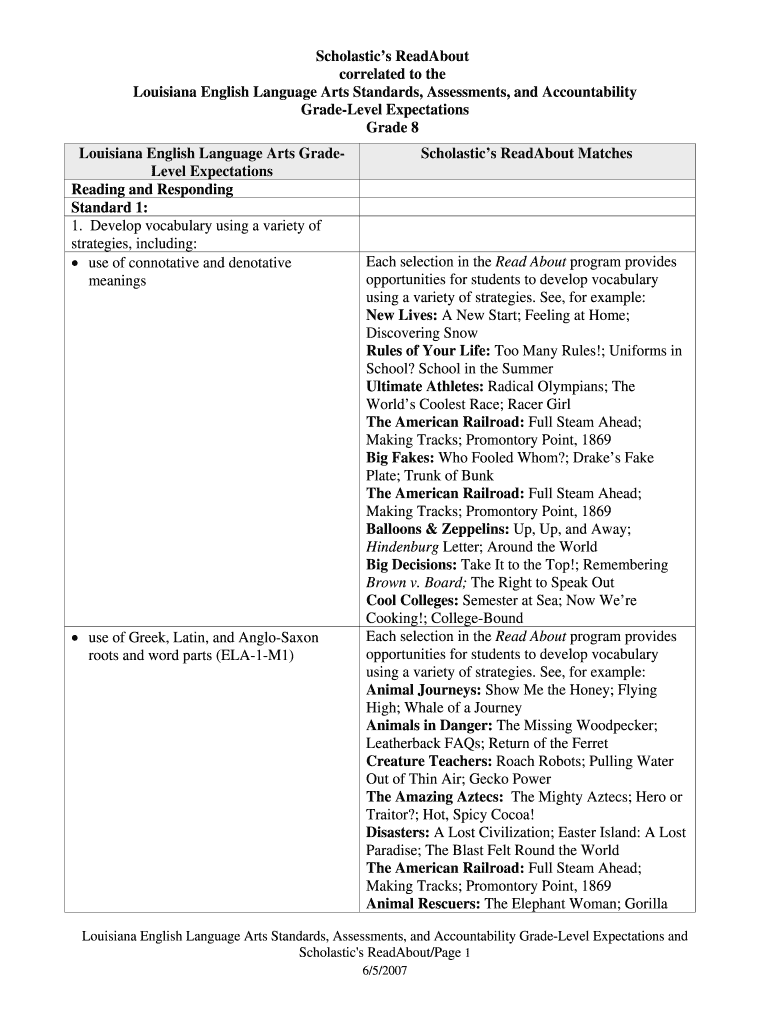
Grade-Level Expectations refer to specific educational standards developed to outline the knowledge and skills students are expected to acquire at each grade level. These expectations serve as a benchmark for academic progression and ensure consistency in curriculum delivery across different educational institutions. For example, in the context of English Language Arts, Grade-Level Expectations may include being able to interpret literary texts and effectively use vocabulary. They provide educators, students, and parents with a clear understanding of academic goals and necessary competencies for success at each grade.
How to Use Grade-Level Expectations
Grade-Level Expectations can be used as a guiding framework for teachers when developing lesson plans and instructional strategies. Educators can align their teaching practices with these standards to ensure their students meet the required competencies by the end of each school year. For instance, if third-grade students are expected to master multiplication and division concepts, teachers might incorporate various exercises and real-world applications in their math lessons to reinforce understanding and proficiency.
For Students
Students can use Grade-Level Expectations as a checklist to gauge their strengths and identify areas needing improvement. By understanding the specific skills they need to achieve, students can focus their study efforts more effectively and seek additional resources or assistance where necessary.
Steps to Complete the Grade-Level Expectations
-
Review the Curriculum: Teachers should familiarize themselves with the educational standards and incorporate them into their lesson planning.
-
Assess Current Performance: Evaluate students' initial understanding and skills in relation to the expectations.
-
Develop Instructional Strategies: Create lesson plans tailored to meet outlined standards, using a variety of teaching methodologies to cater to diverse learning styles.
-
Monitor Progress: Regularly assess students' performance to ensure they are on track to meet the expectations.
-
Provide Feedback and Support: Offer constructive feedback and intervention for students who are struggling to meet the standards.
Who Typically Uses Grade-Level Expectations
Grade-Level Expectations are primarily used by educators, school administrators, and curriculum developers. They help to ensure that the education provided meets the academic standards required by state or national guidelines. Parents and guardians also reference these standards to understand the educational objectives their children should achieve each year.
Educators
Teachers utilize Grade-Level Expectations to design curriculum and assess student progress. They play a crucial role in interpreting these standards into actionable teaching approaches that facilitate learning.
Important Terms Related to Grade-Level Expectations
- Curriculum Framework: A structured plan or set of standards used to design, implement, and evaluate student learning.
- Instructional Strategies: Specific methods employed by educators to create learning experiences that facilitate student understanding.
Educational Standards
Set criteria outlining what students need to learn and be able to apply at each grade level. These are often state-mandated and may vary depending on regional educational policies.
State-Specific Rules for Grade-Level Expectations
Each state in the U.S. may have its own set of Grade-Level Expectations to reflect regional educational goals and priorities. For example, California might place a strong emphasis on bilingual education, while Texas could prioritize STEM (Science, Technology, Engineering, and Mathematics).
Variations in Implementation
- Local Adaptations: While the core standards remain consistent, individual schools may have flexibility in applying these based on local needs and student demographics.
- Benchmark Testing: States use different assessment methods to evaluate compliance with these expectations.
Key Elements of the Grade-Level Expectations
Grade-Level Expectations encompass several core components:
- Content Area Standards: Specific subject matter expectations, such as Mathematics or Language Arts.
- Benchmarks: Milestones within the standards that indicate progress towards achieving full mastery.
- Performance Indicators: Measurable outcomes that determine whether students meet the benchmarks.
Examples of Using the Grade-Level Expectations
In practical terms, teachers might use Grade-Level Expectations to design a unit plan in eighth-grade English that covers narrative techniques. The course might include analyzing classic literature, followed by writing assignments that emphasize storytelling from different perspectives. This ensures that students not only consume information but also apply critical thinking and creative skills aligned with the grade-level standards.
Case Study: Science Curriculum
In a science class, expectations might require students to grasp fundamental concepts of biology by conducting experiments. Teachers could implement lab activities that promote hypothesis testing, data collection, and result analysis to meet these educational goals.
Digital vs. Paper Version
With the advent of educational technology, Grade-Level Expectations are accessible online as digital documents, which offer interactive ways for both educators and students to engage with the material. Digital versions support multimedia elements, such as video tutorials and online quizzes, enhancing the traditional paper-based resources.
Advantages of Digital Access
- Interactive Learning: Digital formats allow for integration of multimedia resources, fostering an engaging learning environment.
- Instant Updates: Online documents can be updated quickly to reflect any changes in educational standards.




