







Definition and Meaning
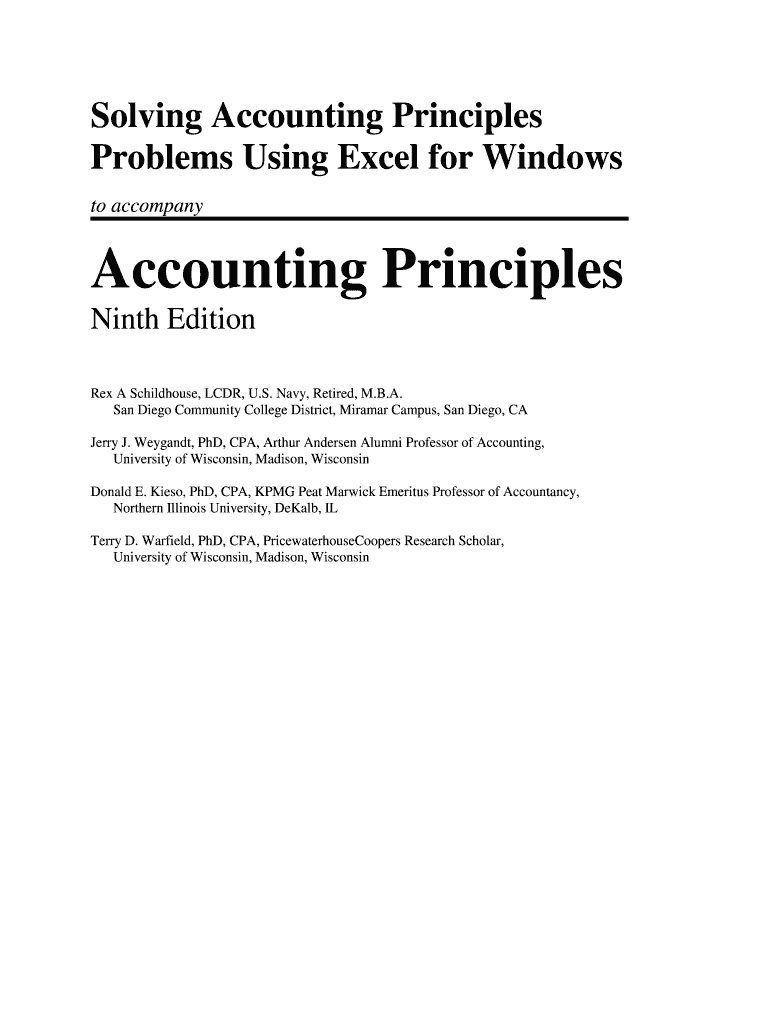
"Solving Accounting Principles" refers to the systematic approach employed to address complex accounting tasks and principles. This involves the application of fundamental accounting concepts to ensure the accurate recording, analyzing, and reporting of financial transactions. Mastery of these principles is crucial for maintaining the integrity of financial statements and ensuring compliance with regulatory standards.
Key Elements of Solving Accounting Principles
Understanding the key elements of solving accounting principles is essential for accurately managing financial data. These elements include:
- Accrual vs. Cash Accounting: Differentiating between recognizing revenues and expenses as they occur versus when cash changes hands.
- Matching Principle: Recording expenses in the same period as the revenues they help generate.
- Consistency Principle: Applying the same accounting methods over time to ensure comparability.
- Materiality: Focusing on transactions that significantly impact financial statements.
- Conservatism: Exercising caution in financial reporting by anticipating potential losses rather than gains.
How to Use the Solving Accounting Principles
To effectively use solving accounting principles, one must systematically apply the foundational concepts to everyday accounting scenarios. This process involves:
- Identifying the specific accounting issue or question.
- Selecting the appropriate accounting principle relevant to the situation.
- Applying the principle consistently and accurately to derive a solution.
For example, when determining when to recognize revenue, one must decide between using the accrual basis or cash basis, based on the nature of the transaction and organizational policies.
Steps to Complete the Solving Accounting Principles
Successfully solving accounting principles involves a structured approach:
- Gather Necessary Data: Collect pertinent financial data and documents.
- Analyze Transactions: Break down transactions to identify relevant accounting elements.
- Apply Principles: Use applicable accounting principles to analyze and record transactions.
- Review and Adjust: Ensure entries are accurate and make adjustments where necessary.
- Finalize and Report: Compile finalized data into financial reports for review and decision-making.
Who Typically Uses the Solving Accounting Principles
The principles are typically employed by accountants, auditors, financial analysts, and other finance professionals within organizations. These individuals are responsible for:
- Ensuring financial statements are accurate and compliant with financial regulations.
- Assisting in strategic financial planning and analysis.
- Conducting audits to verify the accuracy of financial data.
- Advising management on fiscal practices and implications.

Important Terms Related to Solving Accounting Principles
Several technical terms are essential in the context of solving accounting principles, including:
- Depreciation: Allocation of the cost of tangible assets over their useful lives.
- Amortization: Gradual expensing of intangible assets.
- Liabilities: Financial obligations owed to external entities.
- Equity: Owner's interest in the organization, calculated as assets minus liabilities.
- Revenue Recognition: Criteria for recognizing income in financial statements.
Examples of Using the Solving Accounting Principles
Practical application of accounting principles can vary across scenarios such as:
- Depreciation Calculation: Applying straight-line or accelerated depreciation methods based on asset utilization.
- Revenue Recognition: Recognizing sales revenue upon delivery of goods/services as per the accrual basis.
- Expense Matching: Associating advertising costs with the corresponding revenue period to ensure accurate profitability analysis.
Software Compatibility
The use of solving accounting principles is often facilitated by software tools such as Excel, QuickBooks, and TurboTax. These platforms support:
- Automated calculation and application of accounting principles.
- Integration with other systems for seamless financial data management.
- Customizable templates to fit specific accounting needs and regulatory requirements.
Legal Use of Solving Accounting Principles
Compliance with legal standards is a crucial aspect of implementing accounting principles. This involves:
- Adhering to Generally Accepted Accounting Principles (GAAP) or International Financial Reporting Standards (IFRS), depending on jurisdiction.
- Understanding and implementing changes in accounting policies dictated by regulatory bodies.
- Ensuring that financial statements are prepared transparently and reliably for stakeholders.
Understanding these blocks and effectively implementing them ensures better financial management, reporting accuracy, and regulatory compliance, making it a crucial skill in the accounting profession.




