







Definition & Meaning
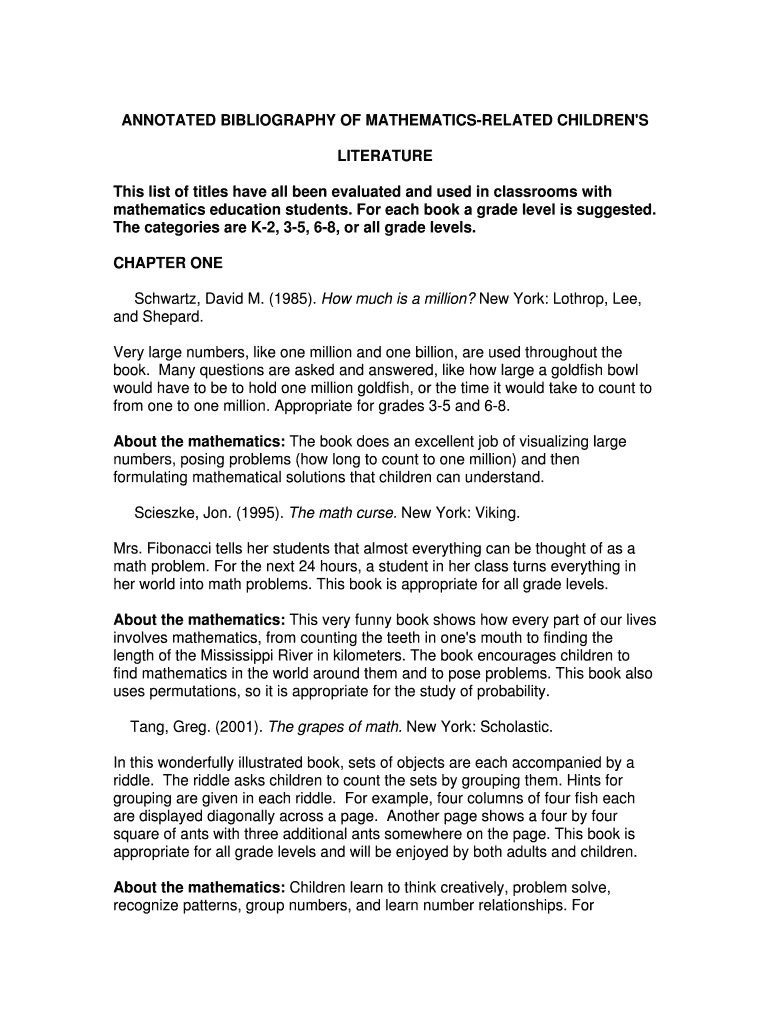
The "Annotated Bibliography of Mathematics-Related Children's Literature" is a comprehensive reference tool designed for educators and professionals working within educational environments. This resource consists of carefully curated entries of children’s books that integrate mathematical concepts with engaging storytelling. Each entry typically includes the book's title, author, publication year, suggested grade levels, and a concise description of the mathematical themes explored, such as counting, fractions, or geometry. The bibliography is a valuable asset for those seeking to enrich mathematics education through literature, fostering an interdisciplinary approach to learning.
Key Elements of the Bibliography
The essential components of the annotated bibliography are systematically organized to facilitate easy navigation and optimal use:
- Title and Author: Each book entry begins with the title and author, ensuring quick identification.
- Publication Year: This provides context for the book's educational content and its relevance in contemporary settings.
- Suggested Grade Levels: Recommendations for suitable grade levels help educators integrate materials appropriately for their students.
- Mathematical Concepts: Each annotation highlights specific mathematical concepts covered, such as large numbers, probability, or geometry.
- Brief Description: Summarizes the book’s narrative and educational objectives, aiding in selection for specific teaching goals.
How to Use the Annotated Bibliography
Educators and librarians can utilize the bibliography in several ways to enhance curriculum planning and classroom activities:
- Curriculum Integration: Align selected books with lesson plans to reinforce mathematical concepts through stories.
- Thematic Units: Group books by mathematical themes to create comprehensive units that delve deeper into each concept.
- Individualized Learning: Tailor reading lists to meet the diverse learning needs and interests of individual students or small groups.
- Professional Development: Use the bibliography as a resource for teacher training workshops, emphasizing effective methods to blend literature with math instruction.
Steps to Complete the Bibliography
To effectively develop or maintain an annotated bibliography, follow these methodical steps:
- Collect and Review: Gather children’s literature that meets educational objectives.
- Analyze Content: Examine each book’s mathematical themes to determine its suitability and effectiveness in teaching.
- Prepare Annotations: Write concise and informative annotations, including all key elements.
- Organize by Theme: Arrange entries by mathematical themes or grade levels to enhance usability.
- Update Regularly: Continuously expand and update the bibliography with new literature to remain current.
Why Use the Annotated Bibliography
Using an annotated bibliography in educational settings offers numerous benefits:
- Evidence-Based Selection: Provides a vetted collection of books, saving time and ensuring quality.
- Enhanced Learning: Supports interdisciplinary teaching methods that can improve comprehension and retention of mathematical concepts.
- Cultural Relevance: Offers diverse literature that can engage students from various backgrounds, promoting inclusivity.
- Professional Resource: Acts as a reputable source for educators aiming to improve math literacy through innovative approaches.
Who Typically Uses the Bibliography
The annotated bibliography is primarily utilized by:
- Classroom Teachers: Implement it for daily instruction and curriculum planning.
- School Librarians: Use it as a guide to develop and update library collections.
- Curriculum Developers: Reference it when designing educational materials and programs.
- Education Students: Employ it in university settings for assignments and research in educational methodologies.


Examples of Using the Bibliography in the Classroom
Practical application in the classroom may look like:
- Storytime Sessions: Incorporate books with counting themes in circle time activities for kindergarten students.
- Project-Based Learning: Use books that explore geometry to inspire design and build projects in elementary school.
- Math Clubs: Choose literature on probability to initiate discussions and experiments in problem-solving clubs.
- Homework Help Resources: Provide older students with a list of literature that supports complex concepts such as algebra.
Software Compatibility for Digitally Accessing the Bibliography
To maximize the bibliography's accessibility and integration with existing technology platforms:
- Digital Formats: Consider digital copies that can be viewed on e-readers or shared through online databases compatible with educational software.
- Integration with Learning Management Systems: Ensure compatibility to allow seamless sharing and assignment creation within platforms like Google Classroom or Blackboard.
- Searchable Database Configuration: Develop the bibliography in formats that allow keyword searches for efficient resource retrieval.
This structured approach ensures that the Annotated Bibliography of Mathematics-Related Children's Literature serves as an invaluable tool for educators to inspire a love for mathematics through engaging storytelling.




