
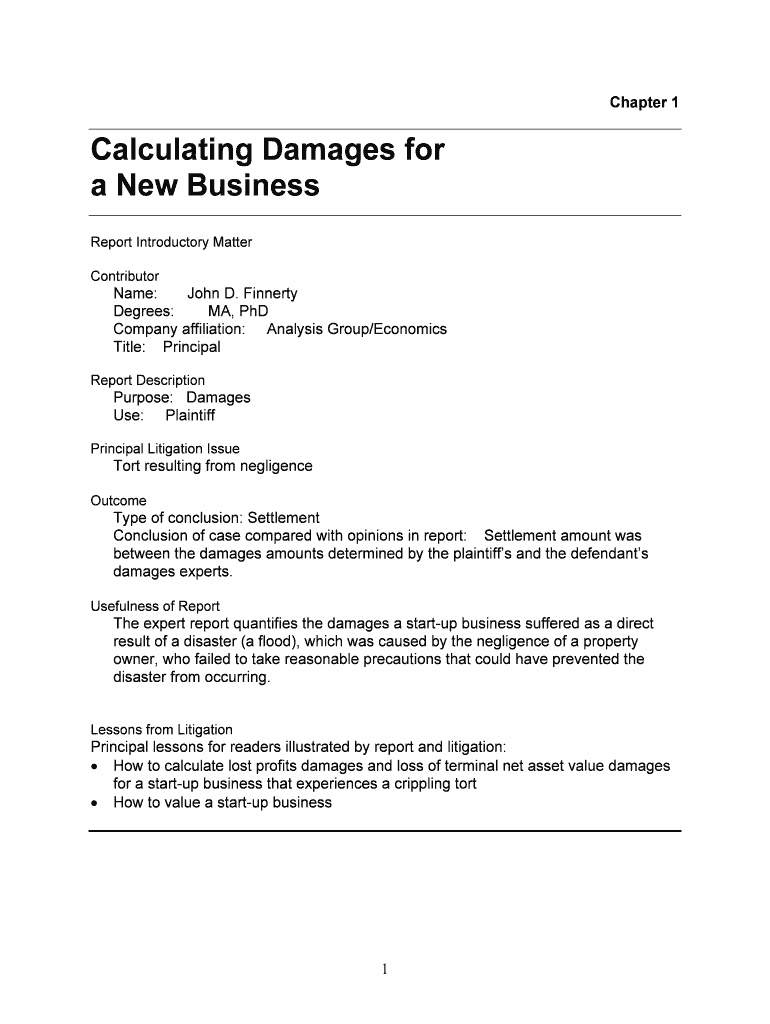







Understanding the Concept of Calculating Damages
Calculating damages is a critical component in legal proceedings where the aim is to quantify the financial loss suffered by a party due to the actions or negligence of another. It involves assessing tangible and intangible elements to determine a fair and equitable compensation amount. For instance, in a case where a company like New Plastics Corporation experiences a flood induced by negligence, calculating damages would involve considering lost profits and the reduction in asset values. This process requires detailed analysis using expert reports, financial statements, and market evaluations to substantiate claims and present a compelling case for compensation.
Steps to Complete the Calculating Damages
- Documentation Gathering: Collect financial records, contracts, correspondence, and any other documents relevant to the incident.
- Damage Identification: Identify all forms of damage, including loss of profit, damage to property, and disruption to business operations.
- Loss Calculation: Use quantifiable data to calculate financial loss. This can involve comparing projected profits against actual outcomes.
- Expert Analysis: Engage financial or industry experts to assess the impact of damages and validate calculations.
- Compile the Report: Create a comprehensive report that outlines the calculated damages, supported by evidence and expert testimony.
Legal Framework for Calculating Damages
In the U.S., calculating damages must align with principles established by common and statutory law. The goal is to ensure that compensation is reasonable, considering actual loss and future impacts. Courts often rely on expert testimony to validate claims, and documents like those from John D. Finnerty, Ph.D., serve as critical evidence. Parties involved should be familiar with legal precedents and adjust their strategies accordingly.
Key Elements of Calculating Damages
- Lost Profits: Arise from anticipated revenue streams being disrupted, impacting overall profitability.
- Diminution of Asset Value: This represents the decrease in the value of the company's assets due to the incident.
- Operational Disruptions: Evaluate how business processes and strategies have been hampered by the incident.
- Future Growth Impact: Consider the long-term effects on company growth and market strategy disruption.
State-Specific Rules Impacting Calculations
While the fundamental principles of calculating damages are uniform, specific states may have particular rules or interpretations that influence how such calculations are structured. Factors include local statutes, court opinions, and industry standards that could impact the methodology used in each jurisdiction.
Practical Examples of Calculating Damages
- Corporate Loss: A manufacturing company might quantify damages by reviewing decreased production rates and associated profit loss due to machinery damage.
- Retail Business: A flood causing store closure would result in calculating potential lost sales and increased operational costs during the period of closure.
- Service Industry: In cases where client projects are delayed, calculation might focus on contractual penalties and customer compensation costs.
Software for Calculating Damages
Modern tools such as accounting software or custom analytics platforms can assist in calculating damages. They offer functionalities like financial data visualization, report generation, and predictive analysis, making the damage calculation process more efficient and accurate. Integration with platforms like QuickBooks ensures seamless handling of financial records.
Considerations for Business Entities
Different types of business entities, such as LLCs, corporations, or partnerships, might face distinct challenges when calculating damages. These variations often stem from differences in structure, operational practices, and regulatory obligations. Businesses should tailor their damage calculation approach to reflect their specific legal and operational needs.
Penalties and Compliance
Failure to adequately calculate and report damages may result in legal penalties or unfavorable outcomes in court. Companies must ensure compliance with relevant standards to mitigate risks associated with incorrect or incomplete damage assessment, which could undermine their credibility in litigation or negotiation settings.




