







Definition & Meaning
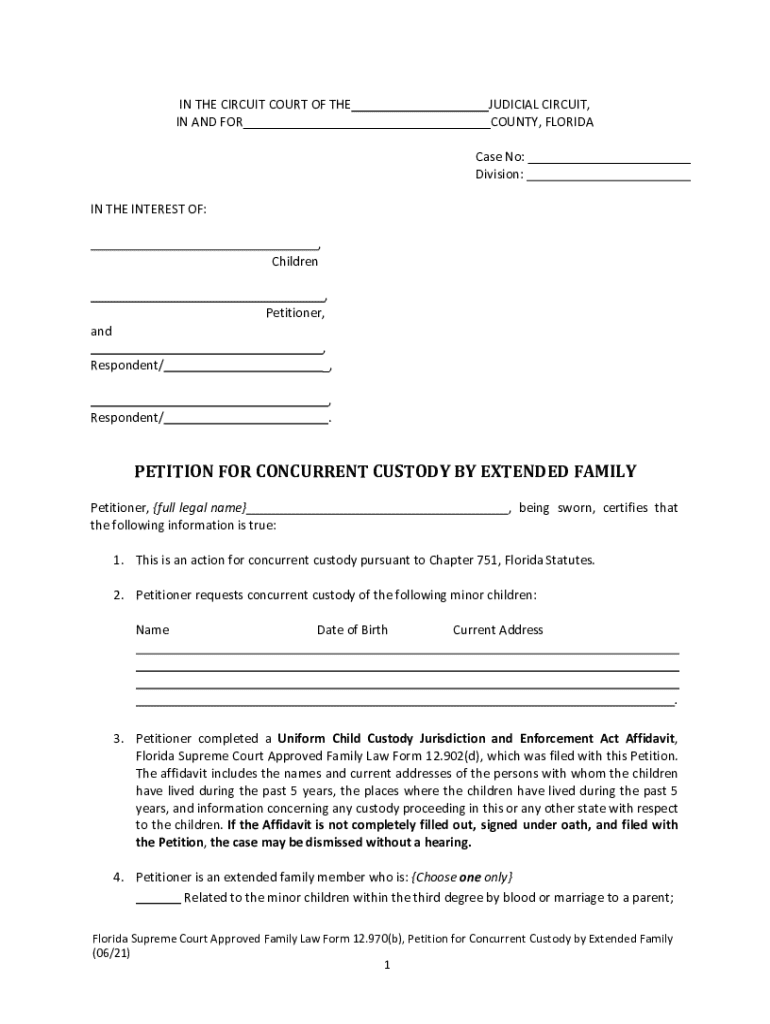
The "Petition for Concurrent Custody by Extended Family" refers to a legal document used to seek temporary or concurrent custodial rights over a child by a family member who is not the biological parent. This form allows extended family members to obtain custody in situations where they can provide better care or have an existing significant relationship with the child. The primary goal is to ensure the child's welfare and stability, especially when the parents are unable or unwilling to fulfill their custodial duties.
Eligibility Criteria
To file a Petition for Concurrent Custody by Extended Family, certain eligibility requirements must be met. Typically, petitioners must be relatives of the child, such as grandparents, aunts, uncles, or older siblings. Extended family members must show a close relationship with the child or demonstrate that taking custody serves the child's best interest. Additionally, petitioners might need to prove that the child's parents consent to the custody arrangement or that they are unable to care for the child due to specific circumstances, such as illness or incarceration.


Steps to Complete the Petition for Concurrent Custody by Extended Family
- Gather Necessary Information: Collect all relevant details about the child, parents, and yourself. This includes full names, addresses, and social security numbers.
- Complete the Form: Accurately fill out the Petition for Concurrent Custody by Extended Family form, ensuring all information is correct and up-to-date.
- Compile Supporting Documents: Attach any documents that support your case, such as affidavits from relatives or friends attesting to your relationship with the child.
- Review State Requirements: Verify the specific guidelines related to your state to ensure compliance with regional rules.
- Submit the Petition: File the completed document with the appropriate family court in your jurisdiction. An accompanying filing fee may be required.
- Serve the Parents: Legally notify the child's parents about the custody petition.
- Attend Court Hearing: Be prepared to appear in court, where a judge will evaluate the petition and make a custody determination.
Key Elements of the Petition for Concurrent Custody by Extended Family
- Identification Details: Full legal names, addresses, and relationship to the child of all parties involved.
- Consent Statement: If applicable, written consent from the biological parents agreeing to the custody arrangement.
- Justification for Custody: A detailed explanation outlining why the extended family member is best suited for custody.
- Child's Best Interests: Evidence that the custody arrangement aligns with the child's welfare, including emotional, educational, and medical considerations.
- Proposed Custody Arrangements: A comprehensive plan for the child's living arrangements, schooling, and healthcare responsibilities.
State-Specific Rules for the Petition for Concurrent Custody by Extended Family
Different states in the U.S. have varying policies regarding the Petition for Concurrent Custody by Extended Family. While some states might prioritize kinship care and make the process straightforward, others require more rigorous court oversight. For instance:
- Florida: Uses Florida Supreme Court Approved Family Law Form 12.970(b); petitioners must provide detailed evidence of a significant relationship with the child.
- California: May require proof of a substantial conflict or inability of parents to care for the child.
- New York: Emphasizes the child's best interest but may have specific requirements for demonstrating parental unfitness.
Important Terms Related to Petition for Concurrent Custody by Extended Family
- Concurrent Custody: Refers to a legal situation where more than one party shares legal responsibilities for a child at the same time.
- Extended Family: Family members who are not the child's direct parents, such as grandparents, aunts, uncles, and siblings.
- Kinship Care: A caregiving arrangement where relatives take on the responsibility of raising children whose parents are unable to do so.
- Best Interests of the Child: A standard assessing what arrangement would most benefit the child's physical, emotional, and psychological needs.
Examples of Using the Petition for Concurrent Custody by Extended Family
- Grandparents Raising a Child: A grandmother steps in to file the petition when both parents are unable to care for the child due to substance abuse issues.
- Aunt Taking Custody During Deployment: An aunt files a petition to care for her nephew while his single parent is deployed overseas for military service.
- Uncle as Primary Caretaker: An uncle petitions for custody after becoming the primary caregiver following the sudden illness of the child's mother.
Application Process & Approval Time
The application process for the Petition for Concurrent Custody by Extended Family involves several sequential steps:
- Document Preparation: Complete the petition and gather all necessary supporting documents.
- Filing with Court: Submit your petition, either electronically or in paper form, to the appropriate family court.
- Notification and Serving Process: Officially notify the child's parents about the custody application.
- Court Review: A judge will review the documents and potentially request additional information.
- Hearing Scheduling: Attend a court hearing where arguments can be presented, and the petition will be judged on its merits.
Approval time varies depending on the complexity of the case and the court's caseload. Simple cases might resolve in a few months, while more complex situations can extend the timeframe significantly.




