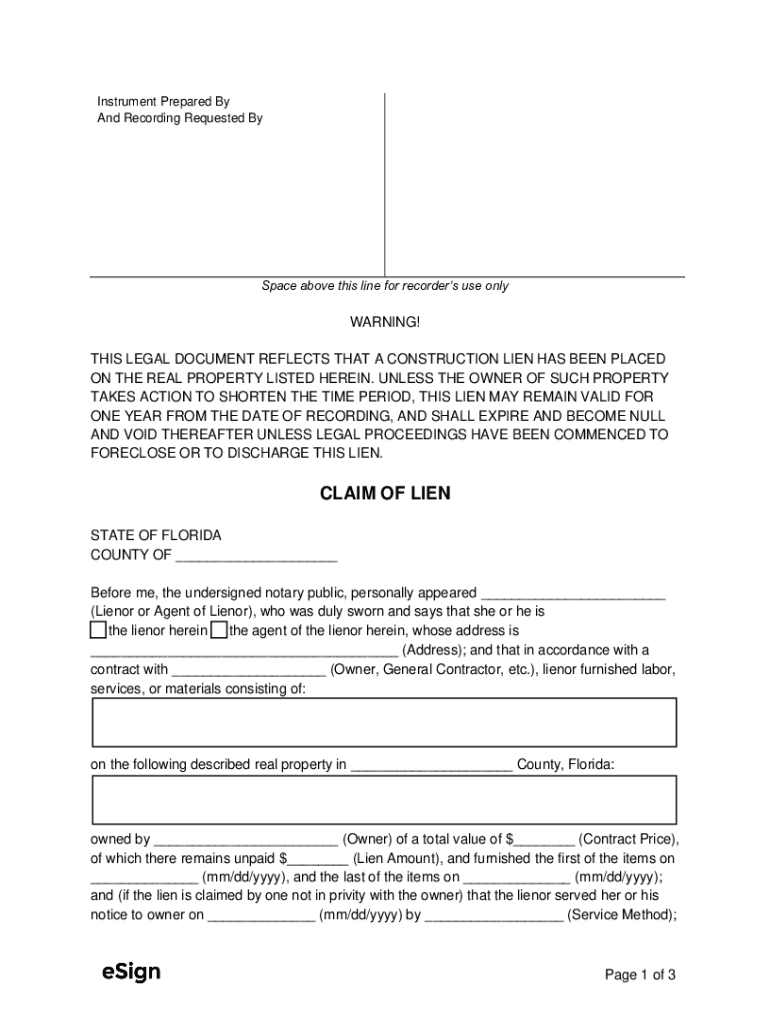







Definition and Meaning
The Florida's Construction Liens Laws: The Claim of Lien is a legal instrument used primarily in Florida to assert a lien on a specific piece of real property. It serves as a formal notice that a lienor, such as a contractor or supplier, claims a legal right or interest in the property due to unpaid construction-related services or materials. This form is a critical document that must accurately reflect all necessary details concerning the lienor, the nature of the work or materials provided, and the total amount claimed. The claim underscores the seriousness of the debt and acts as a catalyst for the property owner to address the outstanding issue to avoid further legal complications.
Key Elements of the Claim of Lien
Several critical components make up a valid Florida's Construction Liens Laws: The Claim of Lien. These include:
- Lienor Information: Details about the person or entity placing the lien, including name and address.
- Property Information: A legal description of the property subject to the lien, which should be precise to avoid any disputes over jurisdiction or enforceability.
- Services or Materials Provided: A detailed account of the labor, services, or materials furnished by the lienor.
- Amount Owed: The exact amount of money that remains unpaid, representing the value of the services or materials.
- Notary Acknowledgment: The document must be notarized to ensure its authenticity and validity. This typically involves an official seal and the notary’s signature.
- Proof of Service: Evidence that the property owner has been officially notified of the lien filing, which may include a return receipt from certified mail or other verifiable forms of delivery.
Steps to Complete the Claim of Lien
Filing the Claim of Lien involves several clear, concise steps:
- Detailed Preparation: Gather all necessary information regarding the services provided, the amount owed, and the legal description of the property.
- Draft the Form: Complete the form with precise details of the lienor, the exact nature of the work or supplies, and the accurate amount claimed as due.
- Notarization: Once drafted, the document must be notarized to fulfill the legal requirements. Ensure all parties needing to sign the document are present at the notary.
- Serve the Property Owner: Deliver a copy of the filed lien to the property owner, ensuring proof of service through certified mail or another reliable method.
- File with County Clerk: Submit the notarized lien form to the Clerk of Court in the county where the property is located for recording.
Why Use the Claim of Lien
Utilizing the Claim of Lien is an essential step for contractors, suppliers, and other parties to secure payment for provided services and materials. It gives legal standing in demanding due payment and outlines a clear path to potential compensation through foreclosure if unresolved. It protects the interests of laborers and suppliers by prioritizing their claims against a property over other unsecured debts. The lien also creates a public record, alerting potential buyers or financiers of the outstanding claim, thereby pressuring the property owner to settle the debt promptly.
State-Specific Rules
Florida’s lien laws are comprehensive and require specific adherence to timelines and procedural steps to ensure validity. Some notable rules include:
- Notice to Owner (NTO): Prior to or shortly after starting work or supplying materials, lienors must serve an NTO to protect their right to later file a lien.
- Timeframe for Filing: The claim must be filed within 90 days of the last labor performed or materials supplied.
- Expiration of Lien: A filed lien is valid for one year, during which the lienor must either encourage settlement or initiate legal proceedings to enforce the lien.
Legal Use of the Claim of Lien
Authorized under state statutes, the Claim of Lien provides a structured way for lienors to assert their rights. If the lien remains unpaid, the lienor might initiate a foreclosure lawsuit, potentially resulting in the property’s sale to satisfy the debt. The legal binding of the lien demands that all stakeholders—lienors, property owners, and potential buyers—adhere to its stipulations, ensuring clarity and enforceability.
Examples of Using the Claim of Lien
Practically speaking, a subcontractor who has not been paid for their labor on a large construction project can file a Claim of Lien. This, in turn, can expedite resolution as the prime contractor or property owner seeks to settle to remove the lien, especially when refinancing or selling the property. Suppliers, similarly, can leverage the lien to prompt payment for materials delivered as part of a building endeavor, reinforcing the primary function of the lien to safeguard payment rights.
Penalties for Non-Compliance
Failure to comply with the appropriate lien filing requirements or incorrect form submissions can result in significant penalties, including the dismissal of the lien, the inability to recover unpaid funds, and possible damages against the lienor for fraudulent claims. It is, therefore, critical for lienors to ensure that every detail is accurate and submitted within mandated deadlines to avoid loss of lien rights.
Eligibility Criteria
To file this lien, lienors must engage in supplying labor, materials, or services directly associated with the improvement of real property. Eligibility extends to contractors, subcontractors, laborers, material suppliers, and professionals like architects and engineers where their contribution adds value to the property. Understanding who holds the right to file is vital for lawful enforcement.


Who Typically Uses the Claim of Lien
The primary users of Florida’s Construction Liens Laws: The Claim of Lien encompass a wide range of professionals involved in building and site development. This includes:
- General Contractors: Engaged directly with property owners for major construction projects.
- Subcontractors: Performing detailed tasks or segments under the main contractor’s purview.
- Material Suppliers: Providing essential supplies utilized throughout construction.
- Service Providers: Such as design specialists whose work contributes directly to property enhancement.
By comprehending these diverse roles, participants in the construction industry can safeguard their financial interests through strategic use of the lien.