







Definition and Meaning
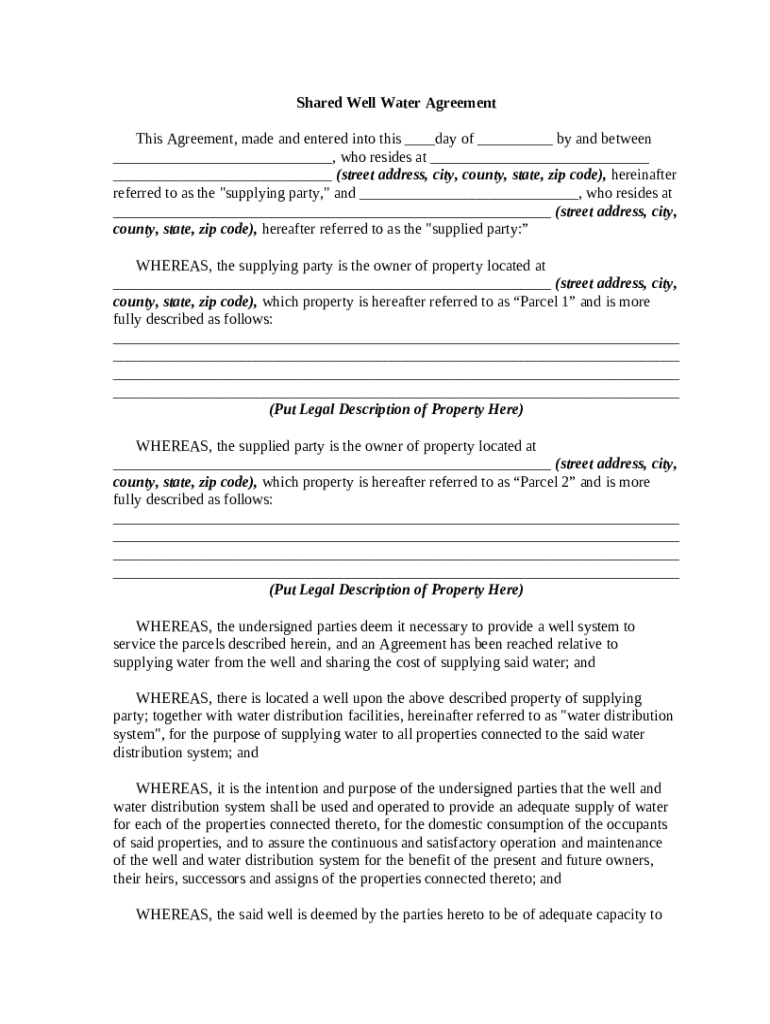
The Shared Well Water Agreement is a legally binding document that outlines the terms and conditions for two or more parties sharing a well for water supply. This agreement specifies each party's rights and responsibilities regarding access, usage, and maintenance of the well. It ensures a fair distribution of costs and supports the equitable use of resources. This agreement typically covers situations where properties are unable to access municipal water and rely on a shared well for their water needs.
Key Aspects of Shared Well Water Agreement
- Purpose: To allocate water resources efficiently between different parties sharing the same well and ensure continuous water supply.
- Parties Involved: Applies to neighboring property owners or entities that depend on the same water source.
- Rights and Obligations: Outlines the duties, such as maintenance and repair responsibilities, and the rights related to water usage for each party.
- Cost-Sharing: Details the financial arrangements for upkeep, repair, and operational costs, offering clarity and avoiding potential disputes.
How to Use the Shared Well Water Agreement
The primary use of the Shared Well Water Agreement is to establish the framework for a cooperative water-sharing arrangement between multiple parties.
Implementation Steps
- Identify Parties: Clearly list all individuals or entities involved in the sharing agreement.
- Define Water Usage Rights: Each party's entitlement to the water supply should be clearly specified, with maximum usage limits if applicable.
- Set Payment Terms: Agree on how costs related to water usage and maintenance will be shared. This could be based on a percentage method or equal division.
- Draft Maintenance Responsibilities: Outline who is responsible for routine maintenance and dealing with emergencies or repairs.
- Include Conflict Resolution: Document procedures for resolving disagreements, possibly involving a third-party mediator or legal intervention.
Practical Examples
- Scenario A: Two neighboring homes utilize the same well; a shared agreement defines how much each home can use and details the financial responsibilities of both parties.
- Scenario B: A commercial building and an adjacent farm share a well, requiring detailed agreements on peak water usage periods to prevent shortages.
Key Elements of the Shared Well Water Agreement
The agreement is composed of several critical areas to ensure it serves its intended function effectively.
Essential Components
- Access and Easement: Includes provisions for legal access to the well and necessary property access for maintenance.
- Water Quality Maintenance: Details the processes to be followed if the water quality falls below safe standards.
- Dispute Resolution: Specifies mechanisms for handling potential disputes, such as property mediation or court options.
- Emergency Procedures: Outlines actions to be taken during water shortages or equipment failure, along with who bears the associated costs.
Detailed Breakdown
Maintenance Responsibilities
- Routine Checks: Specifies regular inspections and general upkeep, including pumping equipment checks and water testing.
- Repair Costs: States who will take charge of repairs and how these costs will be allocated between involved parties.
Financial Responsibilities
- Usage Costs: Clarifies liabilities for operational costs, which might include pumping fees or electricity used by the well system.
- Upgrade Costs: Discusses possibilities of future upgrades and how these will be financed.
Who Typically Uses the Shared Well Water Agreement
This agreement is primarily used by individuals or entities sharing a common water source that cannot be sourced independently from a municipality.

Typical Users
- Homeowners: Particularly those in rural or semi-rural areas without municipal water access.
- Farmers and Agricultural Businesses: A common arrangement for properties that heavily depend on steady and reliable water sources.
- Commercial Property Owners: Businesses sharing a common facility may jointly utilize a shared well, necessitating a structured agreement.
User Scenarios
- Scenario C: Homeowners in a subdivision rely on a communal water source, necessitating clear guidelines for managing water rights.
- Scenario D: Adjoining agricultural lands sharing a well require precise rules to allocate water for irrigation without affecting neighboring crops.
Important Terms Related to Shared Well Water Agreement
Certain terminology is crucial to understanding and drafting a thorough Shared Well Water Agreement.
Terminologies
- Easement: The legal right for a party to use another’s property for a specific purpose, such as accessing a shared well.
- Potable Water: Water that is safe to drink and suitable for human consumption.
- Water Table: The underground level at which soil and rock are completely saturated with water, affecting well functionality.
- Aquifer: An underground layer of water-bearing rock from which groundwater can be extracted.
- Hydraulic Head: Refers to the potential energy available in an aquifer, impacting water flow to the well.
Legal Use of the Shared Well Water Agreement
This agreement operates under a legal framework ensuring all parties abide by the terms and conditions.
Legal Considerations
- Binding Nature: Once signed, the agreement becomes a legally enforceable contract.
- Local Regulations: The agreement must align with local water-use laws and zoning requirements.
- Environmental Compliance: Abides by relevant environmental protection standards, ensuring sustainable water use.
Implications
- Legal Recourse: Provides a legal basis for resolving disputes in court if the mediation fails.
- Protective Measures: Helps safeguard water rights and access, protecting investments into property improvements reliant on well water.
State-Specific Rules for the Shared Well Water Agreement
Different states in the U.S. may have varying requirements and regulations regarding shared water resources.
Variation in Regulations
- Water Rights: Understandable in the western U.S. where water rights and allocation might be more complex than in the eastern regions.
- Permit Requirements: Different states may require permits for shared well operations, impacting how agreements are drafted.
State-Specific Examples
- California: Particularly stringent on water use due to conservation laws and drought conditions.
- Colorado: Requires adherence to specific water rights regulations due to its semi-arid climate.
Examples of Using the Shared Well Water Agreement
Real-world applications of the Shared Well Water Agreement demonstrate its utility and flexibility.
Illustrative Cases
- Case Study #1: A suburban neighborhood in upstate New York uses a shared well system, with an agreement providing clear terms for maintenance and usage, resulting in harmonious resource management.
- Case Study #2: In rural Texas, a shared well agreement avoids disputes between a cattle farming business and a neighboring organic vegetable farm, ensuring a legal framework for equitable water distribution.
Best Practices
- Regular Review: Frequently revisiting and updating the agreement can prevent future disputes and accommodate changing legal frameworks or property needs.
- Professional Drafting: Engaging legal professionals to draft and review the agreement ensures compliance and thorough coverage of potential scenarios.




