




01. Edit your form online
Type text, add images, blackout confidential details, add comments, highlights and more.

Type text, add images, blackout confidential details, add comments, highlights and more.

Draw your signature, type it, upload its image, or use your mobile device as a signature pad.

Send it via email, link, or fax. You can also download it, export it or print it out.
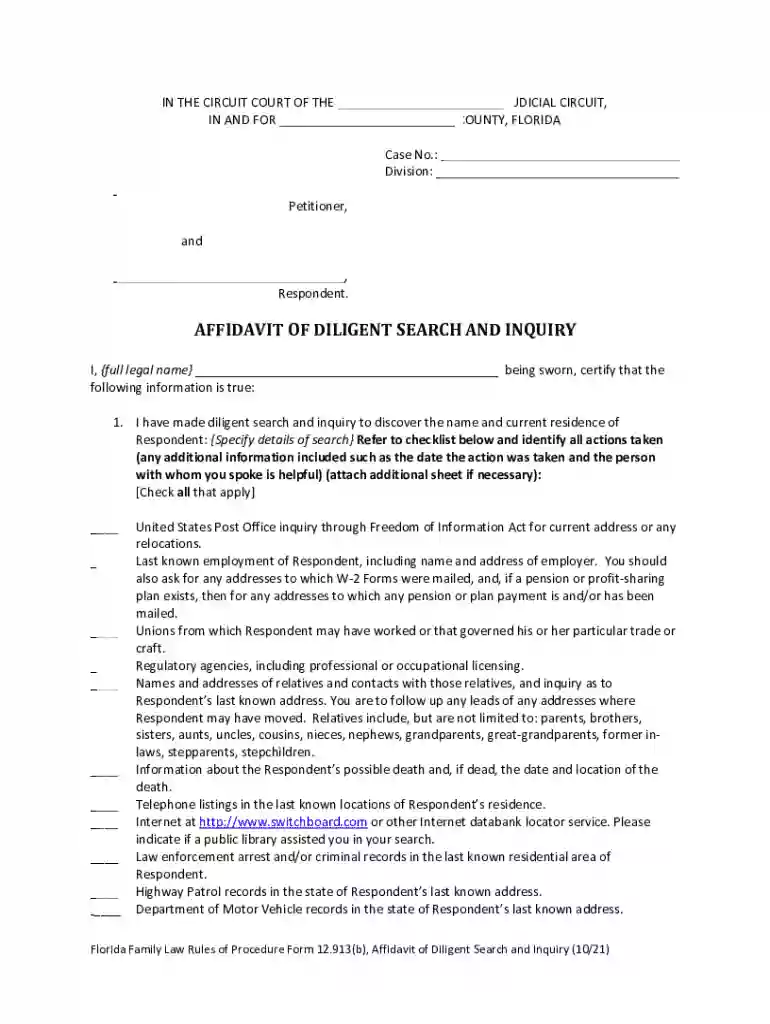
Florida Family Law Form 12.913(b), also known as the Affidavit of Diligent Search and Inquiry, is a document used to facilitate constructive service in divorce cases where the respondent's whereabouts are unknown. This form serves as a sworn statement indicating that the party making the request has taken all necessary steps to locate the other party, adhering to the standards set forth by Florida law. Its purpose is to ensure that the court case can proceed even in the absence of direct contact with the missing party.
Completion by the Petitioner: The petitioner in the divorce case should complete the form by detailing the actions taken to locate the respondent.
Details of Search Efforts: This includes listing all locations, institutions, and individuals contacted during the search, such as employers, relatives, and utility companies.
Filing with the Court: Once completed, the affidavit must be filed with the appropriate court handling the divorce proceedings.
Service Through Publication: If approved, the court may allow service by publication, placing a notice in a newspaper as a substitute for direct service to the missing spouse.
Gather Required Information: Collect all relevant details and documentation related to the search for the other party. This includes addresses, names of individuals contacted, and dates of communication.
Fill Out the Form: Enter all information into Form 12.913(b) accurately, ensuring every statement made is truthful and can be supported by evidence if required.
Notarize the Affidavit: The document must be signed in the presence of a notary public to add legal validity.
Submit to the Court: File the notarized affidavit with the court where the divorce case is pending, ensuring it is submitted within any deadlines set forth by the court.
Form 12.913(b) is legally mandated in cases where the petitioner is unable to serve the divorce papers directly due to the unknown location of their spouse. It aligns with Florida's requirements for diligent search and is critical for processing a constructive service. This allows the court to proceed with the divorce in a manner that is fair and legally justifiable, ensuring all legal avenues to reach the respondent have been exhausted.
Constructive Service: A legal method of serving court documents on a person who cannot be located, typically through publication in a newspaper.
Diligent Search: An obligation to thoroughly search for an individual by contacting known associates, checking public records, and utilizing other reasonable methods.
Affidavit: A written statement confirmed by oath or affirmation, used as evidence in court.
Petitioner Information: Includes the full name and contact information of the petitioner.
Respondent Description: Detailed description of search efforts for the respondent.
List of Contacts and Sources: Documents every attempt made to locate the missing spouse.
Sworn Statement: The petitioner must affirm the truthfulness of the information provided in front of a notary.
Florida Regulations: This form strictly complies with Florida state laws, particularly regarding the protocols for a diligent search and the conditions under which constructive service is permitted.
Publication Requirements: If the court permits service by publication, it often requires specific newspapers and duration for the notice, typically within the county of the court’s jurisdiction.
Case Study 1: A wife filing for divorce cannot contact her husband, who has moved without leaving a forwarding address. She uses Form 12.913(b) to document her search efforts, allowing the court to approve service by publication.
Case Study 2: A husband, unable to find his wife due to relocation for work, completes the form detailing his inquiries with former employers and relatives, enabling the court to proceed with the case.
This form is typically used by individuals involved in family law cases, particularly in situations of divorce where one party cannot be located. It is especially relevant for parties who are self-represented and for whom direct service is not possible. Legal professionals may also assist their clients in completing and filing this form to ensure compliance with court requirements.
At DocHub, your data security is our priority. We follow HIPAA, SOC2, GDPR, and other standards, so you can work on your documents with confidence.

The Electronic Fund Transfer Act (EFTA) protects consumers in electronic fund transfers, including ATM, POS, ACH, and remote banking transfers.
This form is to be used with Notice of Action for Dissolution of Marriage (No Child or Financial. Support), Florida Supreme Court Approved Family Law Form
12-12-913 (b) provides that local law enforcement agencies having jurisdiction shall disclose, in accordance with guidelines promulgated by the [Arkansas]


