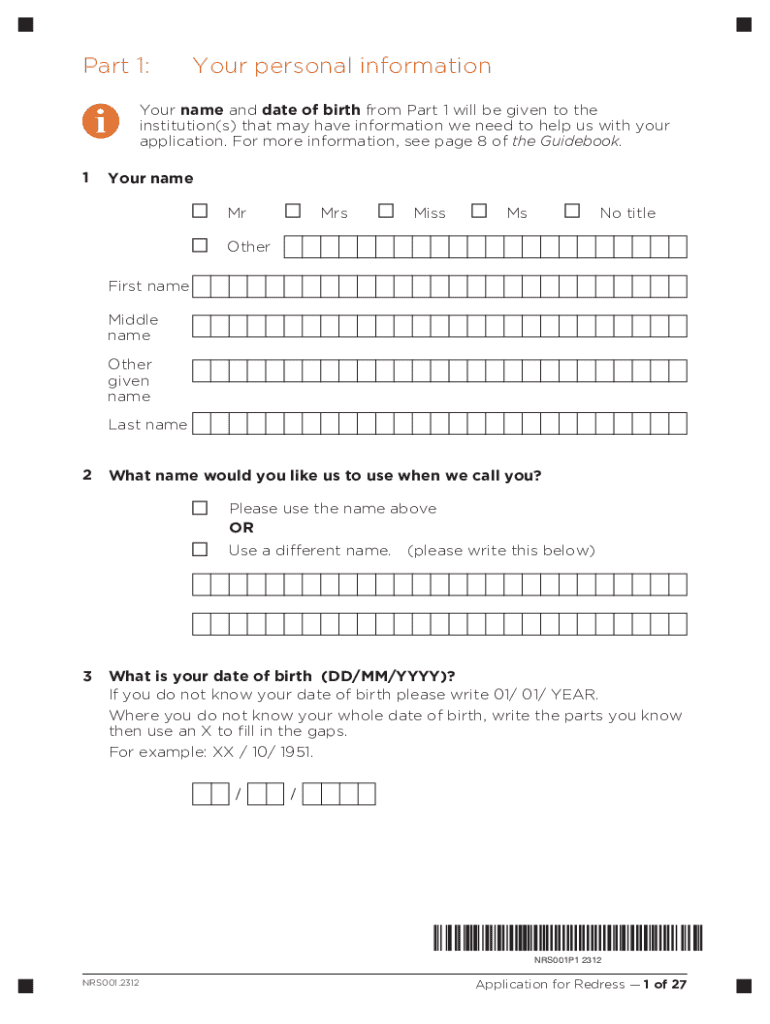







Definition and Importance of the Application for Redress
The "Application for Redress" is a formal process within the United States aimed at individuals who seek compensation or resolution for a grievance. This form is most commonly associated with cases involving institutional child sexual abuse, where applicants might be eligible for support such as counselling or financial redress. The most critical aspect behind the form is that it provides a structured mechanism for victims to convey their experiences and receive acknowledgment and mitigation from relevant institutions.
- Purpose: Primarily, the form serves to collect detailed information about the applicant's experiences and any supporting evidence for their claim.
- Impact: Successful applications can lead to monetary compensation, access to professional counselling services, and an official apology from the institution involved.
Steps to Complete the Application Form
Filling out the Application for Redress can be a detailed and sensitive process that requires completeness and accuracy.
-
Read Instructions Carefully: Begin by thoroughly reading all instructions provided with the form to understand the necessary components and documentation required.
-
Personal Information: Enter your full legal name, contact details, and any relevant identification numbers accurately.
-
Description of Incident: Provide a comprehensive account of the event you wish to redress, including any dates, locations, and parties involved.
-
Gather Documentation: Compile any evidence related to your case, such as medical reports, police records, or witness testimonies.
-
Complete Required Fields: Ensure that all mandatory fields are completed to avoid delays in processing your application.
-
Review Your Application: Carefully review the entire form for errors or omissions before submission.
-
Form Submission: Submit the completed form through the method that best suits your preference, whether online, in-person, or by mail.
Eligibility Criteria for Applicants
To qualify for redress, applicants must meet specific criteria, which typically include:
- Victim of Institutional Abuse: The form is intended for individuals who have suffered abuse within an institution, such as schools, churches, or government organizations.
- Eligible Institutions: Only those cases involving institutions listed within the official redress scheme apply.
- Timing Constraints: Applications must be filed within any prescribed deadlines set by state or federal regulations.
- Age and Residence Requirements: Applicants often must meet minimum age criteria and provide proof of citizenship or residency within the United States.


Key Elements of the Form
Understanding the fundamental components of the Application for Redress is crucial for proper completion:
- Personal Details Section: Captures essential identity information.
- Incident Details: A narrative section where applicants describe the abuse experienced.
- Supporting Evidence: Applicants are required to attach relevant documents to substantiate their claims.
- Declaration and Signatures: Final section where the applicant attests to the accuracy and completeness of the information provided.
Legal Use and Compliance
The Application for Redress plays a vital role in the legal framework regarding justice for abuse victims:
- Legal Acknowledgment: Provides victims with a recognized avenue to seek justice, aligning with federal and state legislations on victim rights.
- Compliance: Ensures that applicants adhere to prescribed legal standards in submitting claims, which helps in the effective legal processing of cases.
- Penalties for False Information: Submission of false or misleading information can lead to severe penalties, including legal actions against the applicant.
Application Process and Approval Time
The timeline and steps involved in processing and approving the Application for Redress can vary:
- Initial Review: Upon receipt, the application is reviewed for completeness and accuracy, which typically takes several weeks.
- Investigation: A detailed investigation into the claims may be conducted by relevant authorities, taking a few months.
- Decision Notification: Applicants receive a decision letter outlining whether their application has been approved or rejected, and any available appeals process.
- Follow-up Actions: Approved applicants may be required to complete further steps, such as providing additional documentation or attending review meetings.
Required Documentation
Supporting documents greatly influence the application’s evaluation:
- Personal Identification: Government-issued ID or passport as proof of identity.
- Evidence of Abuse: Medical records, therapy notes, legal documents, or eyewitness accounts.
- Institutional Connection: Documentation proving your association with the implicated institution during the time of the alleged abuse.
- Financial Records: If claiming financial hardship due to the incident, relevant financial documents may also be necessary.
State-specific Rules and Differences
Though the Application for Redress follows federal guidelines, variations exist across different states:
- Different Deadlines: Some states may have specific deadlines for filing applications that applicants must adhere to.
- State-specific Support Services: Variations in available resources for counselling and legal aid.
- Adjustments in Procedure: Certain states may modify certain procedural aspects or have additional documentation requirements.
By thoroughly understanding and completing the Application for Redress, applicants can advance their claims effectively and seek the justice they deserve through this formal process.