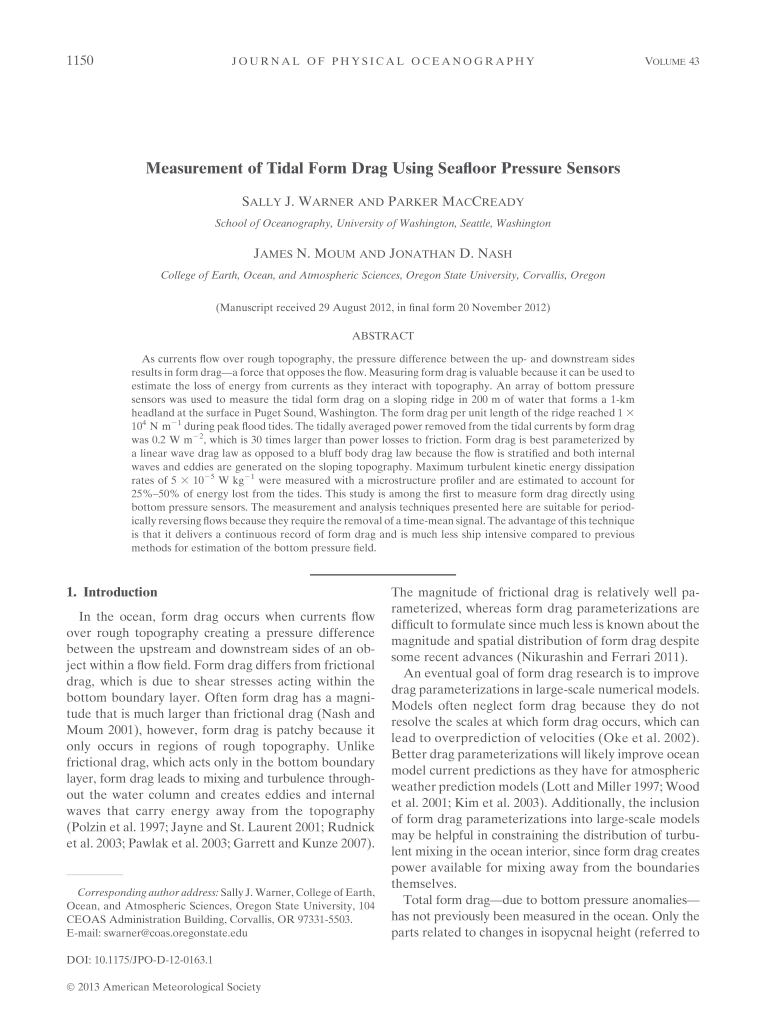







Definition & Meaning
The "Measurement of Tidal Form Drag Using Seafloor Pressure Sensors" refers to a research methodology aimed at understanding the forces exerted by tidal currents on underwater topographic features. This method involves using seafloor pressure sensors to capture data about how tidal flows interact with the ocean floor, resulting in what's known as "form drag." This type of drag is the resistance experienced by moving water due to the underwater landscape, which can significantly affect oceanographic models and energy equations.
Key Elements of the Measurement Process
To accurately measure tidal form drag, researchers deploy pressure sensors on the seafloor, particularly in strategic locations known to experience dynamic tidal flows. These sensors detect changes in pressure as water moves over ridges, valleys, and other features. Key elements include:
- Pressure Sensors: Essential for capturing continuous data about pressure fluctuations at various depths.
- Data Collection Sites: Typically areas with complex topographical features, like sloping ridges.
- Measurement Duration: Extended over periods to capture various tidal cycles and weather conditions.
Steps to Complete the Measurement
- Site Selection: Identify strategic locations with notable underwater features for sensor deployment.
- Equipment Setup: Deploy the seafloor pressure sensors and secure them to withstand marine conditions.
- Data Collection: Allow sensors to gather data over multiple tidal cycles to ensure comprehensive results.
- Data Analysis: Retrieve sensor data to analyze pressure changes and calculate form drag values.
Detailed Data Analysis
- Data Retrieval: Use advanced software to extract data from sensors.
- Calculation Technique: Apply oceanographic models to derive form drag from pressure readings.
- Topographical Influence: Assess how specific features impact measured drag values.
How to Use the Measurement Data
The data obtained from measuring tidal form drag can be leveraged to enhance the accuracy of ocean models. Applications and uses of this data include:
- Improving Ocean Models: Incorporating form drag into hydrodynamic models to better simulate tidal flows.
- Energy Calculations: Assessing energy loss in tidal currents, useful for renewable energy considerations.
- Topography Influence Studies: Understanding how underwater features influence water movement and mixing.
Real-World Applications
- Renewable Energy Design: Data can optimize the placement of tidal turbines by providing detailed drag insights.
- Marine Navigation: Offers insights into how tidal forces might affect shipping routes.
Why Measure Tidal Form Drag
Measuring tidal form drag is crucial for several reasons, particularly in enhancing the precision of ocean modeling and environmental management. The insights gained can:
- Enhance Predictive Models: Provide more accurate predictions of tidal behaviors.
- Support Environmental Conservation: Aid in developing strategies to mitigate the impacts of tidal energy extraction.
- Improve Marine Safety: Offer navigational data that can inform safer shipping practices.
Examples of Using the Measurement
Researchers in Puget Sound, Washington, utilized this type of measurement to uncover significant energy losses in tidal currents. By identifying that form drag was substantially greater than frictional drag, they were able to refine local water flow models and improve the understanding of tidal flow dynamics. This kind of research can lead to more effective strategies in managing coastal environments and developing renewable energy solutions.
Important Terms Related to the Process
- Form Drag: The resistance experienced by an object moving in a fluid, influenced by the object's shape and the flow dynamics.
- Tidal Currents: Water movement driven by tidal forces, significantly impacting drag forces.
- Seafloor Pressure Sensors: Devices that measure the pressure exerted by water columns at specific depths, used to infer tidal dynamics.
Legal and Compliance Considerations
When conducting these measurements, it's important to comply with local and federal regulations regarding marine research and data collection. In the United States, researchers may require permits from entities like the National Oceanic and Atmospheric Administration (NOAA) to conduct underwater studies, ensuring activities do not disrupt marine ecosystems.
- Environmental Regulations: Ensuring research methods minimize impact on marine life and habitats.
- Data Privacy: Safeguarding data against non-authorized access or use.
Who Typically Uses This Measurement
The primary users of the "Measurement of Tidal Form Drag Using Seafloor Pressure Sensors" include:
- Oceanographers: Utilize data to advance scientific understanding of marine systems.
- Environmental Scientists: Apply findings to conservation efforts.
- Renewable Energy Engineers: Inform the design and placement of tidal energy systems.
Associated Business and Government Stakeholders
- Marine Research Institutions: Conduct extensive studies using these measurement techniques.
- Government Agencies: Use data to develop policies on marine resource management.
State-Specific Rules and Considerations
While the overall methodology remains consistent, state-specific environmental laws and marine regulations might affect how the measurements are conducted, particularly within territorial waters. Depending on local jurisdictions, specific permissions and assessments may be required.