






Definition & Meaning
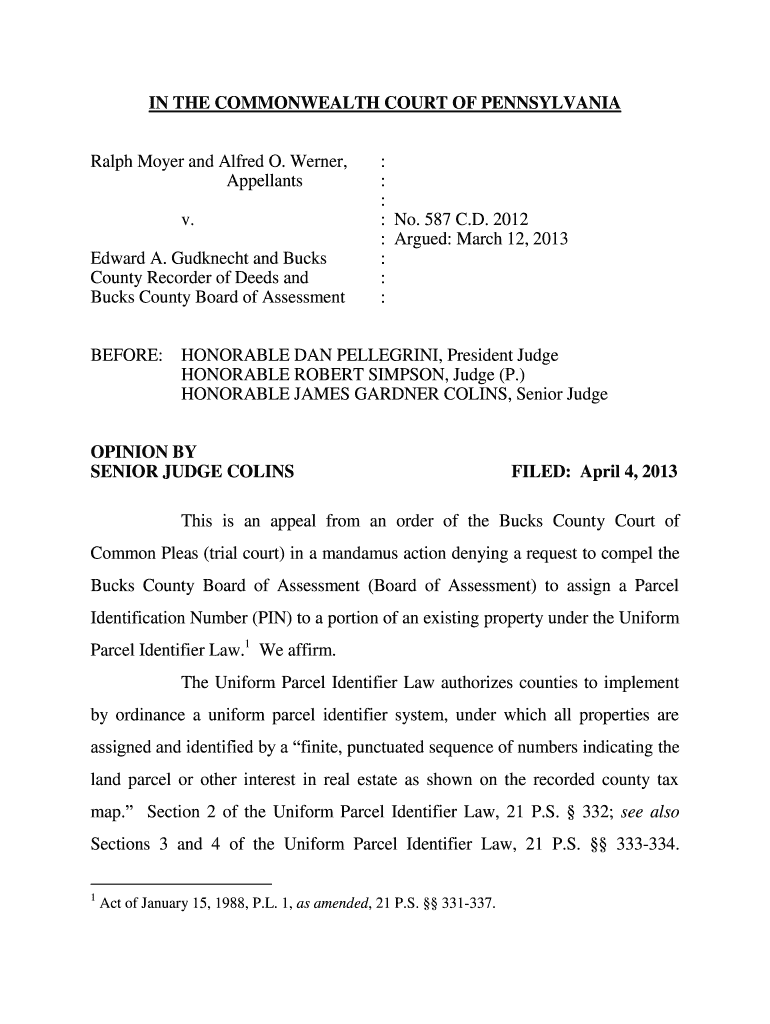
The term "Moyer v Gudknecht - Penn State Law" refers to a legal case that was heard by the Commonwealth Court of Pennsylvania. This case centers around the appeal made by Ralph Moyer and Alfred O. Werner against decisions made by local entities in Bucks County. Specifically, it involved the Bucks County Recorder of Deeds and the Bucks County Board of Assessment. The landowners were seeking to obtain a Parcel Identification Number (PIN), a unique identifier under the Uniform Parcel Identifier Law, which was necessary for a portion of their property. The trial court denied their request based on the absence of a recorded subdivision plan, a requirement defined by local regulations.
Key Elements of the Case
Court and Jurisdiction
This case was adjudicated by the Commonwealth Court of Pennsylvania, which deals with matters of statewide significance including those related to governmental and regulatory issues. The court's decision reaffirmed legal protocols for property identification and assessments in the state.
Legal Arguments
The appellants argued for mandamus relief, hoping to legally compel the Bucks County Board to assign a PIN to their property. They asserted that the Parcel Identifier Law obliged the Board to do so; however, the court determined that the lack of a subdivision plan exempted the Board from this obligation.
Decision Summary
Ultimately, the court ruled against Moyer and Werner, determining that no legal duty existed to assign a PIN in the absence of a recorded subdivision plan. This decision underscores the importance of meeting specific local property requirements before seeking official identifiers.
Steps to Complete Required Legal Procedures
-
Understand the Requirements:
- Review state laws regarding property identification, especially focusing on the need for a subdivision plan.
- Recognize the role of local entities such as the Recorder of Deeds and Boards of Assessment in property matters.
-
Documentation Preparation:
- Gather all necessary documents that support property claims, including previous property documents and any potential subdivision plans.
- Consult with legal experts for accurate interpretations and advice on compliance with local laws.
-
Submission to Authorities:
- File the necessary requests with local governing bodies, ensuring that all submitted documentation complies with legal standards.
- Follow up with these authorities to track the status of your request or appeal.
-
Legal Recourse:
- In the event of denial, consider the potential for legal action or appeals as demonstrated in Moyer v Gudknecht.
- Work with a qualified attorney to build a case tailored to individual circumstances and comply with state judicial processes.
Importance in Legal and Practical Context
The case of Moyer v Gudknecht holds significance for property owners within Pennsylvania and potentially in other jurisdictions that follow similar property assessment protocols. The decision clarifies the relationship between regulatory compliance and property identification, encouraging landholders to adhere to procedural requirements to avoid legal complications.
Who Typically Uses This Legal Precedent?
Legal Professionals
Attorneys and other legal professionals seeking to understand state-specific property law may reference this case when advising clients or handling similar disputes.
Property Owners
Those wishing to obtain or dispute property identification numbers can learn from this case, ensuring they navigate legal processes efficiently.
Important Terms Related to Moyer v Gudknecht
Parcel Identification Number (PIN)
A numeric identifier assigned to parcels of land, facilitating assessments and property management.
Mandamus Relief
A judicial remedy which orders a government agency or official to perform a duty that is mandated by law.
State-Specific Rules and Exceptions
Pennsylvania-Specific Regulations
This case highlights Pennsylvania's specific requirements for property identification, underscoring the importance of subdivision plans in the state's property management laws.
Exceptions to Common Rules
The ruling demonstrates that even when appellants believe they meet conditions for relief, specific exclusions may apply, particularly regarding unmet legal prerequisites like the subdivision plan in this instance.
Real-World Scenarios and Applications
This case serves as a valuable example of how legal theories translate into practical applications. Landowners facing bureaucratic challenges can look to this decision for insight into potential hurdles and required documentation. For instance, those developing property for residential or commercial use must ensure comprehensive compliance with all applicable laws to secure proper identification and avoid prolonged legal battles.