






Definition & Meaning
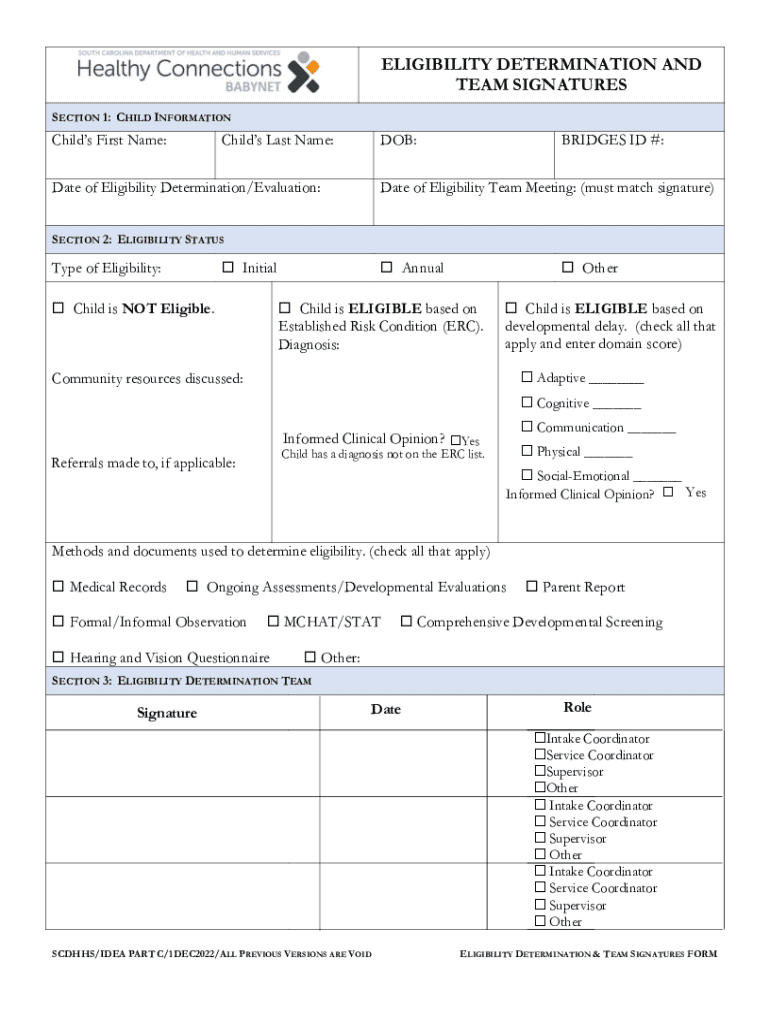
The "Special Education Eligibility Initial and Reevaluation" form is a critical document used to determine a child's qualification for special education services under the Individuals with Disabilities Education Act (IDEA). It is used to assess whether a child requires special education based on specific risk conditions or developmental delays. This form includes several sections such as child information, eligibility status, and input from an eligibility determination team.
Components of Eligibility Assessment
- Child Information: This section captures essential details about the child, including their name, date of birth, and any identifying information necessary for evaluation.
- Eligibility Status: Here, the form indicates whether the child meets the criteria for special education services. This decision is based on documented evidence of disabilities or delays.
- Signatures from the Team: The form requires signatures from all members of the eligibility determination team, ensuring that the decision is a collective and informed one.
Steps to Complete the Special Education Eligibility Initial and Reevaluation
- Collect Necessary Information: Gather all relevant data about the child's current educational status, medical history, and any existing individualized education programs (IEPs).
- Complete Child Information: Fill out the child's section with accurate personal details and any specific needs or accommodations they might have.
- Conduct Assessments: Involve specialists to evaluate the child's developmental levels, cognitive abilities, and emotional needs. These assessments help provide a comprehensive view of the child's educational requirements.
- Review and Verify Eligibility: Based on the collected data, determine if the child is eligible for services under IDEA. This includes a detailed analysis against set eligibility criteria.
- Team Discussion and Decision: Conduct a meeting with the eligibility determination team to discuss findings and reach a consensus about the child's needs.
- Final Documentation: Document the decision, collect team signatures, and provide details of any recommended services. Ensure all sections are correctly filled out.
Eligibility Criteria
To qualify for special education services, a child must meet specific criteria under federal law. These criteria generally include:
- Identified Disability: The child must be diagnosed with one or more disabilities as defined by IDEA, such as autism, blindness, emotional disturbance, or intellectual disabilities.
- Adverse Educational Impact: The child's disability must adversely affect their educational performance, necessitating special education and related services.
- Need for Special Services: There should be a demonstrated need for specially designed instruction or support services to address the child's unique learning challenges.


Documentation Requirements
- Psychological Reports: Evaluations from psychologists or psychiatrists providing insights into the child's cognitive and emotional state.
- Medical Records: Relevant documentation from medical professionals supporting the presence of a physical or neurological disorder.
- Educational Assessments: Tests and observations conducted by educators to gauge the child’s academic performance and learning needs.
Key Elements of the Special Education Eligibility Initial and Reevaluation
This form comprises several crucial sections that need detailed completion:
- Eligibility Status: Clearly define if the child is eligible and outline reasons for the decision.
- Methods of Determination: Describe the methods and tools used for evaluation—this could include standardized tests, classroom observations, and parent interviews.
- Community Resources Discussed: Summarize discussions on community resources available to support the child’s education, including local special education programs or therapy services.
Legal Use of the Special Education Eligibility Initial and Reevaluation
The form must be used in compliance with federal regulations under IDEA. It is essential for maintaining an accurate record of the child's eligibility status and ensuring that all decisions are legally defensible. The form also serves as a protective measure for both schools and parents, ensuring clear communication and agreed-upon plans for the child’s education.
Compliance and Safeguards
- Confidentiality: All information included in the form is confidential and should be shared only with authorized personnel.
- Parental Consent: Before proceeding with the evaluation and implementation of services, parental or guardian consent is typically required.
- Review Dates: The form specifies required timelines for reevaluations, ensuring the child’s needs are continuously met.
Who Typically Uses the Special Education Eligibility Initial and Reevaluation

Key Participants
- School Psychologists: Professionals responsible for conducting assessments and interpreting psychological data.
- Special Education Teachers: Experts in designing and implementing educational programs tailored to the child's identified needs.
- Parents or Guardians: Critical team members who provide insights into the child's behavior and progress outside the school environment.
Team Collaboration
The eligibility determination team typically comprises educators, administrators, psychologists, and family members who collaborate to assess and decide on the child's educational path. This collaborative approach ensures diverse perspectives are considered, leading to more comprehensive support plans.
Examples of Using the Special Education Eligibility Initial and Reevaluation
In practice, a school district uses this form when a teacher suspects a student may have learning disabilities impacting their educational performance. Detailed observations and assessments are conducted by a school psychologist, whose findings are discussed with the parents and other team members to arrive at a formal eligibility decision.
Case Study
A five-year-old child with suspected autism undergoes an eligibility evaluation. The team conducts a series of assessments, finds community resources for further support, and utilizes this form to document eligibility decisions. After thorough discussion, they agree on specific services, and all members, including the parents, sign the form to reflect their consensus and commitment to the child’s success.
State-Specific Rules for the Special Education Eligibility Initial and Reevaluation
Each U.S. state may have unique regulations and procedures for handling special education eligibility. These variations might include specific forms, definitions of educational impact, and resources available for children with disabilities.
Navigating State Differences
- Alternate Forms: Some states might have variants of this form requiring additional state-specific information.
- Regional Resources: Availability of local special education programs or supplementary services might differ significantly from one state to another.
- Legal Adjustments: States may impose additional legal requisites to comply with local education laws.