
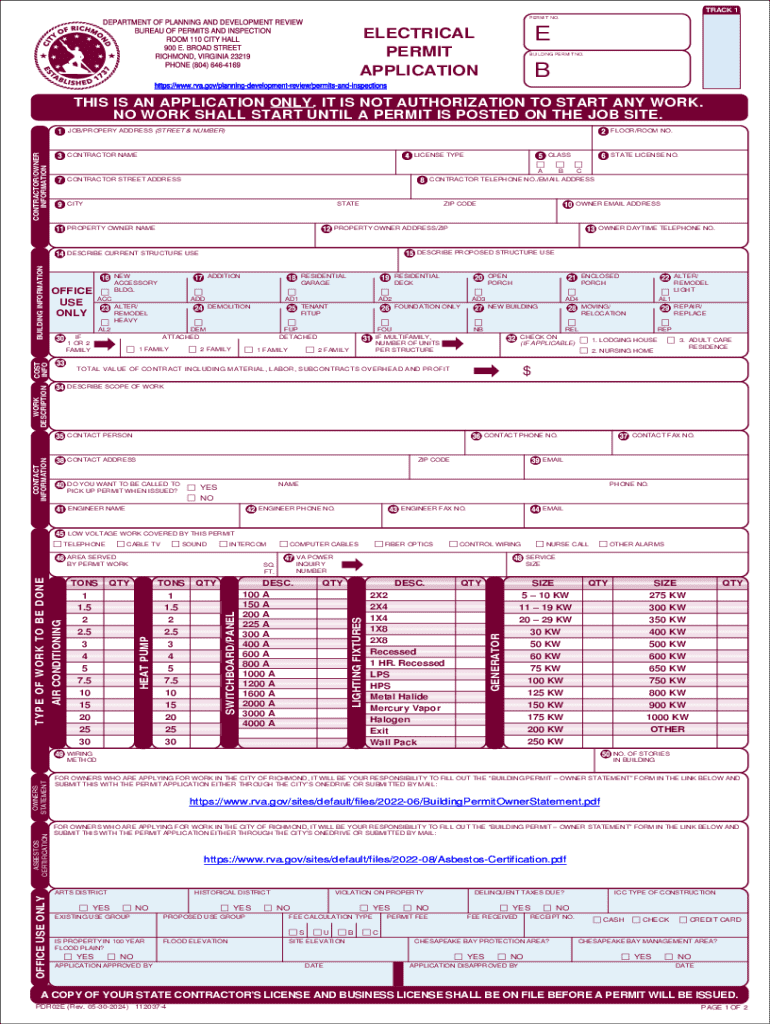







Definition & Meaning
An Electrical Permit Application is a formal request submitted to a local authority or building department for approval to commence electrical work on a property. It serves as a necessary compliance step ensuring that all electrical installations meet safety and building standards. Typically, it includes details about the scope of the project, contractor information, and the estimated cost of work. Understanding its meaning is crucial to ensuring legal adherence and safety in electrical undertakings.
Detailed Explanation
An Electrical Permit Application acts as a safeguard for both the property owner and the community. By requiring this documentation, authorities can monitor, regulate, and approve electrical work, ensuring that it is performed safely and according to code. These applications are critical in preventing potential hazards, such as electrical fires, which can arise from substandard or unsupervised work. Through this process, applicants provide comprehensive details about the proposed work, enabling inspectors to evaluate the project's suitability and compliance with all relevant regulations.
Legal Implications
Submitting an Electrical Permit Application is not merely an administrative formality. It carries legal implications that bind the applicant to adhere to stipulated codes and regulations. Failure to secure an electrical permit before starting work can lead to fines, invalidation of insurance coverage in case of mishaps, and even mandated removal or correction of completed work that does not meet established codes. This legal framework ensures that all parties involved, from the contractors to the property owners, are accountable for maintaining safety standards.
Key Elements of the Electrical Permit Application
An Electrical Permit Application consists of several critical components that must be accurately filled out to ensure successful processing.
Required Information
- Project Details: Includes a detailed description of the work, such as installation of wiring, outlets, fixtures, or other equipment.
- Contractor Information: Must provide the contractor's license number and business details.
- Property Owner Details: The owner’s full contact information.
- Project Location: The specific address of where the electrical work will take place.
Supporting Documentation
Applicants often need to attach supplementary documents such as schematics, electrical plans, or load calculations. These documents assist the reviewing authorities in assessing the project's technical merits and potential implications.
Fee Structure
The application must detail how fees are calculated, typically based on the project's value or size. Understanding the fee structure can help in budgeting and avoiding unexpected costs during the application's processing.
Steps to Complete the Electrical Permit Application
Completing the Electrical Permit Application involves a series of methodical steps that ensure accuracy and completeness.
- Gather Necessary Information: Collect all required personal and project data, including measurements and schematics.
- Review Local Codes: Familiarize yourself with specific codes and regulations in your area. These can typically be accessed through local government websites or building departments.
- Fill Out the Application: Carefully enter all information into the relevant sections of the form. Pay close attention to details, as small errors can lead to delays.
- Attach Supporting Documents: Include any required supplementary documents or plans.
- Submit the Form: Depending on local requirements, submission might be available online, via mail, or in-person at the relevant office.
Practical Examples
For example, if installing a home solar energy system, the permit application would require detailed plans and load distribution diagrams. If incorrect project codes are submitted or the required attachment is missing, it can result in the rejection or delay of the application.
State-Specific Rules for the Electrical Permit Application
Not all states in the U.S. have identical requirements for the Electrical Permit Application. Variations exist due to differences in state safety standards, regulatory frameworks, and administrative procedures.
Examples of State Differences
- California: Requires additional environmental impact assessments for certain projects.
- Texas: May have simplified application processes for standard residential projects but more complex requirements for commercial properties.
- New York: Stricter fire safety codes may require additional documentation and inspections.
Importance of State Considerations
Understanding and adhering to state-specific rules are crucial to ensure that your application is approved without delays. Non-compliance can lead to additional fees or the requirement to make costly post-completion modifications.
Who Typically Uses the Electrical Permit Application?
Several parties are typically involved in using and processing Electrical Permit Applications.


Primary Users
- Contractors: Licensed electricians or electrical contractors who are responsible for performing the work.
- Property Owners: Individuals or corporate owners seeking to make electrical improvements or installations on their property.
- Architects and Engineers: Professionals who may be involved in drafting and designing plans that require permits.
Scenarios and Use Cases
For large commercial projects, multiple applications may be required due to the separation of work across different phases or sections of a building. For residential homeowners, a single application might suffice if renovations are contained within a single unit.
Importance of Accurate Use
Correct usage and submission by these parties ensure that electrical work proceeds smoothly and adheres to legal standards. Misuse or misunderstanding of responsibilities might lead to legal or financial repercussions.
Legal Use of the Electrical Permit Application
Proper legal use of the Electrical Permit Application ensures compliance with local laws and secures the safety and legitimacy of electrical work.
- Adherence to Local Codes: Ensures that all electrical installations conform to safety standards.
- Assignment of Responsibility: By having the proper parties sign and endorse the application, legal responsibilities are clearly delineated.
- Safeguarding Public Welfare: Enhances community safety by ensuring rigorous inspection and oversight of electrical work.
Legal Consequences for Non-Compliance
Failing to secure an electrical permit can have severe legal consequences, including but not limited to:
- Fines and Penalties: Local authorities may impose financial penalties.
- Structural Inspection Failures: Without a permit, projects might fail inspections, delaying occupancy and use.
- Legal Action: In cases where negligent electrical work causes damage or injury, legal actions or liability claims may arise.
Required Documents
Certain documents are recurrently needed in conjunction with the Electrical Permit Application to ensure a complete submission that is ready for review and approval.
Commonly Required Documents
- Proof of Contractor Licensing: Ensures the individual or company meets professional standards.
- Architectural Drawings: For certain types of electrical work, these may demonstrate the proposed scope and impact.
- Engineering Reports: Especially in commercial projects, reports that illustrate structural load considerations or safety evaluations may be needed.
- Project Schedule: A timeline indicating start and end dates helps authorities coordinate inspections and resource allocations.
Ensuring Document Readiness
Having these documents prepared before initiating the application process greatly enhances efficiency and minimizes the chances of rejections due to insufficient information.
Examples of Using the Electrical Permit Application
Examples of situations where an Electrical Permit Application might be particularly relevant include:
Residential Upgrades
Homeowners seeking to upgrade electrical systems to accommodate modern appliances may require permits to perform the work legally and safely.
Commercial Developments
In building new shopping centers or office buildings, multiple applications will likely be necessary to cover the extensive and varied electrical work involved.
Public Infrastructure Projects
For public projects such as parks or street lighting, obtaining the necessary permits ensures that public safety is maintained and regulatory compliance is met.
Practical Considerations
For instance, while residential projects might focus on upgrading circuits to handle increased safety loads, commercial applications may encompass extensive electrical distribution networks that require detailed planning and approval. Understanding specific project needs drastically improves the likelihood of a successful application.




