







Definition and Meaning
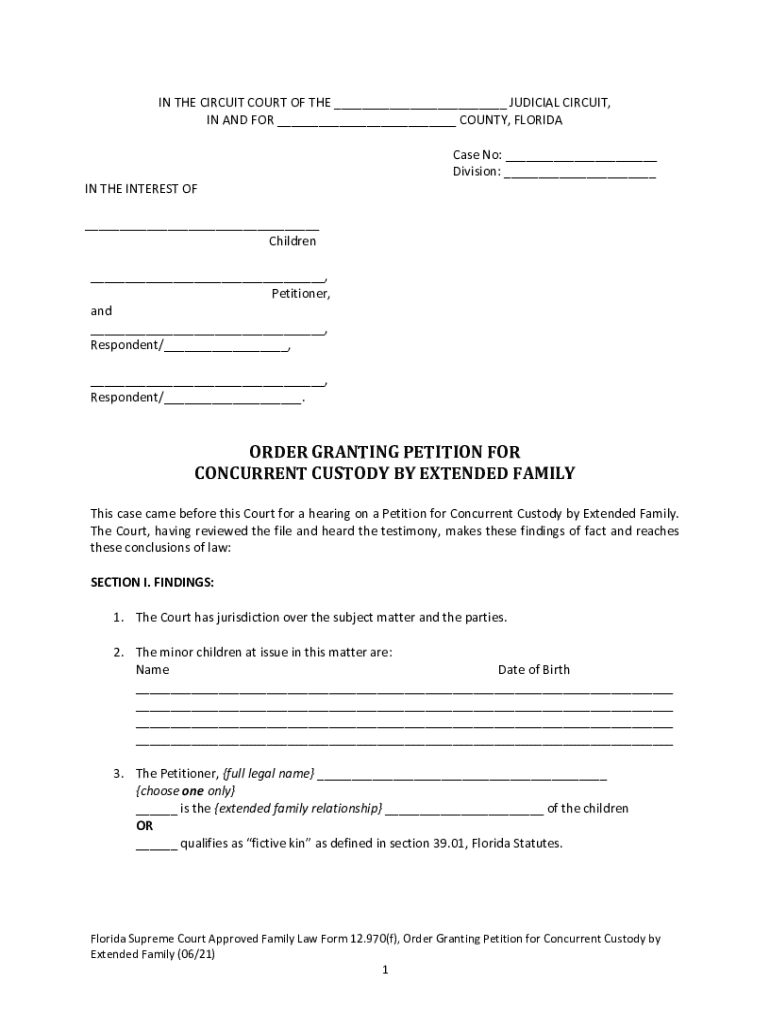
The "Order Granting Petition for Concurrent Custody by Extended Family" is a legal document issued by the Florida Supreme Court, permitting an extended family member, such as a grandparent or aunt, to share custody of a child along with the child's legal parents. This order acknowledges the authority granted to the extended family member to participate in making significant decisions related to the child's health, education, and overall welfare. The order typically arises in situations where the child’s parents are unable to fully meet the child's needs due to various reasons, including financial or health-related challenges.
Key Components
- Petitioner Relationship: The petitioner, typically a grandparent, aunt, uncle, or other relatives, must establish a clear relationship with the child.
- Best Interests of the Child: The order is guided by the principle of ensuring the child's best interests, focusing on their physical, emotional, and educational welfare.
- Parental Rights: It ensures the biological parents' rights are protected, indicating that their parental rights are not diminished.
How to Use the Order
The order is utilized primarily by those granted concurrent custody to make decisions in realms typically reserved for legal guardians. This includes authorizing medical care, enrolling the child in school, and consenting to extracurricular activities. Having this order allows the extended family member to act swiftly in circumstances where immediate attention to the child's needs is required.
Practical Applications
- Emergency Situations: In instances requiring quick medical or educational decisions, this order enables immediate action without waiting for parental consent.
- Shared Responsibilities: The order divides responsibilities between parents and the custodian, streamlining processes related to childrearing and decision-making.
Steps to Complete the Order
- Gather Required Documents: Collect necessary documents, including proof of relationship to the child and any court documents related to past custody arrangements.
- Complete the Petition: Fill out the required family law forms, ensuring all sections are thoroughly completed with accurate information.
- Submit the Petition: File the petition with the appropriate family court, along with any supporting documents.
- Attend Court Hearing: Be prepared to attend a hearing for the court to assess the petition's merit, focusing on the child's best interests.
- Receive Court Decision: Await the court's decision, which will either grant or deny the petition based on the evidence presented.
Important Terms Related to the Order
- Concurrent Custody: The granting of legal custodial authority to an extended family member, shared alongside the biological parents.
- Best Interests of the Child: A legal standard used to determine the most beneficial arrangement for the child's welfare.
- Petition: A formal application submitted to a court requesting a specific legal action be taken.
Legal Use and Implications
The order serves as a legally binding document that ensures the child’s needs are met by an extended family member. It requires adherence to legal protocols, underscoring the need for compliance with both state and federal regulations.
Legal Considerations
- Jurisdiction: The court that issues the order retains jurisdiction for any future modifications.
- Child Support: Addresses financial responsibilities, including child support obligations and insurance requirements.
- Court Modifications: Future changes to the order must be made through official court proceedings.
Eligibility Criteria
Eligibility hinges on the petitioner’s established relationship with the child and their ability to demonstrate that concurrent custody is in the child’s best interests.

Verification Requirements
- Proof of Relationship: Documentation proving familial ties to the child.
- Demonstration of Need: Evidence indicating the necessity of concurrent custody, such as the current inability of parents to provide for the child independently.
Application Process and Approval Time
The process includes the submission of a detailed application to the family court, often followed by a waiting period as the court reviews the petition. Approval time varies based on the case's complexity and the court's caseload.
Step-by-Step Process
- Preparation: Assemble all required documentation and evidence supporting the custody request.
- Filing: Submit the petition alongside the fee to the designated family court.
- Court Review: The court evaluates the submission to determine the validity of the request.
- Decision: A decision is rendered, with the possibility of modification if circumstances change.
Key Elements of the Order
This order includes crucial details that enable the custodian to fulfill their role effectively. Elements address custody specifics, define terms of decision-making authority, and outline parental rights and responsibilities.
Detailed Breakdown
- Medical and Educational Authority: Defines the scope of decision-making powers granted to the custodian.
- Child Support and Insurance: Addresses financial support obligations for the child.
- Legal Compliance: Ensures compliance with all requisite legal requirements to uphold the order's terms and conditions.
State-Specific Rules for Florida
While many of the elements of the order are universally applicable, specific state laws, like those in Florida, provide unique procedural guidelines and requirements for filing such petitions.
Florida-Specific Considerations
- Form Filing Locations: Specific courts handle concurrent custody petitions across different counties.
- State Guidelines: Align with state laws concerning the rights and responsibilities of non-parental custodians.
Understanding these essential aspects of the "Order Granting Petition for Concurrent Custody by Extended Family" in Florida helps ensure that the involved parties can efficiently fulfill their legal responsibilities while prioritizing the welfare of the child.




