
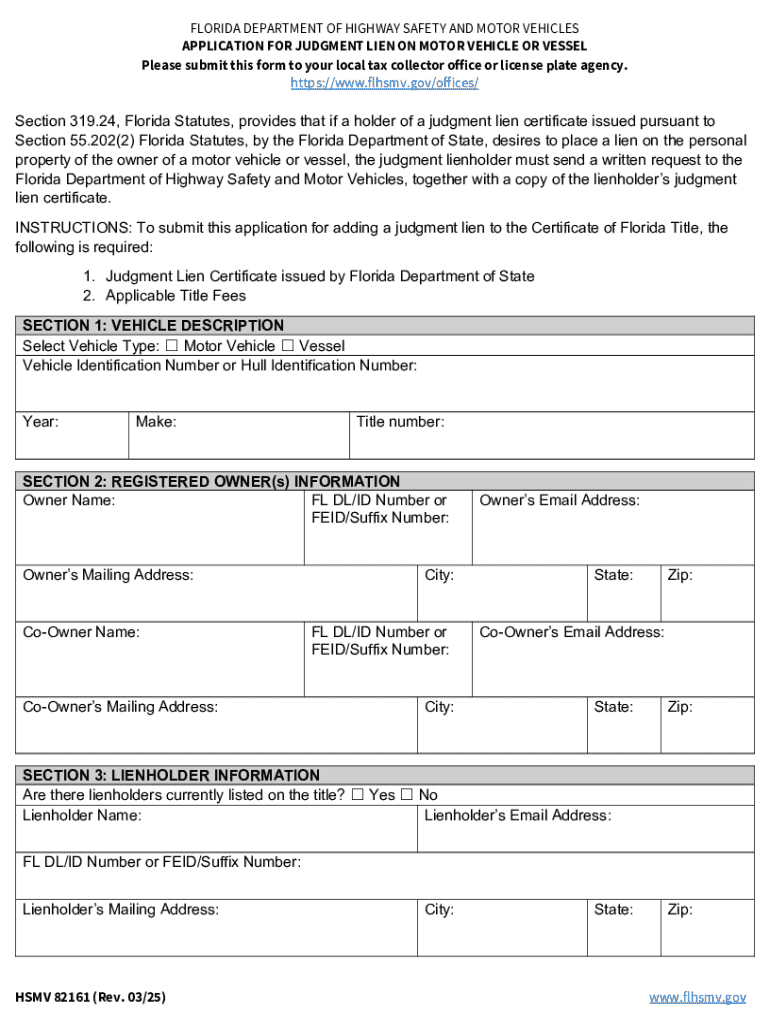







Definition & Meaning
An "Application for Judgment Lien on Motor Vehicle or Vessel" is a legal document used to place a claim on a debtor's motor vehicle or vessel. This claim is a result of a court judgment where the creditor is awarded financial recovery due to an outstanding debt owed by the debtor. The lien ensures that the creditor has a legal right to the vehicle as collateral until the debt is satisfied. Filing this lien can restrict the owner’s ability to sell or transfer the vehicle without settling the debt, adding a layer of security for the creditor.
Steps to Complete the Application for Judgment Lien
-
Obtain the Judgment Lien Certificate: Before completing the application, ensure you have the judgment lien certificate from the court that awarded the judgment. This document formally recognizes the creditor’s right to place a lien.
-
Gather Vehicle or Vessel Information: Collect detailed information about the vehicle or vessel, such as make, model, year, and vehicle identification number (VIN) or hull identification number (HIN).
-
Provide Debtor’s Details: Include accurate details about the debtor, including their full name, address, and contact information. Ensure these details match the court judgment documentation.
-
Complete the Form: Fill in the application form with precise information, ensuring no discrepancies. Include data from the judgment lien certificate and other relevant documents.
-
Attach Required Documents: Attach any necessary supporting documents, such as the original court judgment, identification documents, and the lien certificate, to substantiate the application.
-
Submit the Application: Submit the completed application form, along with all required attachments, to the appropriate state Department of Highway Safety and Motor Vehicles. Check if submission can be done online, by mail, or in person.
Important Terms Related to Judgment Liens
- Creditor: The entity or individual who is owed money by the debtor.
- Debtor: The individual or organization that owes a debt and is subject to the lien.
- Lien: A legal right to keep possession of a property belonging to another person until a debt owed by that person is discharged.
- VIN: Vehicle Identification Number, a unique code used to identify individual motor vehicles.
- HIN: Hull Identification Number, similar to a VIN but used for water vessels.
Legal Use of the Application for Judgment Lien
The application is primarily used within the legal framework to enforce debt recovery through a vehicle or vessel lien. It allows creditors to secure their interests in case of debtor default by making it public records. This process helps in protecting the creditor’s claim against third parties and deters the unauthorized sale or transfer of the asset while a debt is unsettled. The lien remains in effect until the debt is paid in full or legally resolved, and it must be handled in compliance with state-specific regulations and deadlines to be valid.
Key Elements of the Application
- Judgment Information: Details of the court judgment, including court name, judgment date, and the amount awarded.
- Acknowledgement of Lien Rights: A section where the creditor acknowledges their right to impose a lien based on the court judgment.
- Title Fees: Indication of any title fees required for processing the lien, which may vary by state.
- Signature and Notarization: Requires creditor’s signature and possibly notarization to attest to the truthfulness and accuracy of the application.
State-Specific Rules for Application
Each state in the U.S. may have variations in rules governing the filing and enforcement of a judgment lien on vehicles or vessels. For example, the time frame within which a lien must be filed post-judgment, the duration of the lien, and renewal processes can differ significantly. Some states might require additional documentation or have distinct procedures for lien releases once the debt is paid. Always consult local state regulations and legal advice to ensure compliance and appropriateness of the lien application process for your jurisdiction.
Required Documents
- Judgment Lien Certificate: Official documentation from the court recognizing the creditor's right to file the lien.
- Vehicle or Vessel Title: Current title in the debtor's name as proof of ownership.
- Application Form: Completed and signed application form with accurate information.
- Identification: Valid identification of the creditor or authorized representative.
- Notarized Affidavits: If required by state law, to confirm the authenticity of the information provided.
Form Submission Methods
Understanding the accepted methods for submitting the application is crucial for timely processing:
- Online: Some states offer digital submission through official DMV websites, requiring the upload of scanned documents and electronic applications.
- Mail: Submission via postal service, usually requiring physical copies of the application and supporting documents.
- In-Person: Direct submission at the local Department of Highway Safety and Motor Vehicles office allows for immediate processing and verification.
Ensuring adherence to the specified submission method helps prevent delays and potential rejections of the lien application.




