
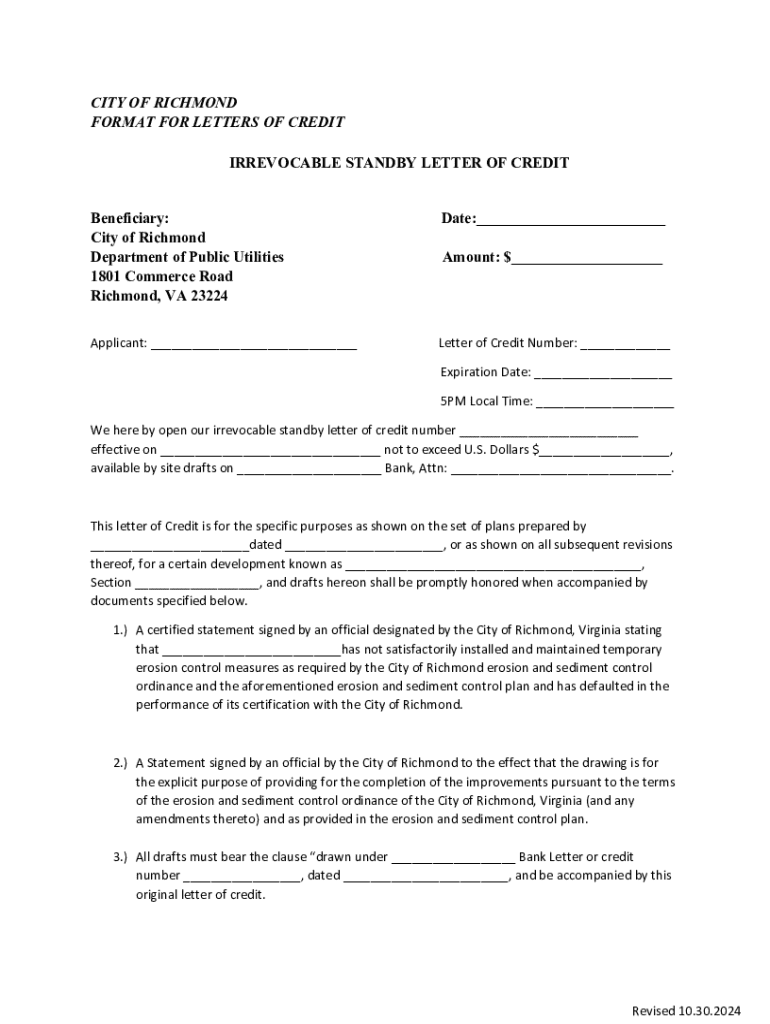







Definition and Meaning of a Letter of Credit Format
A letter of credit is a financial document that guarantees the payment from a bank to a seller, under specified conditions. The format for a letter of credit is structured to clearly outline the terms and conditions agreed upon by the involved parties. It serves as a comprehensive document ensuring that all parties, including the applicant, the beneficiary, and the banking institutions, understand and agree on the financial and operational terms.
A typical letter of credit includes several essential components: the name of the issuing bank, the total amount involved, the expiration date, and the conditions under which the funds can be drawn. It also details the documentation required to trigger payment, such as shipping documents or proof of delivery. This formal arrangement not only facilitates international trade by mitigating risks but also helps in building trust between trading partners by ensuring compliance with the specified terms.
How to Use the Format for Letters of Credit
Using the format for letters of credit effectively requires a thorough understanding of its key components and how they apply to your specific transaction. Begin by consulting the issuing bank to obtain the standard format and procedures. Next, carefully review the format to ensure it aligns with your trading needs and contractual obligations.
When filling out the format, ensure that all details such as the beneficiary’s information, the transaction amount, and the precise conditions for drawing funds are accurately recorded. It’s important to coordinate with the trading partner to avoid discrepancies that could delay payment processing. Consider consulting with financial or legal advisors who are experienced in handling letters of credit to avoid common pitfalls and ensure all relevant clauses are included for adequate protection.
Steps to Complete the Format for Letters of Credit
-
Initial Consultation: Begin by discussing the need for a letter of credit with your bank and trading partner.
-
Gather Information: Collect all necessary details including the beneficiary's information, transaction specifications, and required documentation.
-
Draft the Document: Using the bank’s template, draft the letter of credit ensuring accurate details are inserted.
-
Review by All Parties: Present the draft to your trading partner and the issuing bank for review and confirmation.
-
Finalize and Issue: Upon agreement, finalize the document and have the bank issue the official letter of credit.
-
Fulfillment of Conditions: The beneficiary must submit the required documents as per the letter of credit’s terms to request payment from the issuing bank.
Key Elements of the Format for Letters of Credit
- Issuing Bank Details: The name and address of the bank providing the letter of credit.
- Total Amount and Currency: Clearly states the financial limit and currency involved in the transaction.
- Expiration Date: Specifies when the letter of credit is no longer valid.
- Beneficiary Details: Including complete name and contact information of the party entitled to claim the funds.
- Conditions of Payment: Detailed conditions under which funds can be accessed, such as specific documentation or proof of goods.
- Confirmation Clause: Indicates whether a second bank will confirm the letter of credit, adding another layer of security.
Who Typically Uses the Format for Letters of Credit
The format for letters of credit is primarily used by businesses engaged in international trade. This includes importers who seek to assure exporters of their likelihood of getting paid. It is also leveraged by exporters who need to mitigate risks associated with cross-border transactions. Additionally, project managers working within large construction contracts might use letters of credit to secure milestone payments. Financial institutions and banks frequently facilitate these documents as part of their trade finance services.


Legal Use of the Format for Letters of Credit
In the United States, the legal framework for letters of credit is grounded in the Uniform Commercial Code (UCC), specifically Article 5. This law provides guidance on how letters of credit are to be interpreted and enforced. Under the UCC, letters of credit are recognized as legally binding documents that outline clear obligations and rights for the parties involved.
To ensure the letter of credit is legally enforceable, all parties should carefully follow UCC guidelines and consult legal expertise if unfamiliar with these regulations. It is also essential that any letter of credit used in international transactions complies with the International Chamber of Commerce's Uniform Customs and Practice for Documentary Credits (UCP 600).
Examples of Using the Format for Letters of Credit
Consider a company based in New York seeking to import textiles from a supplier in India. To assure the Indian supplier of payment, the New York company requests a letter of credit from its bank, which guarantees payment upon fulfillment of specified shipment conditions. The standard format would require the Indian supplier to provide specific shipping documents, such as a bill of lading, before funds are released.
In another scenario, a construction firm working on an infrastructure project in Mexico might use a letter of credit to guarantee payment as project milestones are completed. By agreeing on the terms in advance, both the Mexican client and the U.S. construction firm reduce financial risks associated with large-scale, cross-border projects.
Important Terms Related to the Format for Letters of Credit
- Applicant: The party who requests the letter of credit from their bank (usually the buyer in the transaction).
- Beneficiary: The party that receives payment under the letter of credit (usually the seller or exporter).
- Issuing Bank: The bank that provides the letter of credit.
- Advising Bank: A bank that helps facilitate communication between the issuing bank and the beneficiary.
- Draft: A document drawn by the beneficiary demanding payment under the terms of the letter of credit.
- Bill of Lading: A document issued by a carrier detailing the shipment of goods and acknowledging their receipt.
State-Specific Rules for the Format for Letters of Credit
While the format for letters of credit is standard, certain state-specific variations may apply. For instance, certain states could potentially have additional regulatory requirements or differences in how local banking laws interact with UCC Article 5.
Businesses operating within different states should familiarize themselves with local banking laws and consider consulting with a state-specific trade attorney. This ensures compliance with any additional regulatory requirements and aligns the letter of credit with regional business practices.




