
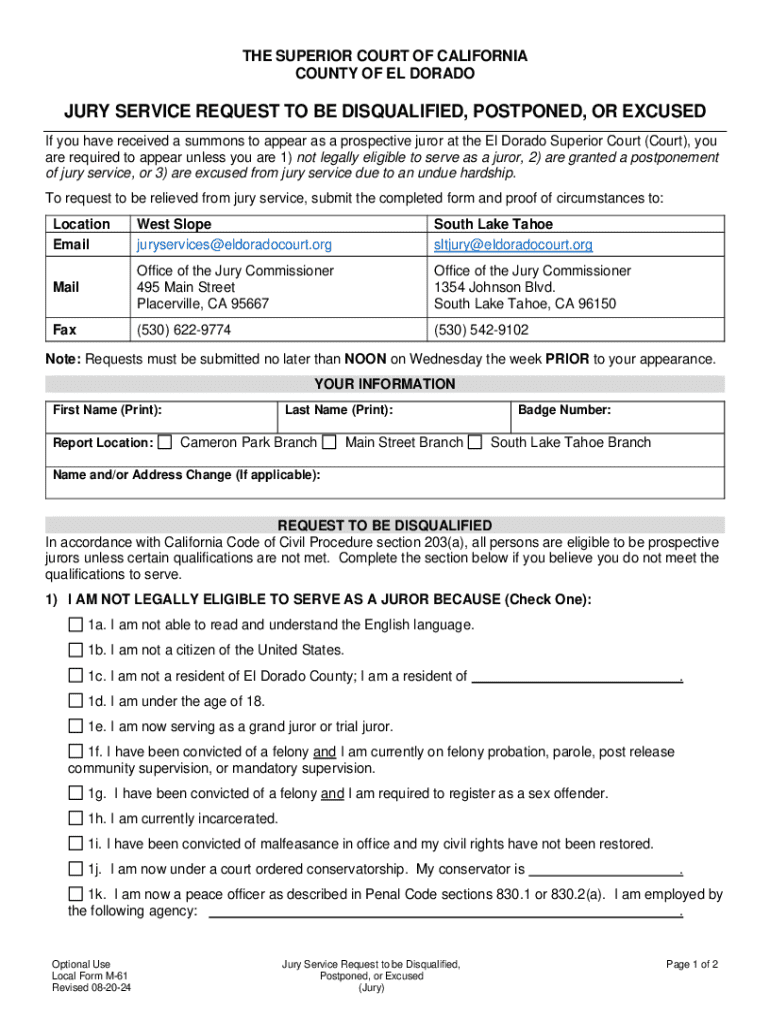







Definition and Meaning
The "Jury Service Request to Be Disqualified, Postponed, or Excused" form is a legal document used by individuals summoned for jury duty to formally request a change in their obligation. This form allows prospective jurors to either be disqualified from serving, seek a postponement of their jury service date, or be excused entirely based on specific criteria.
Key Purposes
- Disqualification: Individuals who do not meet eligibility requirements, such as age or citizenship, can request disqualification.
- Postponement: Allows jurors to delay their service to a later date due to valid reasons, such as scheduling conflicts.
- Excusal: For cases where fulfilling jury duty would cause undue hardship or affect their personal circumstances, individuals can seek an excusal.
How to Obtain the Jury Service Request Form
Obtaining the form is a straightforward process essential for those needing to modify their jury duty commitments.
Methods to Acquire the Form
- Online Download: Most court websites provide downloadable versions of the form, compatible with PDF readers.
- Court Offices: Physical copies can be collected from the court offices where the summons was issued.
- Mail Request: Some jurisdictions offer to mail forms upon receiving a request, which typically involves contacting the court's jury administration office.
Steps to Complete the Jury Service Request Form
Completing the form accurately is crucial to ensure your application is processed without delay.
Detailed Process
- Read Instructions: Carefully review all instructions provided with the form to understand the requirements for your situation.
- Provide Personal Information: Fill in details such as your name, address, and contact information.
- State Your Reason: Clearly describe the reason for your request—whether disqualification, postponement, or excusal. Attach supporting documents if required.
- Sign and Date: Ensure that the form is signed and dated as an unsigned form may be rejected.
Eligibility Criteria
Understanding the eligibility criteria is vital for successfully navigating the disqualification, postponement, or excusal process.

Common Criteria
- Disqualification: Non-citizens, individuals under the age of 18, or those with recent felony convictions typically qualify for disqualification.
- Postponement: Acceptable reasons include medical appointments, pre-planned travel, or work-related commitments.
- Excusal: Grounds for excusal often include severe medical conditions, being a primary caregiver, or experiencing extreme financial hardship.
Required Documents
Submitting the correct documentation alongside your form can significantly impact the decision-making process.
Examples of Required Proof
- Medical Reasons: Provide a physician's note detailing your condition and its impact on your ability to serve.
- Employment Conflicts: A letter from your employer explaining why postponement or excusal is necessary.
- Financial Hardship: Documentation, such as bank statements, that demonstrates your financial situation.
Form Submission Methods
The completed form must be submitted accurately to ensure consideration.
Available Submission Methods
- Online: Many courts offer electronic submission through their websites, which is often the most efficient method.
- Mail: Forms can be mailed to the specified court address included on the jury summons.
- In-Person: Submit the form directly to the court office, where staff can provide immediate confirmation of receipt.
Legal Use of the Jury Service Request Form
Understanding the legal implications of using this form is vital for all parties involved.
Responsibilities and Impacts
- Accuracy: Providing false information can result in legal consequences, including fines or additional legal action.
- Timeliness: Submit the form well before your scheduled jury date to allow for processing time and possible appeals if necessary.
State-Specific Rules
Jury service laws and form procedures can vary significantly by state.
Considerations for State Variances
- Different Criteria: States may have varying requirements for disqualification, postponement, or excusal based on local laws.
- Application Deadlines: Deadlines for submission can differ, so it's essential to consult local court guidelines.
- Jurisdictional Procedures: Some states may require additional steps, such as appearing in court, to validate a request.




