
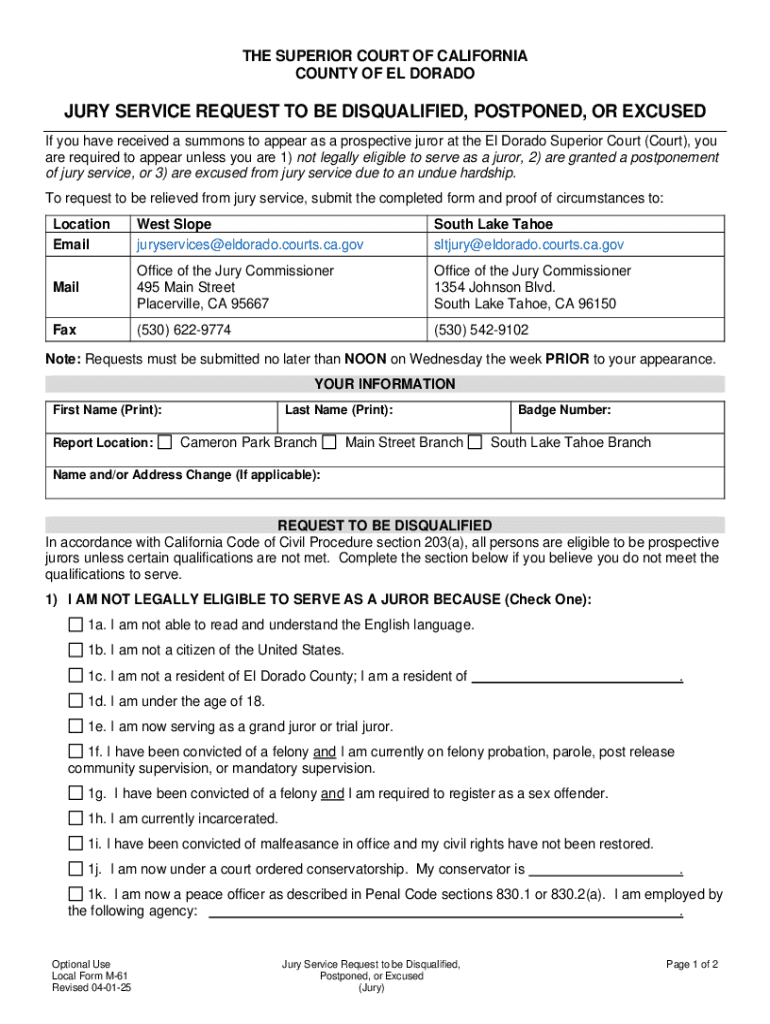







Definition and Purpose of the Jury Service Request Form
The "Jury Service Request to Be Disqualified, Postponed, or Excused" form serves as an official document utilized by individuals summoned for jury duty who seek exemption or deferment. This form is primarily used to communicate with the court to justify reasons for not participating in jury service. Whether it is due to legal ineligibility, severe scheduling conflicts, or experiencing undue hardship, the form provides a structured way to present one's case. The document ensures that the court receives comprehensive information to review the legitimacy of the request.
How to Use the Jury Service Request Form
To effectively use the "Jury Service Request to Be Disqualified, Postponed, or Excused" form, follow these detailed steps to ensure completed submission:
-
Determine Eligibility: Before completing the form, verify that your reasons for requesting disqualification, postponement, or excusal are valid under court guidelines. Typical grounds include experiencing severe personal hardship or having a legal conflict with jury service.
-
Complete Personal Information: Enter your full name, contact details, and any reference number associated with your jury summons at the top of the form to ensure proper identification.
-
Select Applicable Options: Indicate whether you seek disqualification, postponement, or excusal. Provide specific reasons under the guided sections of the form, ensuring all explanations align with the guidelines provided by the court.
-
Attach Supporting Documents: If required, include documentation that substantiates your claim, such as a medical certificate, academic schedule, or employment proof. This adds credibility to your request.
-
Submission: Submit the completed form and supporting documents either online, via mail, or in person to the appropriate court office as instructed in the official summons.
Steps to Complete the Jury Service Request Form
Here is a detailed, step-by-step guide to completing the "Jury Service Request to Be Disqualified, Postponed, or Excused" form:
-
Fill in Contact Details: Start by clearly listing your current contact information, which allows the court to update you regarding the status of your request.
-
Reason Selection: Check the appropriate box to indicate whether you are requesting a disqualification, postponement, or excusal from jury service.
-
Detailed Justification: Provide a thorough explanation of your situation. Use the form's allocated space to detail the reasons leading to your request, focusing on clarity and relevance to ensure your case is understood.
-
Include Documentation: Attach any necessary documentation to support your claim. Ensure these documents are copies and not originals, and clearly label them for easy reference by the court.
-
Review and Proofread: Double-check your entries to avoid errors or omissions. A well-prepared and thoroughly checked form indicates seriousness and credibility.
-
Send Note of Submission: After submission, keep a note or receipt of when and how you submitted the form for your records.
Eligibility Criteria for Jury Service Requests
Outlined below are the key eligibility criteria and typical conditions under which a "Jury Service Request to Be Disqualified, Postponed, or Excused" may be filed:
-
Legal Ineligibility: Situations where the individual does not meet the legal requirements to serve as a juror, such as age limitations or citizenship status.
-
Medical Conditions: Severe medical or health conditions that make participating in jury duty untenable, often requiring a doctor's note stating the incapacity.
-
Extreme Hardship: Circumstances that cause significant personal or financial loss if required to serve, such as critical family obligations or sole caregiving responsibilities.
-
Scheduling Conflicts: Pre-existing commitments, such as academic classes or previously scheduled travel, that cannot be rescheduled without considerable burden.


Legal Use and Implications
Understanding the legal parameters around the "Jury Service Request to Be Disqualified, Postponed, or Excused" form ensures compliance:
-
Authorization: Only courts and authorized judicial bodies provide and process these forms. Requests must adhere to court regulations and relevant state laws.
-
Valid Grounds for Disqualification: Recognized legal reasons must be explicitly stated, adequately supported by evidence, and align with the judicial standards for exemption.
-
Consequences of Misinformation: Submitting false or misleading information on a request form can result in penalties, including fines or mandatory jury service without favorable scheduling.
Case Examples and Practical Scenarios
Numerous scenarios exemplify the appropriate use of the "Jury Service Request to Be Disqualified, Postponed, or Excused" form:
-
Medical Emergency: A summoned individual experiences an unexpected medical emergency. Providing a doctor's note verifying the condition can justify an excusal or postponed service.
-
Educational Obligation: A full-time student with class commitments during the jury service period may request postponement, supported by an enrollment letter indicating attendance requirements.
-
Primary Caregiver: Acting as the main caregiver to dependents without alternative support could justify an excusal.
Possible State-Specific Variations
Courts across different states may have unique provisions or requirements related to jury service requests:
-
California: Specific criteria such as transportation issues or linguistic limitations may be considered valid grounds.
-
New York: Emphasis on occupational necessity may warrant postponement when properly documented.
-
Texas: Military duties have recognized precedence for excusal or deferral.
Required Documentation for Submission
Ensuring all necessary documentation accompanies your Jury Service Request form will facilitate the court's decision process:
-
Medical Certificates: Outlining treatment parameters and limitations.
-
Employment Letters: From employers detailing work-related conflicts or financial implications.
-
Academic Verification: Indicating conflicting schedules with signed confirmation from an institution’s office.
By closely adhering to these structured guidelines and integrating comprehensive explanations, individuals submitting a "Jury Service Request to Be Disqualified, Postponed, or Excused" form can effectively communicate their case to the court system, ensuring a fair and expedited review process.




