







Definition & Meaning
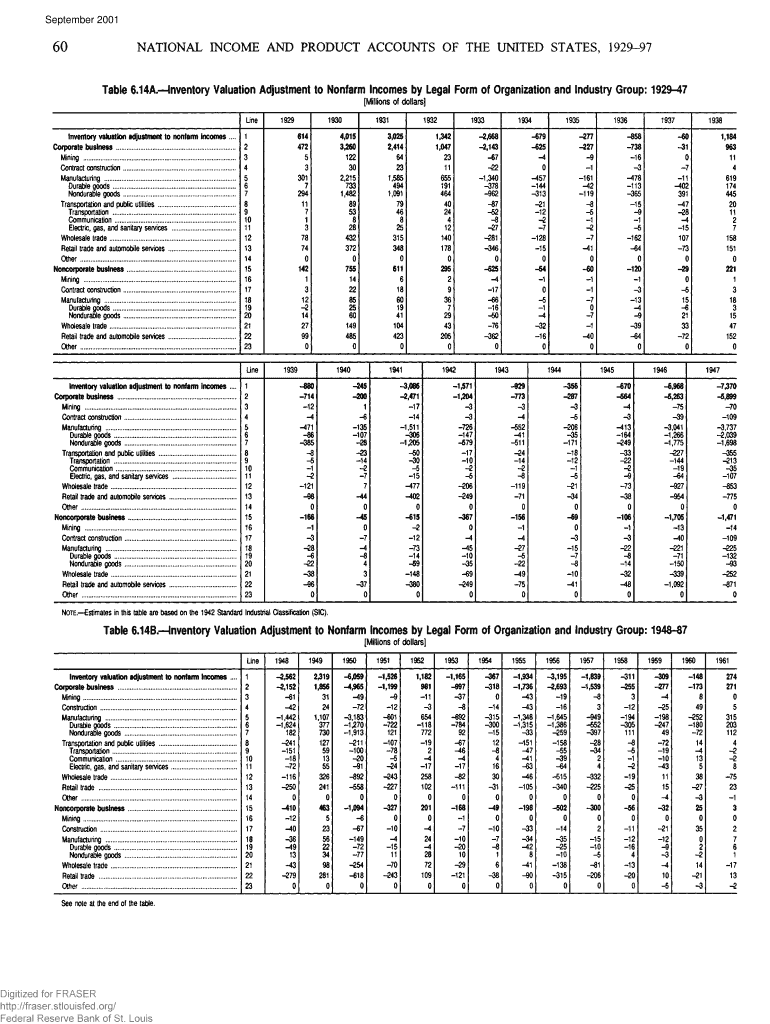
The "Inventory Valuation Adjustment to Nonfarm Incomes by Legal Form - fraser stlouisfed" refers to financial data adjustments made to align inventory valuations with nonfarm incomes in the United States, cataloged by the Federal Reserve Bank of St. Louis. These adjustments are organized according to the legal form of the business, such as corporations, partnerships, or sole proprietorships. The process addresses the fluctuations in inventory values over time, ensuring that nonfarm business incomes are accurately reported to reflect external economic conditions, market changes, or physical changes such as spoilage or obsolescence.
Key Components
- Inventory Valuation: Measures changes in value of inventory that impacts business income.
- Nonfarm Incomes: Earnings derived from sectors outside of agriculture.
- Legal Form Classification: Organizing financial data by the structure of the business entity.
How to Use the Inventory Valuation Adjustment Data
This data provides valuable insights into historical trends and economic conditions impacting businesses. Individuals and businesses utilize it for economic forecasting, policy-making, or financial analysis. The Inventory Valuation Adjustment data supports research that requires detailed understanding of business income over time and helps identify economic shifts.
Usage Contexts
- Economic Research: Analysts and economists use the data for forecasting market conditions and analyzing business cycles.
- Business Strategy: Companies can leverage insights to strategize inventory management and pricing.
How to Obtain the Data
The data on Inventory Valuation Adjustment can be accessed through the Federal Reserve Economic Data (FRED) platform, maintained by the Federal Reserve Bank of St. Louis. Users can download historical sets, view visualizations, and explore related economic indicators.
Access Steps
- Go to the FRED website.
- Search for "Inventory Valuation Adjustment".
- Select desired data subsets for download.
Steps to Complete an Inventory Valuation Adjustment Analysis
Conducting an analysis involves a clear understanding of financial principles and historical data interpretation. The process requires calculating inventory value changes and identifying their impact on reported incomes.
Step-by-Step Guide
- Gather Baseline Data: Assemble historical inventory data and corresponding income records.
- Calculate Adjustments: Identify discrepancies caused by price changes or market trends.
- Apply Adjustments: Modify income statements to reflect corrected inventory valuations.
- Interpret Findings: Analyze adjusted data for economic insights or business strategy formulation.
Who Typically Uses This Data?
Various stakeholders find Inventory Valuation Adjustment data critical, from economists and policymakers to business advisors and accountants.
Common Users
- Economists: For understanding market dynamics.
- Business Owners: For financial planning and inventory management.
- Tax Professionals: To accurately assess taxable income.


Important Terms Related to Inventory Valuation Adjustment
Familiarity with specific terms is crucial for understanding and utilizing the data effectively.
Key Terms
- FIFO (First In, First Out): Accounting method for valuing inventory costs.
- LIFO (Last In, First Out): Method that affects inventory accounting and tax liabilities.
Legal Use of Inventory Valuation Data
The data can also inform legal and compliance frameworks for businesses regarding financial reporting and tax obligations.
Compliance Applications
- Financial Reporting: Ensures accuracy in corporate financial statements.
- Taxation: Adjusts taxable income to reflect accurate inventory valuations.
Software Compatibility
The use of software tools is essential for efficiently analyzing Inventory Valuation Adjustment data. Compatibility with financial software enhances data manipulation and reporting.
Supported Software
- Excel: For data manipulation and analysis.
- QuickBooks: For integrating adjustments into accounting workflows.
- SAP: Enterprise solutions for large-scale data management.
By understanding and applying these components, individuals and organizations can effectively leverage Inventory Valuation Adjustment data for financial, strategic, and compliance-related activities.




