






Definition & Meaning
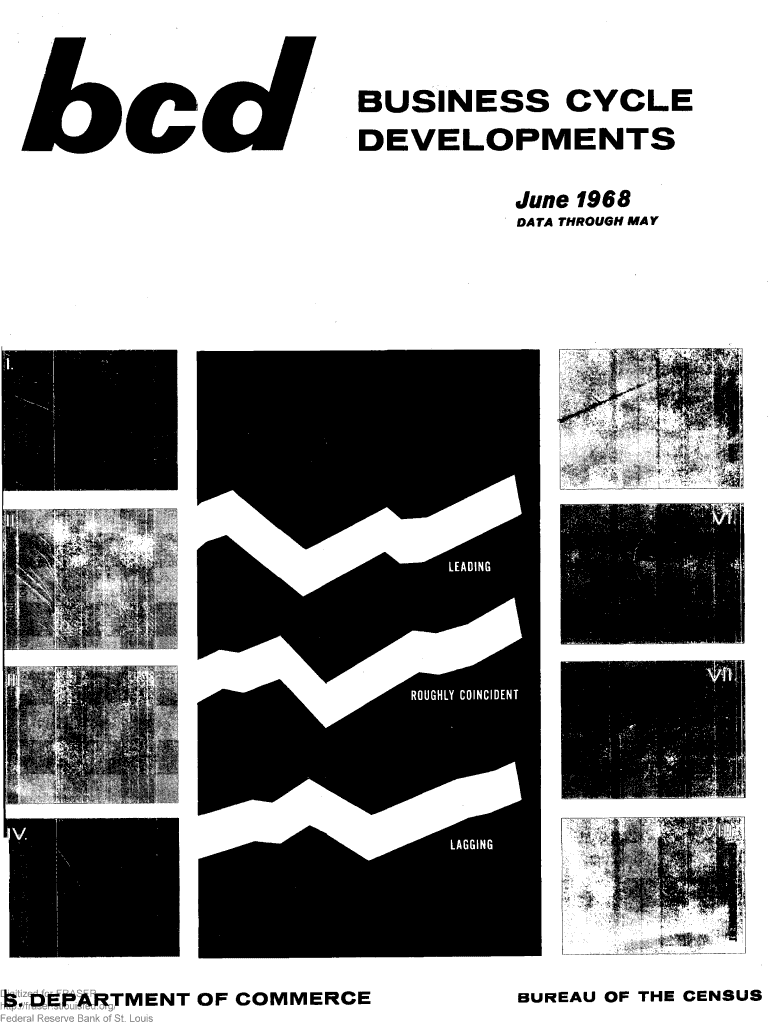
The June 1968 report from the Fraser collection at the Federal Reserve Bank of St. Louis is a comprehensive economic document that presents key indicators related to U.S. business cycles. Compiled by the U.S. Department of Commerce's Bureau of the Census, this report includes leading, coincident, and lagging indicators. It also provides valuable insights into economic factors such as employment, production, income, consumption, trade, and prices. These factors are further analyzed with seasonal adjustments and historical comparisons, making the report a crucial resource for understanding the economic climate of the time.
Key Elements of the June 1968 - Fraser - Federal Reserve Bank of St Louis
The report features several main components that make it an essential source for economic analysis:
- Economic Indicators: Detailed reviews of leading, coincident, and lagging indicators that show the various phases of the business cycle.
- Employment and Production Data: Offers insights into the labor market and industrial output, highlighting trends in these critical areas.
- Income and Consumption Patterns: Explores how household incomes and spending habits affect broader economic trends.
- Trade and Price Analysis: Provides data on both domestic and international trade, along with price movement analysis to understand inflation trends.
- Historical Comparisons: Includes appendices with data from 1854 to 1961, offering a long-term perspective on cycles.
Steps to Complete the June 1968 - Fraser - Federal Reserve Bank of St Louis
Completing or utilizing the information in this report involves several steps:
- Access the Document: Obtain a copy from the Federal Reserve Bank of St. Louis or through educational libraries and databases.
- Understand the Indicators: Familiarize yourself with the different types of economic indicators and their implications.
- Analyze the Data: Use the report’s data to form a comprehensive view of the economic environment during June 1968.
- Draw Comparisons: Compare historical data with current trends to identify patterns or shifts in economic behaviors.
- Apply Findings: Use the insights gained for academic research, policy-making, or business strategy development.
Who Typically Uses the June 1968 - Fraser - Federal Reserve Bank of St Louis
Various individuals and organizations find the June 1968 report highly beneficial:
- Economists and Researchers: Use it for historical economic analysis and academic research.
- Policy Makers: Utilize the data to understand past economic trends, informing present-day policy decisions.
- Business Analysts: Analyze the report to understand historical business cycles and market trends for strategic planning.
- Educators and Students: Integrate the report into curricula as a case study of economic analysis during the late 20th century.


Legal Use of the June 1968 - Fraser - Federal Reserve Bank of St Louis
The report, as a public document, is legal to use for research, education, and analysis:
- Archival Access: The Federal Reserve Bank of St. Louis makes this report available for public consumption under fair use.
- Public Record: It serves as a historical document, allowing wide-ranging use for analysis and educational purposes while respecting copyright laws and proper citation practices.
Important Terms Related to June 1968 - Fraser - Federal Reserve Bank of St Louis
Familiarity with these terms enhances understanding:
- Business Cycle: A cycle of economic expansion and contraction.
- Economic Indicators: Statistics about economic activities that help assess the current and future performance of an economy.
- Lagging Indicators: Metrics that change after the economy as a whole changes, indicating trends.
- Seasonal Adjustments: Modifications made to economic data to account for expected seasonal changes.
Examples of Using the June 1968 - Fraser - Federal Reserve Bank of St Louis
The report is applied in various scenarios:
- Academic Studies: Distribution of data in educational research papers to illustrate historical trends.
- Economic Forecasting: Utilization by analysts to compare past and present economic conditions to predict future economic activities.
- Historical Analysis: Provides context for studying the U.S. economy’s response to national and international events in the 1960s.
Who Issues the Form
The June 1968 document was issued by the Bureau of the Census as part of the U.S. Department of Commerce's efforts in collaboration with the Federal Reserve Bank of St. Louis. This partnership highlights the document's credibility and significance in understanding economic conditions.