






Definition and Meaning
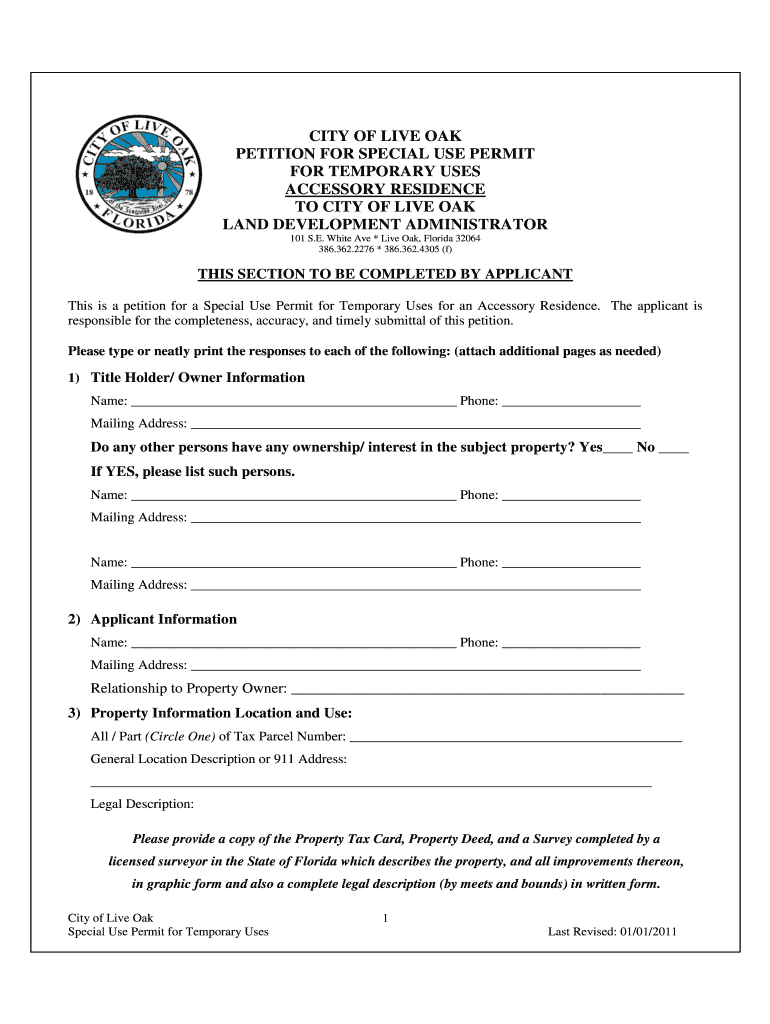
A Petition for Special Use Permit for Temporary Uses is a legal application allowing the temporary establishment of uses not typically permitted in a specific zoning district. In Live Oak, Florida, this often involves placing an accessory residence, such as a mobile home, on a property for a set duration. Temporary uses are essential for accommodating unique residential or business needs that do not conform to established zoning regulations. This permit is valid for five years, requiring reapplication upon expiration if the temporary use is to continue.
Steps to Complete the Petition for Special Use Permit for Temporary Uses
Completing the petition involves several specific steps:
-
Gather Required Documentation: Collect documents verifying the property owner’s consent and the applicant's intent. This could include property deeds, site plans, and written descriptions of the intended temporary use.
-
Consult Local Regulations: Review zoning codes and any amendments specific to Live Oak, Florida, to ensure compliance with local requirements.
-
Complete the Application Form: Accurately fill out the required information, highlighting the purpose, duration, and nature of the temporary use.
-
Submit the Application: Depending on local regulations, submit the completed application form and supporting documents to the appropriate municipal zoning office.
-
Attend a Public Hearing: Prepare to present and justify the request at a required public hearing where community feedback will be solicited.
-
Receive Decision: Once reviewed, you will receive notification of the permit's approval or denial, along with any conditions attached to the temporary use.
Key Elements of the Petition for Special Use Permit for Temporary Uses
A thorough petition typically includes several crucial components:
- Purpose of Use: Clearly define why the temporary use is necessary.
- Description of Structures: Detail the size, type, and nature of the accessory residence or any other structures involved.
- Compliance Plan: Outline plans for adhering to local safety, zoning, and environmental regulations.
- Duration of Use: Specify the intended start and end dates for the temporary use.
- Property Information: Include specifics like the property address, size, and current use.
Legal Use of the Petition for Special Use Permit for Temporary Uses
The legal framework surrounding the permit centers on zoning regulations, ensuring the application aligns with municipal codes. Compliance with the ESIGN Act for document handling is crucial, especially for electronic submissions. Additionally, adherence to public hearing procedures guarantees the applicant's compliance with due process requirements before receiving approval.
Required Documents
The submission requires a precise set of documents, including:
- Zoning Maps: Indicating current zoning category and adjacent land uses.
- Site Plans: Providing a detailed layout of the proposed temporary use.
- Property Title: Confirming ownership and property boundaries.
- Public Notices: Documentation of public notice given to neighbors.
- Municipal Approvals: Letters of support from relevant departments.
Thoroughly compiling these documents ensures transparency and aligns the process with legal standards.
Who Typically Uses the Petition for Special Use Permit for Temporary Uses
This petition is most commonly utilized by:
- Property Owners: Seeking to add temporary structures for residential purposes.
- Businesses: Requiring temporary operational setups that are not typically permissible under standard zoning laws.
- Developers: Engaged in phased projects where temporary occupancy might be needed.
- Local Residents: Addressing personal or familial housing needs with mobile homes or other temporary dwellings.
These users must all be cognizant of the specific requirements and conditions each temporary use brings under local codes.

State-Specific Rules for the Petition for Special Use Permit for Temporary Uses
In Florida, state and local zoning laws govern the permit process. Notably, in Live Oak, there might be additional requirements, such as:
- Environmental Impact Consideration: Evaluating the temporary use’s effect on local ecosystems.
- Community Meeting Attendance: Possible mandatory participation in local meetings for community feedback.
- Insurance Requirements: Verification of liability insurance covering the temporary use.
Familiarity with these state-specific regulations helps ensure a smoother application process.
Form Submission Methods
Options for submitting the petition are generally varied:
- Online: Most efficient and recommended for quicker processing and verification.
- Mail: Traditional method, offering a paper trail but potentially slower response times.
- In-Person: Direct submission at zoning offices, allowing for immediate feedback and clarification of any potential issues.
Choosing the appropriate submission method can impact the overall application timeline and any potential follow-ups needed by local officials.