






Definition & Meaning
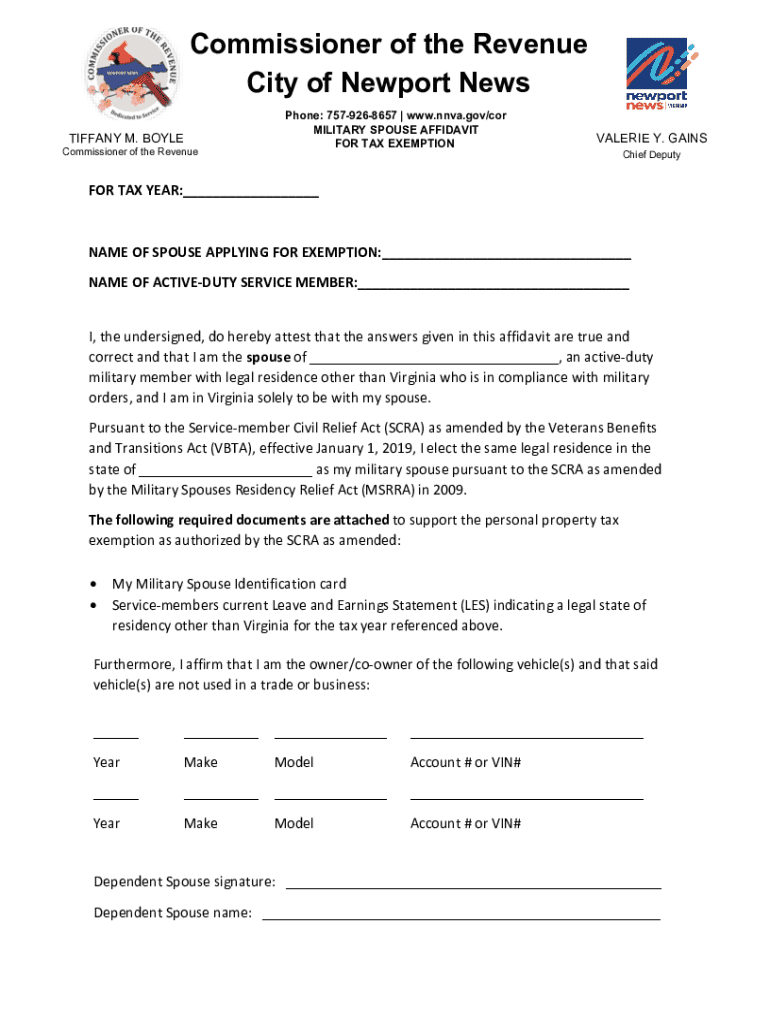
The Military Spouse Residency Affidavit for Tax Exemption is a document that allows military spouses to benefit from a tax exemption on personal property, based on their active-duty spouse's legal residence being outside of the state where they reside temporarily. This affidavit certifies the spouse's claim to such exemption and requires specific information to validate their residency status and eligibility for the said exemption.
- Personal Property Tax Exemption: This refers to the waiver from paying taxes on personal property, such as vehicles, that are typically required for residents.
- Active-Duty Spouse: The military member whose legal residence determines the tax benefit for their spouse.
Eligibility Criteria
To utilize the Military Spouse Residency Affidavit for Tax Exemption, specific eligibility conditions must be met:
- Active-Duty Status: The service member must be on active duty, which grants their spouse the right to tax exemptions based on residency rules.
- Residency Proof: The military spouse must provide evidence linking them to the active-duty member's legal state of residence, which often involves documentation like a Military Spouse ID card and Leave and Earnings Statement (LES).
- Legal Residence: The active-duty member's legal residence must be in a state different from where the spouse currently resides.


Steps to Complete the Form: Military Spouse Residency Affidavit for Tax Exemption
Completing the affidavit is a structured process that requires accuracy:
-
Gather Necessary Documentation
- Obtain the Military Spouse ID and LES of the active-duty member.
- Collect any additional proof necessary to demonstrate legal residency and connection to the service member.
-
Fill Out Personal Information
- Complete sections requiring the spouse's name, current address, and other personal identifiers.
-
Affirm Residency Status
- The form will require you to attest to the residency in the state associated with the active-duty spouse.
-
Submit Supporting Documents
- Attach all required documents to the form to prove residency and eligibility.
-
Finalize the Affidavit
- Review all entries for accuracy before signing the form, ensuring all information is complete.
-
Submit the Form
- Submit the completed document using prescribed methods such as mail, online, or in-person at designated offices.
Required Documents
The process of claiming the tax exemption necessitates specific documents:
- Military Spouse ID Card: Essential for verifying the marriage connection to the active-duty member.
- Leave and Earnings Statement (LES): Provides proof of the service member's legal state of residency.
- Proof of Residence: Any additional documentation that states the spouse's connection to the military member's residency claim.
State-Specific Rules for the Form
While the general guidelines apply nationwide, states can have unique rules regarding the Military Spouse Residency Affidavit:
- Virginia, for Example: Allows for personal property tax exemption in cases where the service member's legal residence is elsewhere.
- Additional Requirements: Some states might require further identification or documentation to verify claims.
Form Submission Methods (Online / Mail / In-Person)
Submitting the affidavit can be done through various channels, depending on the jurisdiction:
- Online Submissions: Many states allow uploads of scanned documents through dedicated portals.
- Mail: Hard copies can be mailed to designated tax offices or military financial aid centers.
- In-Person: Direct submission might be necessary for validating documents or receiving immediate confirmation.
Penalties for Non-Compliance
Failure to accurately complete or submit the affidavit within guidelines can lead to penalties:
- Denial of Tax Exemption: Incomplete forms or missing documentation can result in the loss of eligibility for the tax relief.
- Fines: False claims or errors can attract financial penalties imposed by state tax authorities.
- Legal Repercussions: Intentional fraudulent claims may result in severe legal consequences.
Legal Use of the Form: Military Spouse Residency Affidavit for Tax Exemption
The affidavit serves several critical legal functions within the military community:
- Legal Proof of Residency: Affirms the military spouse's legal home for tax purposes, which is significant when stationed at temporary locations.
- Tax Benefits: Enables spouses to enjoy financial reliefs tied to property and income taxes without changing legal residency.
Application Process & Approval Time
The process of applying for the affidavit is typically straightforward, although timeframes can vary:
- Processing Duration: States aim to process affidavits within weeks, yet this varies based on document completeness and clarity.
- Approval Notification: Applicants receive official communication confirming eligibility status and application success once processed.
Digital vs. Paper Version
Choosing between digital and paper submissions depends on personal and institutional preferences:
- Digital Efficiency: Online submissions afford rapid confirmation and processing but require secure electronic copies of all documents.
- Paper Reliability: Physical submissions embody a traditional approach appreciated for its tangibility, though potentially slower.
Examples of Using the Form: Military Spouse Residency Affidavit for Tax Exemption
Real-world scenarios illustrate the importance of utilizing the affidavit:
- Stationed in Virginia, Legal Residence in Florida: A spouse whose soldier's legal residence is Florida can benefit from Virginia's property tax exemptions on their vehicles.
- Joint Filing with Active-Duty Member: When filing taxes, the exemption claimed through this affidavit can provide substantial savings jointly.
Key Elements of the Form
Several essential components contribute to the comprehensive nature of the affidavit:
- Personal Information Section: Fundamental for identity confirmation.
- Residency Declaration: Critical for asserting the tax exemption.
- Signature and Date: Validates data accuracy and acknowledges legal obligations under false claim laws.
Who Typically Uses the Form: Military Spouse Residency Affidavit for Tax Exemption
Predominant users of the affidavit include:
- Military Spouses: Particularly those residing temporarily in states differing from their spouse's legal residence.
- Tax Advisors: Assisting clients in navigating cross-state tax complexities.
- Military Personnel: Often guiding their families through residency documentation.