







Definition and Purpose
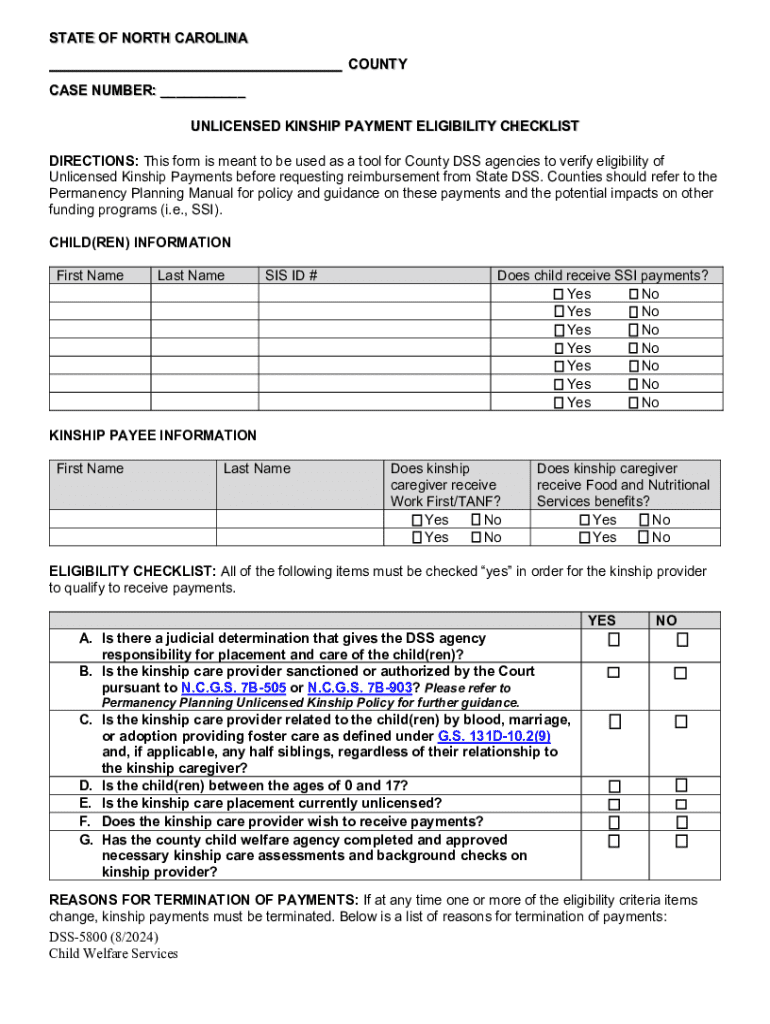
The NC Approves Payments to Unlicensed Kin Providing Foster is a specialized document intended for use by County Department of Social Services (DSS) agencies in North Carolina. The document serves as a tool to determine eligibility for kinship caregivers who are unlicensed but are seeking to receive payments for providing foster care. It aims to streamline the approval process by collecting necessary information regarding the caregiver’s relationship with the child, requisite judicial determinations, and any required assessments or evaluations.
Steps to Complete the Eligibility Checklist
-
Confirm Relationship: Verify the kinship relationship between the caregiver and the child. This may include documenting familial connections and ensuring that the caregiver is a relative as defined by state laws.
-
Judicial Determination: Ensure a judicial determination has been made, establishing the responsibility of care with the unlicensed kin. This step is crucial as it legitimizes the caregiver's role.
-
Complete Assessments: Conduct or confirm completion of required assessments, such as home studies or background checks, to ensure that the caregiver’s home environment meets safety standards.
-
Verify Eligibility Criteria: Go through each eligibility criterion listed in the form, and validate that the caregiver satisfies all requirements. Use supporting documents where necessary.
-
Document Submission: Compile all completed sections and requisite documents for submission to the State DSS for approval.
Eligibility Criteria
To qualify for payments, the unlicensed kinship caregiver must meet several criteria:
- Kinship Relation: The caregiver must have a defined and documented kinship with the child.
- Judicial Endorsement: There must be a legal endorsement designating the caregiver's responsibility for the child.
- Home Environment: The home must pass safety and welfare standards set by the state.
- Financial Need: Demonstration of financial necessity may be required, depending on specific county rules.

Key Elements of the Form
- Personal Information: Details about the child and the caregiver, including names, addresses, and relationships.
- Judicial Documents: Copies of court orders or judicial determinations confirming the caregiver’s responsibility.
- Assessment Reports: Any home study or assessment paperwork detailing the caregiver’s suitability.
- Reason for Unlicensed Status: Explanation regarding why the caregiver is unlicensed, which may include barriers such as insufficient resources for licensing.
Legal Considerations
The completion of the NC Approves Payments to Unlicensed Kin Providing Foster checklist must adhere to state-specific legal requirements. These may include confidentiality obligations, accurate reporting of kinship status, and submission of truthful and complete information. Any falsification can lead to penalties, including forfeiture of payments.
Important Terms and Definitions
- Kinship Caregiver: An individual related by blood, marriage, or adoption, who has taken on the responsibility for the care of a child.
- Judicial Determination: A decision made by a court regarding who is responsible for the care and welfare of a child.
- Assessment: An evaluation process to determine the suitability of the caregiver and their home environment.
State-Specific Rules
North Carolina has distinct rules governing the payment processes for unlicensed kinship caregivers. County DSS agencies may have varying submission processes, and the state's approach to eligibility and payments ensures that all children placed with kin are cared for in a safe environment.
Common Use Cases
Typical users of the NC Approves Payments to Unlicensed Kin Providing Foster form include:
- Kinship Caregivers: Relatives seeking financial support to care for foster children.
- County DSS Employees: Personnel assessing and verifying applications.
- Legal Advocates: Individuals aiding caregivers in understanding and completing the form correctly.
By following this comprehensive guide and utilizing all available resources, caregivers and DSS agencies can efficiently complete the eligibility checklist, ensuring that kinship caregivers receive the financial support they require to provide effective care for foster children in North Carolina.




