






Definition and Meaning of DSS-1432
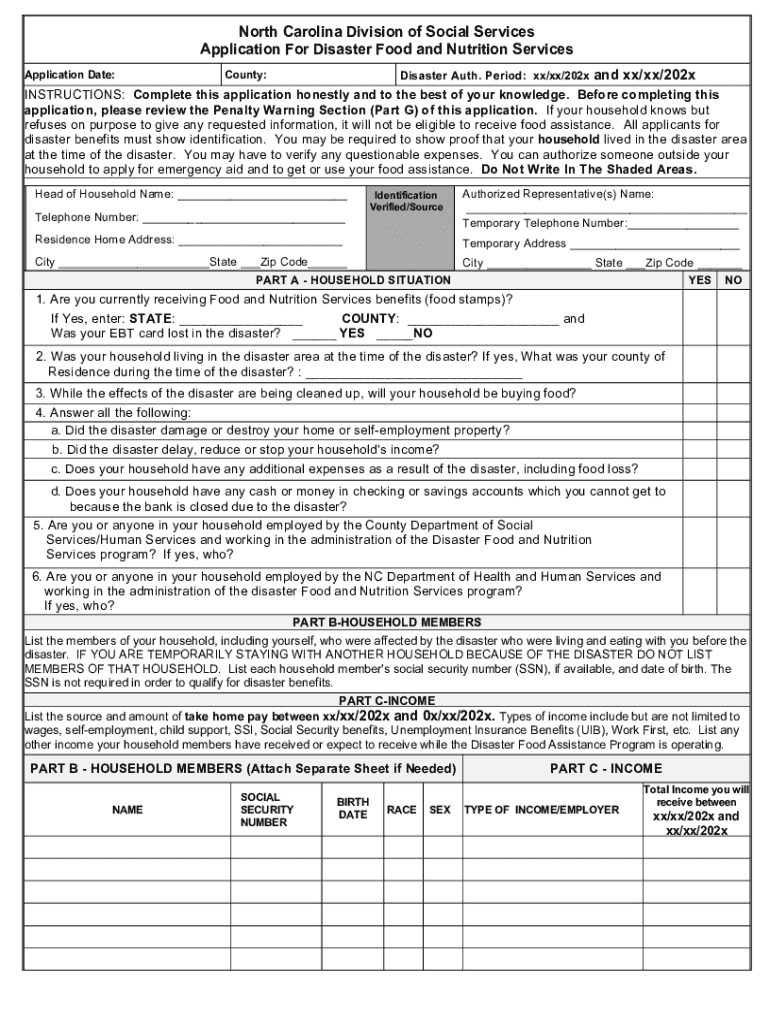
The DSS-1432 form is an application used by the North Carolina Division of Social Services for Disaster Food and Nutrition Services. It is designed to assist individuals and households affected by disasters in applying for temporary food assistance. This form collects essential details about applicants' household composition, income, and expenses directly related to the disaster to determine eligibility for aid.
Important Elements of DSS-1432
When filling out the DSS-1432, certain key elements must be included to ensure a comprehensive application. These include:
- Household data: Information about all household members, including names, birthdates, and social security numbers.
- Income details: Documentation of all sources of income for the household, such as wages, benefits, or pensions.
- Disaster-specific expenses: Any costs incurred due to the disaster, such as housing, medical, or transportation expenses.
- Identification verification: Pieces of identification to prove applicant identity and residency.
Steps to Complete the DSS-1432
Filling out the DSS-1432 involves a series of methodical steps to ensure all necessary information is captured accurately:
- Gather personal information: Collect full names, birthdates, and social security numbers for each household member.
- Document income sources: Assemble records of all household income, including pay stubs and benefit statements.
- List disaster-related expenses: Record any expenses directly attributable to the disaster.
- Prepare identification documents: Include copies of IDs and proof of residency.
- Complete the form: Carefully enter all collected data into the DSS-1432, ensuring accuracy and completeness.
How to Obtain the DSS-1432
The DSS-1432 can be obtained from various sources to facilitate the application process:
- Online access: Visit the North Carolina Division of Social Services website to download the form.
- Local offices: Forms are also available at local social services offices where staff can provide assistance.
- Community centers: In disaster-affected areas, forms may be distributed through community centers and relief sites.
Submission Methods for DSS-1432
Applicants have several methods to submit the completed DSS-1432 form:
- Online submission: If the form is filled out electronically, it can be submitted through the designated online portal.
- In-person delivery: Forms can be delivered directly to local social services offices.
- Mail-in option: Completed forms can be mailed to the address specified in the form's instructions.
Legal Use and Compliance
The legal use of the DSS-1432 is crucial for maintaining program integrity:
- Accuracy of information: False information can lead to penalties, including fines or disqualification from assistance programs.
- Confidentiality assurance: Submission of the form ensures compliance with confidentiality protocols to safeguard applicant data.
Important Terms Related to DSS-1432
Understanding specific terms associated with the DSS-1432 is vital for proper completion:
- Household unit: Defines all individuals living together who share expenses.
- Disaster-related expenses: Refers to necessary costs incurred as a direct result of a disaster event.
- Eligibility criteria: The standards set to determine who qualifies for assistance under the Disaster Food and Nutrition Services.
State-Specific Rules for DSS-1432
Compliance with North Carolina's state-specific guidelines is essential when using the DSS-1432:
- Income limits: Varying thresholds based on household size, affecting eligibility.
- Residency requirements: Proof of current residency in affected areas within North Carolina is mandatory.
- Reporting timelines: Timely submission of the application following a disaster is necessary to qualify for aid.
Penalties for Non-Compliance
Non-compliance with DSS-1432 requirements can result in severe consequences:
- Denial of benefits: Incomplete or inaccurate forms may lead to disqualification.
- Legal action: Intentional falsification is subject to prosecution and fines.
- Repayment obligations: Incorrectly received benefits must be repaid, potentially with additional penalties.