






Definition & Meaning
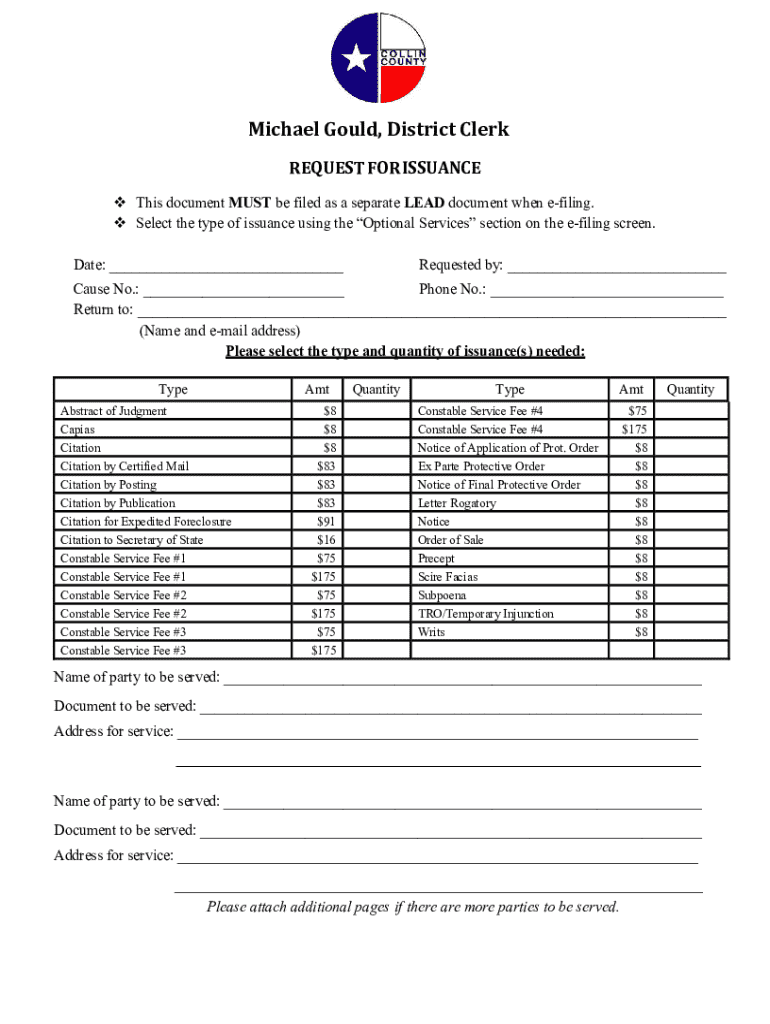
A "Request for Issuance" is a formal document often used in legal settings to request the issuance of official legal documents or services. This form typically involves the filing for legal instruments such as citations, protective orders, and constable services. The process ensures that all pertinent information about the requester and the parties involved is captured accurately. It plays a crucial role in initiating or facilitating various legal processes by formalizing the request and providing a structured means of communication between the parties and the judicial system involved.
How to Use the Request for Issuance
To effectively use a Request for Issuance form, you must first understand its purpose and align your needs with the available options on the form. Start by downloading or obtaining the form from the appropriate legal or governmental entity. Then, carefully fill out the details about the parties involved, including names and addresses. Make sure to specify the type of issuance you are requesting. Pay attention to filing fees and ensure they are paid to avoid processing delays. If e-filing is an option, this can streamline the process. Ensure that all required signatures are included before submission to validate the request legally.
Steps to Complete the Request for Issuance
- Acquire the Form: Obtain the Request for Issuance form from the relevant legal authority or court.
- Fill Out Identification Information: Enter accurate details about both the requester and the intended recipient(s) including names and contact information.
- Specify the Type of Issuance: Clearly indicate which document or service is being requested (e.g., citation, protective order).
- Provide Detailed Instructions: Clearly articulate any specific requirements or instructions for processing.
- Attach Necessary Documentation: Include any additional documents required to support your request, such as previous court orders or identification.
- Pay Associated Fees: Check for any service fees associated with the request and ensure these are paid.
- Review and Sign: Carefully review the entire form for accuracy, then sign and date it to confirm your request.
- Submit the Form: Deliver the completed form to the appropriate authority through the designated method (e.g., online submission, mail).
Key Elements of the Request for Issuance
The Request for Issuance form comprises several essential components. These include sections for the requester's information, detailed descriptions of the desired legal issuance, and the parties involved. It also covers logistics such as delivery methods, payment of fees, and any relevant deadlines. Each component is crucial for ensuring the form serves its intended purpose. For instance, incorrect or missing information in the requester section could result in delays. The detailed description ensures clarity on the type of document or service needed, enhancing the request's likelihood of being fulfilled as intended.
Important Terms Related to Request for Issuance
Understanding certain terms is vital when dealing with a Request for Issuance form:
- Citation: A court-issued order or summons for someone to appear in court.
- Protective Order: A legal injunction protecting an individual from harassment or harm.
- Constable Service Fees: Fees that cover the cost of a constable delivering legal or court documents.
- E-filing: The submission of documents to the court via electronic means.
These terms represent various aspects and services typically associated with the Request for Issuance, and understanding them is critical for accurate completion and submission of the form.
State-Specific Rules for the Request for Issuance
Each U.S. state might have distinct guidelines and criteria regulating the Request for Issuance. For instance, some states mandate specific formats for submission, while others may have unique fee structures or required supporting documentation. It is essential for users to ascertain state-specific requirements prior to completing the form. Legal websites and local courthouses often provide resources or contact points for inquiries. Adhering to these geographical distinctions ensures compliance with local laws, preventing unnecessary rejection or return of submissions.
Legal Use of the Request for Issuance
The Request for Issuance is primarily utilized in legal contexts, providing an official request for legal documents or services necessary for proceedings. Its use ensures that legal actions are initiated properly and documented in a manner that adheres to judicial standards. This form is instrumental in legal settings where documentation is required to authorize events, such as serving court notices or formalizing protective orders. Proper use of the form facilitates legal processes and guarantees that all parties maintain compliance with legal statutes and protocols.
Form Submission Methods (Online, Mail, In-Person)
Methods of submitting a Request for Issuance may vary depending on the jurisdiction:
- Online: E-filing is an efficient and increasingly popular method, reducing processing time and enabling immediate confirmation of receipt.
- Mail: Traditional postal service remains a reliable option, though it may result in longer processing times due to delivery delays.
- In-Person: Direct submission at a courthouse or legal office ensures immediate handover and often allows for on-spot clarifications.
Choosing the most suitable submission method is contingent on proximity, urgency, and personal preference, balancing convenience with the certainty of delivery.
Who Typically Uses the Request for Issuance
The Request for Issuance form is primarily used by legal professionals, such as attorneys, paralegals, or court clerks, who manage and process legal documentation for clients and court systems. Individuals involved in legal proceedings, like plaintiffs or defendants, may also directly utilize these forms to request necessary court actions or document issuances. Understanding the audience ensures that the form is used in appropriate contexts, thereby maintaining efficiency in legal processes and promoting the timely handling of legal matters.