
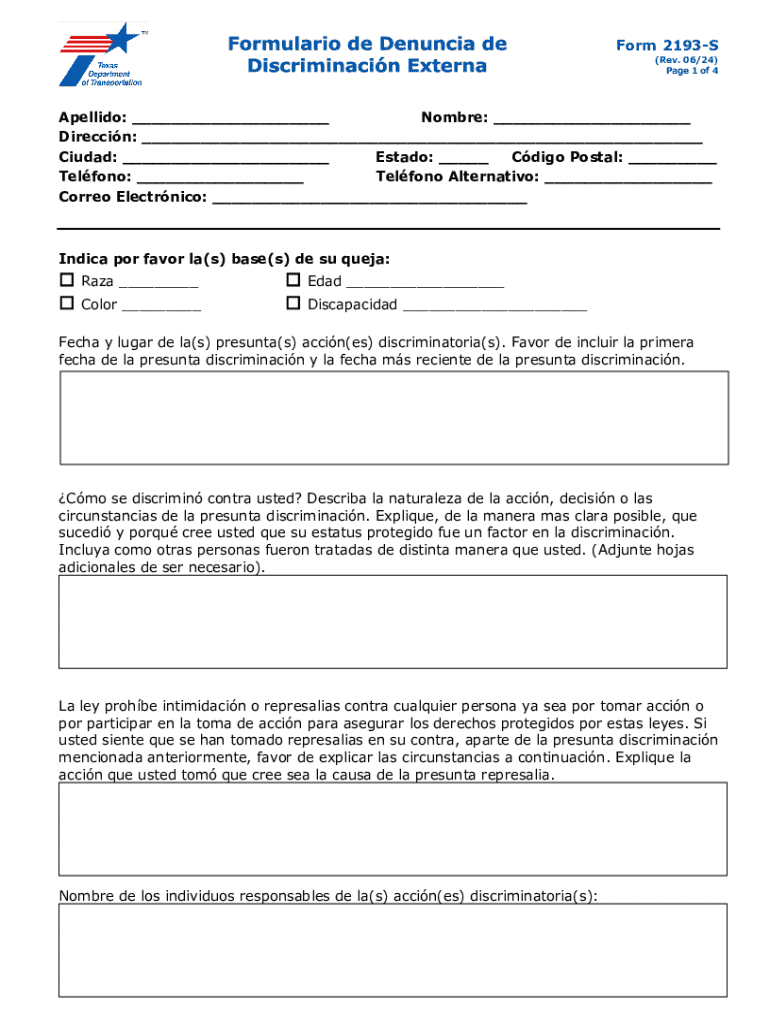







Definition and Meaning of Form 2193-S
Form 2193-S is a formal complaint document used primarily to report instances of discrimination, including but not limited to, race, color, age, or disability. The form requires the complainant to provide detailed personal information and specifics about the alleged discriminatory actions. In addition, it requests data on any witnesses and additional evidence that support the accusations. This form is also a mechanism for understanding if the complainant has previously filed related complaints with pertinent organizations. A critical aspect of Form 2193-S is to elucidate the desired remedy or resolution from the complainant's perspective. To authenticate the submission, a signature is mandatory.
How to Obtain the Form 2193-S
Obtaining Form 2193-S can be done through multiple channels, contingent upon the organization responsible for its issuance. Commonly, the form is available for download from relevant government or institutional websites that focus on discrimination issues. If digital access is not feasible, physical copies can be requested via mail. Organizations may also offer the form in designated offices for in-person collection. For individuals who prefer assistance in form acquisition, contacting the issuing body directly via phone or email can provide guidance and support.
Steps to Complete the Form 2193-S
Completing Form 2193-S requires careful attention to detail to ensure that all sections are accurately filled. The following step-by-step instructions provide clarity on filling out the form:
- Personal Information: Fill in your full name, contact details, and demographic data.
- Incident Report: Describe the nature of the discriminatory action, including dates, locations, and any involved parties.
- Witness Information: Provide names and contact details of any witnesses who can corroborate your account.
- Previous Complaints: Indicate any past complaints filed with other organizations relevant to the issue.
- Desired Outcome: Clearly articulate what resolution or remedy you seek from submitting the complaint.
- Signature: Affix your signature to validate and authorize the complaint submission.
It is vital to review the form for completeness and accuracy before submission.
Who Typically Uses the Form 2193-S
Form 2193-S is predominantly used by individuals who feel they have experienced unlawful discrimination. This includes employees who encounter unjust treatment in the workplace, customers in consumer-facing roles, or residents experiencing bias in housing situations. Civil rights organizations may also utilize this form to document patterns of discrimination against groups of people. Essentially, the form serves as a formal mechanism for those seeking redress from discriminatory practices across various social and institutional contexts.


Important Terms Related to Form 2193-S
Several essential terms are pivotal to understanding and completing Form 2193-S:
- Complainant: The individual filing the complaint who alleges experiencing discrimination.
- Respondent: The person or organization against whom the complaint is filed.
- Witnesses: Individuals who can provide testimony or evidence supporting the complainant's claims.
- Remedy: The resolution or action sought by the complainant to address the discrimination.
Knowledge of these terms ensures clarity and precision in completing and processing the complaint.
Legal Use of the Form 2193-S
The legal use of Form 2193-S is governed by anti-discrimination laws and regulations within the United States. It serves as a documented record that can be used in investigative or judicial processes to advocate for the complainant's rights. Filing this form typically initiates a formal investigative procedure by the relevant authority, and misrepresentation on the form can have legal consequences. Ensuring that all provided information is truthful and accurate is critical as it may be scrutinized in legal or administrative proceedings.
Key Elements of the Form 2193-S
Several key elements must be included in Form 2193-S to ensure it is comprehensive and effective:
- Detailed Narrative: A thorough account of the discriminatory act, including what transpired, where, and how it affected the complainant.
- Supporting Information: Evidence that can substantiate the claim, such as documentation, photographs, or digital proof.
- Coordination Details: Information on where to send the form and contact persons for follow-up inquiries.
- Witness Statements: Written or verbal accounts from witnesses sustaining the claim provide substantial weight.
These elements collectively create a robust submission that facilitates effective investigation and potential resolution.
State-Specific Rules for Form 2193-S
While Form 2193-S is primarily a federal-level document, variations and additional requirements may exist based on state-specific laws and regulations. Some states may have their own complementary or distinct forms that require completion in tandem with federal submissions. Awareness of these differences and consulting state regulations ensures that complainants meet all legal requirements. State-specific advice can typically be found on the official state government or human rights commission websites.
Form Submission Methods
Form 2193-S can be submitted through various methods, allowing flexibility for the complainant:
- Online Portal: Many jurisdictions offer digital submission through secure portals, providing convenience and speed.
- Mail-In Submission: Physical forms can be posted to a designated address. It is recommended to request delivery confirmation when using this method.
- In-Person: For direct submission, forms can often be handed in at specific offices, which may provide an opportunity to ask questions and receive immediate feedback.
Each submission method has its benefits, and selecting the most convenient option will depend on personal circumstances and preferences.




