
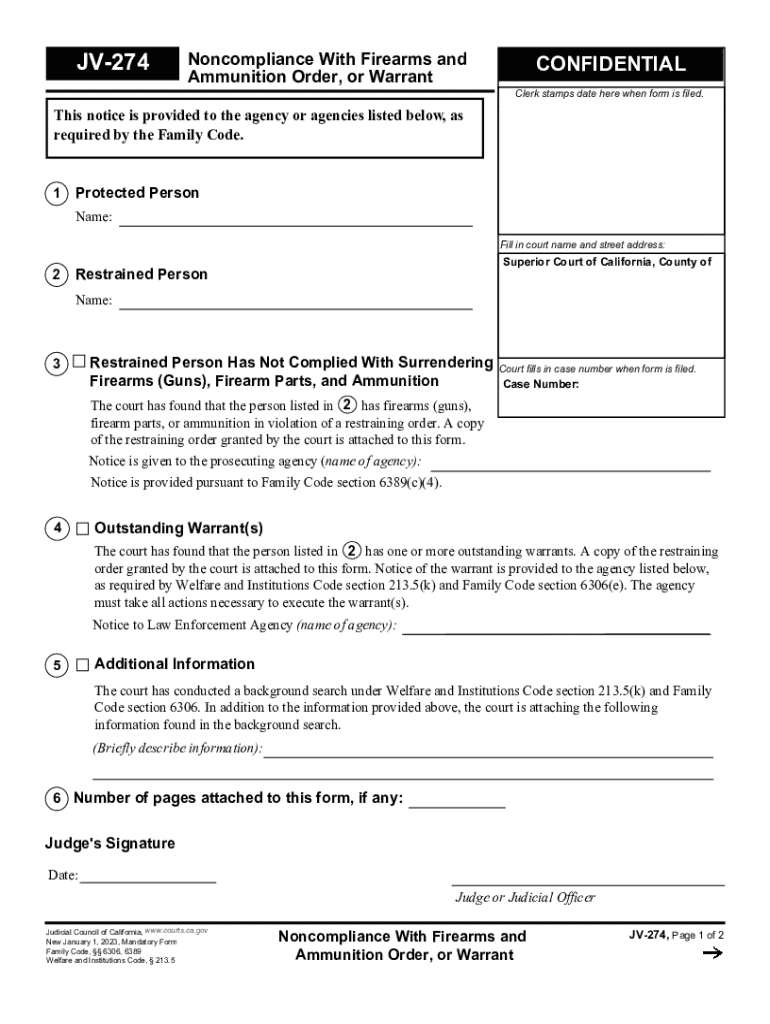







Definition and Meaning of the JV-274
The JV-274 is a legal document used in the judicial process to address noncompliance with firearm surrender orders. It serves as an official notification that a restrained person has failed to comply with a court's directive to surrender firearms and ammunition as mandated by a restraining order. This document is pivotal in informing prosecuting and law enforcement agencies about the breach and any outstanding warrants related to the case. It ensures that legal measures are taken to uphold firearm restrictions under family law, thus maintaining safety and legal integrity.
Characteristics of the JV-274
- Legal Notice: Primarily functions as a notice to relevant authorities about noncompliance.
- Communication Tool: Alerts prosecuting and law enforcement agencies, ensuring all parties are informed.
- Documentation: Provides a record of noncompliance with firearm and ammunition surrender orders, useful for judicial and enforcement actions.
How to Obtain the JV-274
Acquiring the JV-274 form is a straightforward process, but it is crucial to follow the correct procedures to ensure compliance with legal requirements.
Steps to Acquire
- Court Clerk's Office: Visit the nearest family court's clerk office where the original restraining order was issued. The clerks can guide you on obtaining the form.
- Online Resources: Some states provide downloadable versions of the JV-274 on their official judicial websites. Check for availability and region-specific versions.
- Legal Counsel: Consult with an attorney who specializes in family law. They can assist in acquiring the form and provide guidance on related legal processes.
Considerations
- Ensure that you are accessing the correct and most recent version of the form to comply with state-specific rules and regulations.
- Verify with an attorney or court official if additional documentation is needed alongside the form.
Steps to Complete the JV-274
Completing the JV-274 involves attention to detail, ensuring all legal and personal information is accurately provided.
Detailed Instructions
- Personal Information: Fill in the required personal and contact information for the restrained individual. Ensure accuracy as this data is vital for the form's legal validity.
- Compliance Details: Clearly state the aspects of noncompliance, including any missed deadlines for surrender or outstanding warrants.
- Supporting Evidence: Attach necessary documentation that supports the claim of noncompliance, such as copy of the restraining order and any correspondence related to the case.
- Signature and Date: Ensure that all necessary signatures are provided, and the document is dated appropriately to establish timelines.
Common Mistakes to Avoid
- Omitting critical information such as warrant details or personal identification.
- Failing to attach relevant supporting documents.
- Incorrectly filling dates or expiration information.
Legal Use of the JV-274
The JV-274 plays a critical role within the legal system, aiding in the enforcement of firearm surrender laws.
Applications
- Judicial Enforcements: Used by courts to initiate legal actions against noncompliance with firearm surrender orders.
- Law Enforcement: Enables law enforcement agencies to track and act upon outstanding warrants related to the surrendered firearms.
Implications of Legal Use
- Ensures compliance with firearm restrictions, thereby promoting community safety.
- Establishes a legal mechanism for authorities to intervene when a restrained person fails to comply with court orders.
Important Terms Related to the JV-274
Understanding terminologies associated with the JV-274 is essential for accurate completion and use of the form.
Key Terms
- Restrained Person: The individual required to relinquish firearms due to a court order.
- Noncompliance: Failure to adhere to the court's directive, noted in the JV-274.
- Warrant: Legal document authorizing the apprehension of the person failing to comply with the order.
Glossary
- Court Order: A formal statement from a court that mandates compliance with specific terms set forth by the judicial system.
- Firearm Surrender: The act of relinquishing firearms and ammunition as directed by a court order for safety reasons.
State-Specific Rules for the JV-274
Regulations surrounding the JV-274 can vary significantly from one state to another. Understanding these differences is crucial for legal compliance.
Variations Across States
- California: Often requires supplemental documentation and has specific timelines for compliance.
- New York: May involve mandatory procedures for notifying law enforcement about outstanding warrants sooner.
- Texas: Focuses on strict guidelines for document submission and may include additional steps for notifying affected parties.
Why State Differences Matter
- Ensures adherence to local statutes and legal systems.
- Helps in understanding additional requirements or documentation needed for valid submission.
Penalties for Non-Compliance with JV-274
Failing to comply with a JV-274 can lead to serious legal repercussions.
Common Penalties
- Fines: Monetary penalties for failing to adhere to court orders.
- Arrests: Possible apprehension enforced by existing warrants associated with noncompliance.
- Legal Action: Further legal consequences, including more restrictive court orders or additional charges.
Legal Consequences
- Potentially exacerbates legal issues, creating added challenges in resolving restraining order conflicts.
- Negative implications on the individual’s legal standing and personal freedom.
Examples of Using the JV-274
Real-world scenarios provide context on how the JV-274 is practically applied.
Case Studies
- Domestic Dispute Resolution: In instances where one party in a domestic case fails to surrender firearms, the JV-274 is used to escalate the issue legally.
- Law Enforcement Notification: A police department receives the JV-274 to act on outstanding warrants, thereby preventing potential incidents involving firearms.
Practical Applications
- Facilitates communication between courts and enforcement agencies.
- Serves as a preventative measure in disputes involving firearms, highlighting judicial commitment to public safety.




