






Understanding the Qualified Domestic Relations Order (QDRO)
The Qualified Domestic Relations Order (QDRO) is an essential legal document used primarily in divorce cases to assign a portion of a person's retirement benefits to an alternate payee, often an ex-spouse. The QDRO ensures that the division of retirement plan assets complies with established federal laws, including the Employee Retirement Income Security Act (ERISA) and the Internal Revenue Code.
Key Elements of a QDRO
A QDRO must include specific information to be deemed valid. Key elements typically found in a QDRO are:
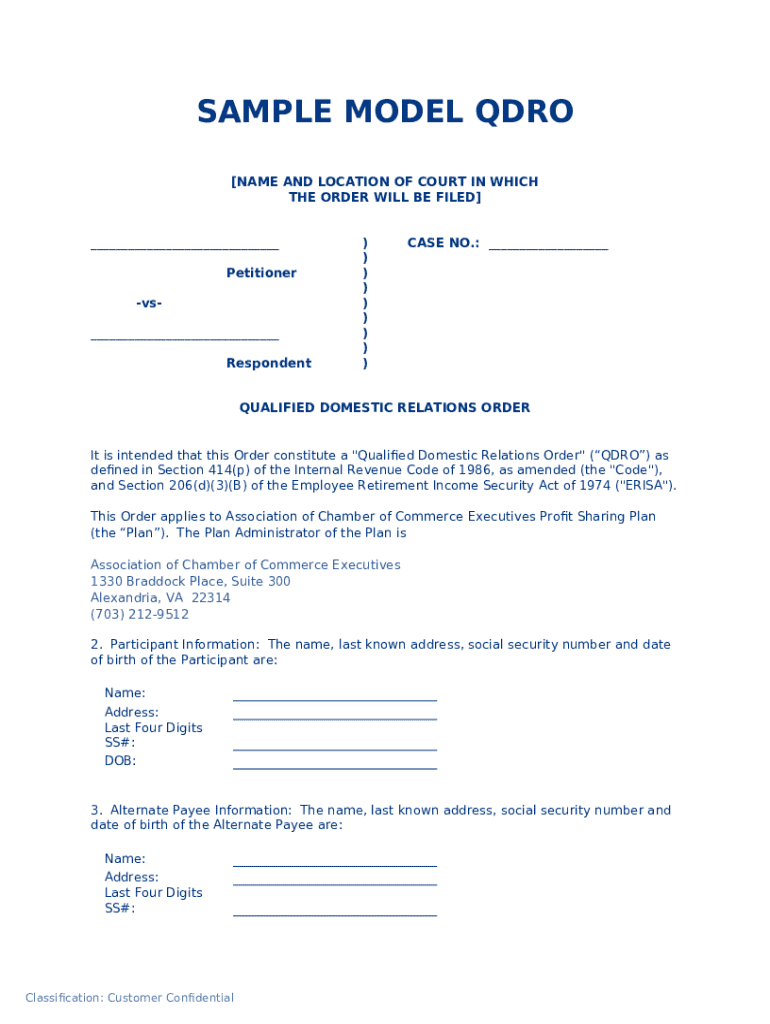
- Participant Details: The document should clearly identify the retirement plan participant, including their name, address, and Social Security Number (SSN).
- Alternate Payee Information: The QDRO must also detail the alternate payee's details, usually an ex-spouse or child, including their name and SSN.
- Plan Name and Contact: Identifying the retirement plan and providing a contact for plan administrators is crucial.
- Benefit Details: Specify the exact percentage or dollar amount of the benefits to be awarded to the alternate payee. This section may also detail the start and end dates for payments.
Steps to Complete the Qualified Domestic Relations Order
Completing a QDRO involves several critical steps to ensure accuracy and compliance:
- Draft Preparation: Begin by gathering all relevant personal information for both the participant and the alternate payee.
- Retirement Plan Review: Understand the specific retirement plan's rules, which may impact the QDRO's drafting. Each plan may have unique requirements.
- Legal and Financial Guidance: Consult with a lawyer or a financial advisor specializing in divorce and retirement assets to draft the document correctly.
- Drafting the Document: Using the QDRO sample as a guide, fill out the necessary details, ensuring all mandatory elements are correctly addressed.
- Submit for Approval: Once drafted, submit the QDRO to the retirement plan for approval before presenting it to a court.
- File with the Court: After receiving preliminary approval from the plan, file the QDRO with the appropriate court for the judge's endorsement.
State-Specific Rules for QDROs
State laws may influence the preparation and execution of a QDRO. While federal law provides the basic framework, individual states might have variations, such as:
- State-Specific Language: Some states require specific language or clauses to be included in the QDRO.
- Filing Procedures: The process of filing with the court can differ, impacting where and how documents need to be submitted.
- Tax Implications: States may have specific tax obligations or considerations that should be addressed during the drafting process.
IRS Guidelines on QDROs
The Internal Revenue Service (IRS) has provided clear guidance on how QDROs should be treated for tax purposes:
- Taxation of Benefits: Generally, the recipient of retirement benefits resulting from a QDRO will be responsible for taxes on the distributions.
- Early Distribution Penalties: Recipients may be subject to penalties if distributions occur before retirement age unless exemptions apply, such as those specified in a QDRO.
Legal Use and Compliance
For a QDRO to be legally binding and enforceable, it needs to comply with several criteria:
- Adherence to Legal Standards: Comply with guidelines established by ERISA and corresponding federal laws.
- Court Approval: The document must be approved and signed by a court to become effective.
- Review by Plan Administrator: The retirement plan's administrator must verify that the QDRO complies with the plan's requirements.
Importance of a Qualified Domestic Relations Order
Procuring a QDRO is vital for several reasons:
- Legal Protection: It ensures that the division of retirement assets is conducted legally and equitably.
- Preventing Disputes: By clearly outlining each party's rights and obligations, a QDRO reduces the potential for future disputes.
- Financial Security: Provides a legal mechanism for alternate payees to receive a fair share of retirement benefits, contributing to long-term financial stability post-divorce.
Obtaining a QDRO Sample PDF
Access to a QDRO sample PDF can greatly assist in understanding and drafting the document:
- Legal Resources: Many legal websites provide sample templates for reference.
- Plan Administrator: Some retirement plans may offer sample QDROs specific to their requirements.
- Legal Professionals: Consulting with a legal professional can provide access to customized and compliant sample documents.
Complexities in QDRO Variants
QDROs may have different variants based on the specific retirement plan and the complexity of each case:
- Defined Benefit vs. Defined Contribution Plans: The details of a QDRO might change depending on whether it concerns a pension or a 401(k)-type plan.
- Multiple Beneficiaries: If there are multiple alternate payees, the structure of the QDRO could differ to accommodate each beneficiary’s share.
Common Use Case Scenarios
A wide array of scenarios necessitate the use of a QDRO:
- Divorce Settlements: Commonly, QDROs are utilized to divide retirement assets equitably during divorce.
- Inheritance Situations: In some cases, QDROs might be used to allocate retirement benefits to beneficiaries named in a will.
- Child Support: Some QDROs are specifically arranged to fulfill child support obligations by dividing retirement benefits accordingly.
By comprehensively addressing these elements and guidelines, individuals can ensure that their QDROs are prepared correctly, legally sound, and agreeable to all involved parties.