
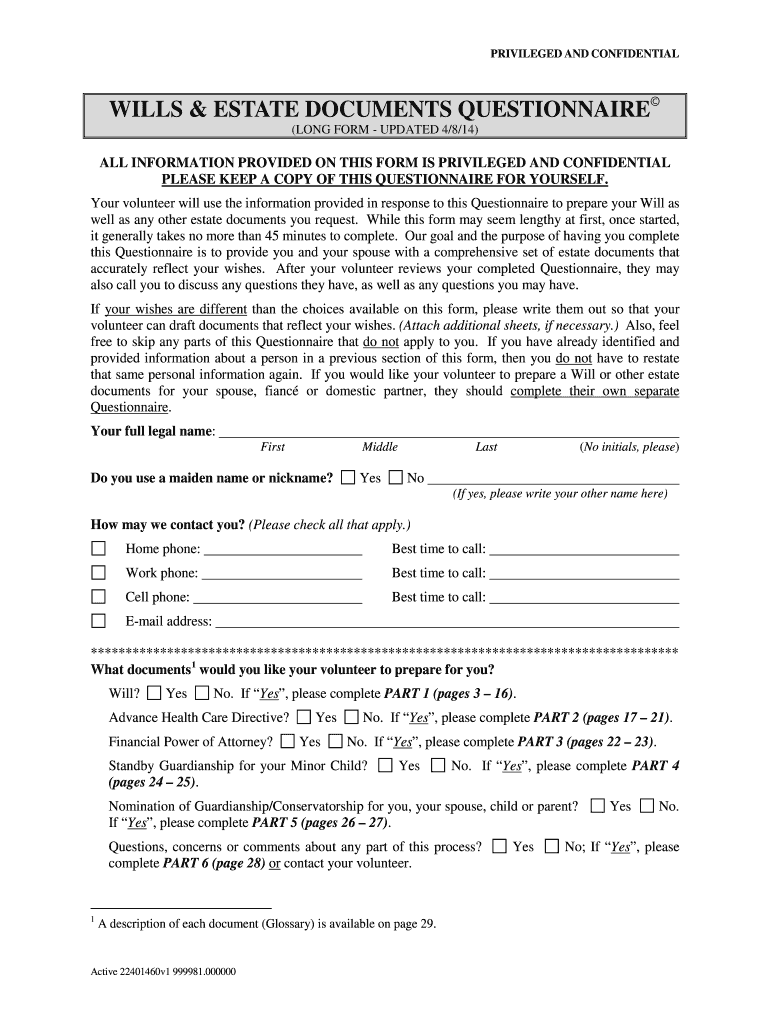







Definition & Purpose of the Wills and Estate Documents Questionnaire
The Wills and Estate Documents Questionnaire is a comprehensive form used to gather essential personal information needed for drafting various legal estate documents. This includes a Will, Advance Health Care Directive, and Financial Power of Attorney. The questionnaire is designed to accurately reflect an individual's wishes regarding property distribution, guardianship for minor children, and health care decisions in cases of incapacity.
Key Documents Included
- Will: Details the distribution of personal assets and names beneficiaries.
- Advance Health Care Directive: Specifies an individual's medical treatment preferences.
- Financial Power of Attorney: Authorizes someone to manage financial responsibilities.
The questionnaire ensures all legal documents align with personal preferences and legal requirements.
How to Use the Wills and Estate Documents Questionnaire
To effectively use the Wills and Estate Documents Questionnaire, follow these steps:
- Review the Questions: Read each section to understand the type of information requested.
- Gather Necessary Information: Collect personal details, beneficiaries' information, and specifics about assets and liabilities.
- Complete the Questionnaire: Fill in each section thoroughly, ensuring accuracy.
- Consult Legal Counsel: If uncertain about specific sections or legal implications, consult with an attorney.
The questionnaire provides a structured approach to collating critical information needed for estate planning.
Steps to Complete the Wills and Estate Documents Questionnaire
- Personal Information Section: Provide full name, contact details, and Social Security number.
- Family Details: Include information about family members and any dependents.
- Asset Inventory: List all assets, including real estate, bank accounts, and investments.
- Beneficiaries: Name individuals or entities that will inherit your assets.
- Executors and Guardians: Designate individuals responsible for executing the will and guardians for minor children.
- Funeral and Medical Preferences: Outline preferences for funeral arrangements and medical directives.
Ensure all entries are precise and reflect current wishes. Regular updates may be necessary as personal circumstances change.
Important Terms Related to Wills and Estate Documents
- Beneficiary: The person or group designated to receive assets.
- Executor: An individual appointed to carry out the terms of a will.
- Guardian: A person who is legally responsible for a minor.
- Testamentary Trust: A trust established through a will to manage assets for beneficiaries.
Understanding these terms is crucial for accurately completing the questionnaire and ensuring legal intentions are clear.
Legal Use of the Questionnaire
The Wills and Estate Documents Questionnaire serves as a foundational tool for creating legally binding estate documents. It is used to:
- Ensure comprehensive and consistent documentation of an individual's wishes.
- Facilitate the drafting of legally compliant wills and directives according to state laws.
- Provide a clear, documented record for legal professionals to reference in estate planning.
Compliance with state-specific legal guidelines is essential to ensure the enforceability of estate documents.
State-Specific Rules for the Wills and Estate Documents Questionnaire
Estate document requirements can vary significantly across different states. Key differences might include:
- Witness Requirements: The number of witnesses needed to validate a will.
- Executor Qualifications: State-specific criteria for who can serve as an executor.
- Property Laws: Variations in how property is distributed according to state law.
It's important to tailor the questionnaire and resulting documents to adhere to the legal requirements of the state in which the estate resides.
Who Typically Uses the Wills and Estate Documents Questionnaire
This questionnaire is primarily used by individuals engaging in estate planning. Typical users include:
- Individuals Planning Retirement: Preparing for financial and medical contingencies.
- Young Families: Ensuring guardianship and financial security for children.
- High-Net-Worth Individuals: Managing complex asset portfolios and tax considerations.
- Individuals With Specific Health Directives: Documenting specific medical treatment preferences.
The questionnaire is widely applicable, addressing the unique needs across different life stages and financial backgrounds.


Examples of Using the Wills and Estate Documents Questionnaire
Scenario 1: A Young Family
- A couple with minor children uses the questionnaire to designate guardians and ensure financial security for their children, incorporating specific instructions for child-rearing and educational expenses.
Scenario 2: Single Retiree
- A retiree without immediate family utilizes the questionnaire to distribute assets to selected charities, specifying end-of-life care preferences through an Advance Health Care Directive.
By seeing how the questionnaire is applied in real-life scenarios, individuals gain insight into its practical utility and importance for personalized estate management.




