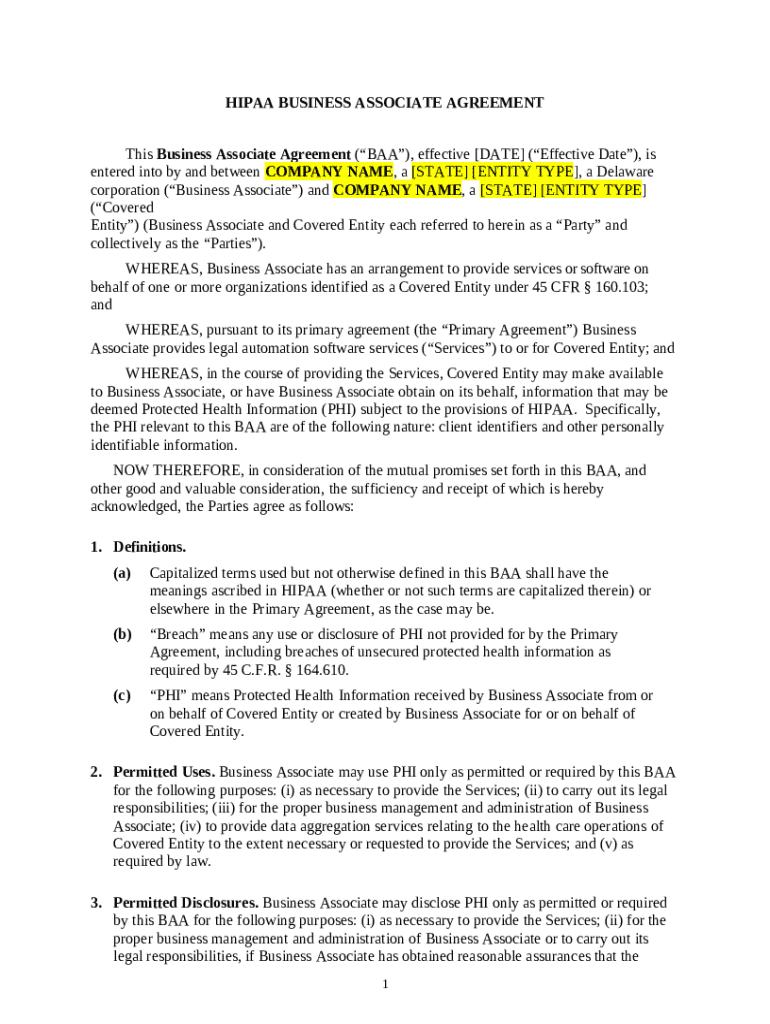







Definition & Meaning
The HIPAA Business Associate Agreement (BAA) is a legal document that establishes the terms under which a Business Associate can provide services to a Covered Entity while managing Protected Health Information (PHI). It ensures compliance with HIPAA regulations by defining permitted uses and disclosures of PHI, detailing the safeguards to protect PHI, and outlining breach notification procedures. This agreement is essential for maintaining the confidentiality and security of health information shared between entities in the healthcare sector.
Key Elements of the HIPAA Business Associate Agreement
A comprehensive HIPAA BAA includes several critical elements designed to protect PHI:
-
Permitted Uses and Disclosures: Clearly specifies how PHI can be used and disclosed by the Business Associate. It limits the use of health information to the purposes stated in the agreement and prohibits any unauthorized use or disclosure.
-
Safeguards to Protect PHI: Outlines the measures that the Business Associate must implement to protect PHI, including administrative, physical, and technical safeguards. These measures align with HIPAA’s Security Rule to ensure PHI's integrity and confidentiality.
-
Breach Notification Procedures: Details the protocol for reporting any breaches involving PHI. The Business Associate is required to notify the Covered Entity without unreasonable delay if a breach is detected, enabling appropriate mitigation actions.
-
Obligations of Both Parties: Defines the responsibilities of the Covered Entity and Business Associate to maintain compliance with HIPAA rules. This includes ensuring that subcontractors agree to the same conditions and requirements.
Important Terms Related to the HIPAA Business Associate Agreement
Understanding terminology is crucial for interpreting a HIPAA BAA accurately:
-
Protected Health Information (PHI): Any information about health status, healthcare provision, or payment for healthcare that can be linked to a specific individual.
-
Covered Entity: Typically refers to healthcare providers, health plans, and healthcare clearinghouses that transmit any health information in electronic form.
-
Business Associate: A person or organization that performs functions or activities on behalf of a Covered Entity involving PHI. This can include data analysis, claims processing, or billing.
-
Breach: An impermissible use or disclosure of PHI that compromises its security or privacy.
How to Use the HIPAA Business Associate Agreement
When utilizing a HIPAA BAA, both parties must adhere to specific steps to ensure compliance and protect PHI:
-
Drafting the Agreement: Start with a template that includes all necessary HIPAA requirements, tailoring it to the specific needs of the Covered Entity and Business Associate.
-
Reviewing Legal Requirements: Both parties should collaborate with legal experts to ensure the BAA complies with all HIPAA regulations and any applicable state laws.
-
Implementing Safeguards: The Business Associate must establish and maintain the required safeguards to protect PHI and demonstrate their compliance practices to the Covered Entity.
-
Training Staff: Both parties should train their workforce about HIPAA requirements, particularly focusing on the provisions of the BAA.
-
Monitoring Compliance: Regular audits and assessments should be conducted to ensure ongoing adherence to the BAA terms and PHI protection.
Steps to Complete the HIPAA Business Associate Agreement
Completing a HIPAA BAA entails several detailed steps:
-
Identify Covered Entities and Business Associates: Determine which parties are involved and their respective roles concerning PHI.
-
Define Scope and Purpose: Clearly articulate the scope of services provided and the specific PHI that will be accessed or managed.
-
Draft Legal Terms: Develop the legal language that will govern the relationship, including all necessary HIPAA stipulations.
-
Review and Revise the Agreement: Both parties should carefully review the draft to ensure completeness and accuracy before proceeding.
-
Obtain Signatures: Secure signatures from authorized representatives of both the Covered Entity and Business Associate to formalize the agreement.
-
Implement and Monitor: Once signed, implement the terms and monitor compliance periodically to ensure ongoing protection of PHI.
Legal Use of the HIPAA Business Associate Agreement
The legal aspects of a HIPAA BAA are critical for ensuring data protection and compliance:
-
Federal Compliance: The BAA should adhere to all HIPAA rules and regulations, reflecting federal mandates for PHI protection.
-
State Considerations: Consideration should be given to any additional state laws that may affect health information privacy and security, ensuring additional compliance where needed.
-
Enforcement and Penalties: The agreement should outline enforcement measures for non-compliance and penalties to deter violations and encourage adherence to HIPAA standards.
Examples of Using the HIPAA Business Associate Agreement
There are numerous scenarios where a HIPAA BAA is utilized effectively:
-
Healthcare Providers and IT Vendors: When a healthcare facility contracts IT services for managing electronic health records, a BAA is necessary to outline how PHI will be protected.
-
Medical Billing Companies: A medical office working with a billing service needs a BAA to ensure patient data used in billing is handled securely.
-
Research Institutions: When researchers partner with healthcare facilities, a BAA helps manage how health information is shared and protected throughout research activities.
Penalties for Non-Compliance
Non-compliance with HIPAA BAA terms can result in severe penalties:
-
Financial Penalties: Organizations may face fines ranging from $100 to $50,000 per violation, depending on the level of negligence, with a maximum penalty of $1.5 million per year for violations of an identical provision.
-
Legal Actions: Non-compliance could lead to legal actions from affected parties or regulatory bodies seeking enforcement of HIPAA regulations.
-
Reputational Damage: Failing to protect PHI could damage an organization’s reputation, significantly impacting patient trust and business operations.