




01. Edit your monthly budget template form online
Type text, add images, blackout confidential details, add comments, highlights and more.

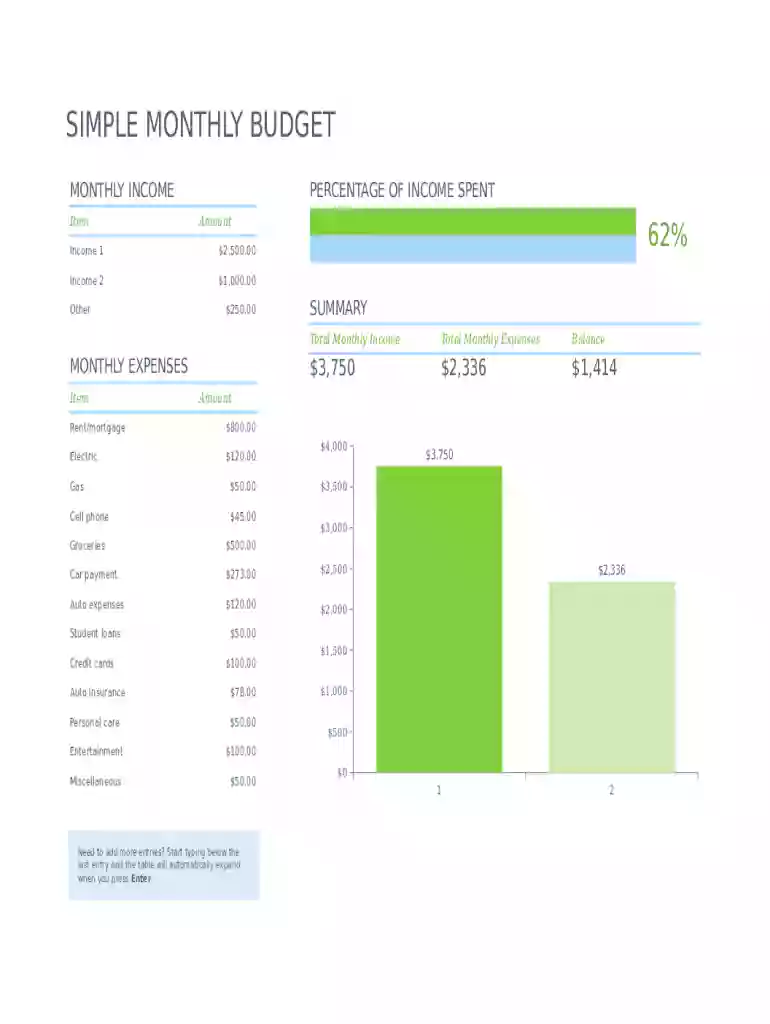
Type text, add images, blackout confidential details, add comments, highlights and more.

Draw your signature, type it, upload its image, or use your mobile device as a signature pad.

Send monthly budget template editing via email, link, or fax. You can also download it, export it or print it out.
A simple monthly budget template is a straightforward financial planning tool designed to help individuals or households monitor and manage their income and expenses on a monthly basis. This template is ideal for those looking to gain a clear understanding of their financial situation, ensuring that they achieve a balanced budget by planning for income and expenses. The tool encourages disciplined spending and saving habits, promoting financial health and well-being. It typically features categories for listing all sources of income and areas of expenditure, such as housing, utilities, groceries, and entertainment.
A well-structured simple monthly budget template typically includes several key components to ensure comprehensive financial tracking. These include:
Individuals utilize a simple monthly budget template to effectively manage their finances in various scenarios. For example:
Utilizing a simple monthly budget template brings numerous benefits, such as improved financial awareness, enabling individuals to make informed financial decisions. It helps prevent overspending by setting realistic spending limits and establishes a clear path towards achieving savings or investment goals. Additionally, it aids in identifying spending patterns, allowing for course correction in financial behavior that may lead to increased savings and resource management efficiency.
A simple monthly budget template is typically versatile and compatible with a variety of software applications. Popular ones include:
The simple monthly budget template is used by a wide array of individuals and groups:


Both digital and paper versions of a simple monthly budget template offer distinct advantages. The digital version, popular among tech-savvy users, allows for ease of updates, automatic calculations, and integration with other digital financial tools. In contrast, the paper version may be preferred by those who enjoy manually jotting down figures and having a tangible record, offering simplicity without the need for electronic devices. Each version serves its purpose, depending on user preference for convenience or a tactile approach to financial management.
At DocHub, your data security is our priority. We follow HIPAA, SOC2, GDPR, and other standards, so you can work on your documents with confidence.
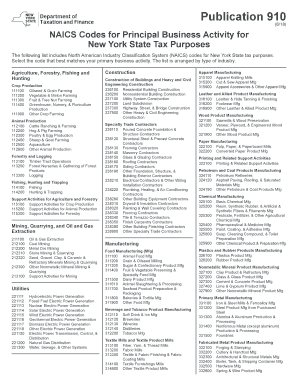



The sheet was created with three goals in mind: that it be easy to use; that it focuses on a daily budget that supports long term goals.
Oct 12, 2021 No more asking others to share their pre-built excel calculator templates, to track your monthly budget or compute XIRR of your stock portfolio.


