






Definition & Meaning
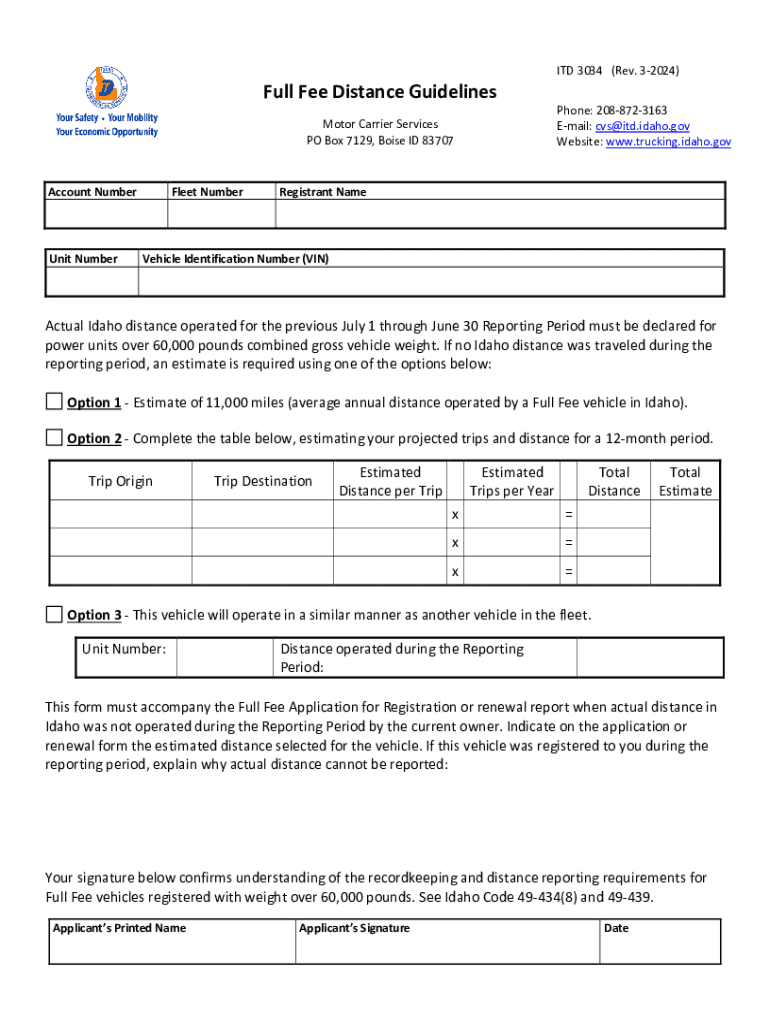
The "Full Fee Mileage Guidelines" provide a structured framework for motor carriers, particularly those in Idaho, to report the distance traveled by vehicles weighing over 60,000 pounds. This document serves to ensure compliance with state regulations regarding mileage reporting. The guidelines are essential in calculating the appropriate fees associated with vehicle registration and the use of transportation infrastructure, thus impacting operating costs for carriers.
- Purpose: To establish a standardized procedure for accurately logging and reporting miles traveled.
- Audience: Primarily motor carriers and transportation businesses operating heavy vehicles.
- Significance: Helps in maintaining transparency and accuracy in reporting operational data for regulatory compliance.
How to Use the Full Fee Mileage Guidelines
Utilizing the Full Fee Mileage Guidelines involves understanding the specific requirements and executing them meticulously. Here’s a process to follow:
- Familiarization: Review the guidelines to understand the expectations and necessary data.
- Data Collection: Track mileage for each vehicle over 60,000 pounds during the specified time frame.
- Documentation: Use trip logs, GPS data, or ELD records to substantiate the reported mileage.
- Form Completion: Fill in all required fields with accurate and verifiable information.
- Review & Verify: Double-check for accuracy before submission to ensure compliance.
- Use existing records or vehicle tracking systems for efficiency.
- Keep supplementary documentation for each entry submitted.
Legal Use of the Full Fee Mileage Guidelines
Legal compliance with the Full Fee Mileage Guidelines is crucial for avoiding penalties and ensuring smooth operations.
- Reporting Accuracy: Motor carriers are legally obligated to provide truthful mileage reports.
- Documentation: Maintain transparent and thorough records to support reported miles.
- Verification: Regulatory bodies may audit reports, necessitating the availability of detailed records.
Consequences of Non-Compliance
- Fines or penalties may be imposed for inaccuracies or intentional misreporting of mileage.
- Regulatory reviews may become more frequent for businesses with a history of non-compliance.
Important Terms Related to Full Fee Mileage Guidelines
Understanding key terminology is essential for effective use of the mileage guidelines:
- Actual Distance: The true number of miles traveled by a vehicle, measured during the reporting period.
- Estimated Distance: An allowed figure when precise measurements aren't possible, computed based on average data or projections.
- Registration Application: A form requiring the documented mileage as part of the vehicle registration process.
- Authentication: Procedures ensuring the submitted data originates from valid and reliable sources.
Key Elements of the Full Fee Mileage Guidelines
The guidelines are composed of several crucial components:
- Mileage Reporting Requirements: Stipulates the need for clear recording and submission of vehicle mileage.
- Estimation Procedures: Offers methods for calculating estimated mileage when actual data isn't available.
- Signature & Confirmation: Validates the submitter’s understanding and agreement to adhere to reporting standards.
Supporting Tools & Processes
- Use spreadsheets or specialized software for data organization and calculations.
- Leverage cloud-based platforms for real-time data input and ease of access.
State-Specific Rules for the Full Fee Mileage Guidelines
The application of the Full Fee Mileage Guidelines can vary by state, often influenced by local regulations. In Idaho:
- Weight Threshold: Applies primarily to vehicles over 60,000 pounds.
- Reporting Periods: Specific dates dictate when reports must be submitted to align with state requirements.
Comparative Variations
- Other states may have differing weight limits or reporting frequency requirements.
Steps to Complete the Full Fee Mileage Guidelines
Successfully completing the Full Fee Mileage Guidelines involves following a structured process:
- Preparation: Gather all necessary documents and supporting records.
- Data Entry: Input actual or estimated mileage into the appropriate sections.
- Verification: Cross-check all entries against original records to ensure accuracy.
- Submission: According to state-specific guidelines, file the completed form with the relevant authority.
- Check with a legal advisor or industry expert if clarification is needed on specific requirements.
- Familiarize yourself with available submission formats, both digital and paper-based.
Examples of Using the Full Fee Mileage Guidelines
Practical scenarios demonstrate the utility of the Full Fee Mileage Guidelines:
- Case Study 1: A regional trucking company successfully reduced penalties by adopting precise GPS tracking aligned with guideline requirements.
- Case Study 2: A logistics firm utilized the estimation provisions to maintain compliance despite data retrieval challenges due to equipment failure.
Practical Benefits
- Ensures alignment with tax obligations and reduces potential for disputes.
- Enhances organizational efficiency through rigorous data management practices.
Required Documents
The robust completion of the Full Fee Mileage Guidelines necessitates several critical documents:
-
Trip Logs: Detailed travel records for each vehicle.
-
Maintenance Records: Supporting documents that may influence mileage.
-
Previous Reports: Past submissions can provide benchmarks for estimating when necessary.
-
Ensure all records are dated, labeled, and stored securely for access during audits.