01. Edit your form online
Type text, add images, blackout confidential details, add comments, highlights and more.

Type text, add images, blackout confidential details, add comments, highlights and more.

Draw your signature, type it, upload its image, or use your mobile device as a signature pad.

Send it via email, link, or fax. You can also download it, export it or print it out.
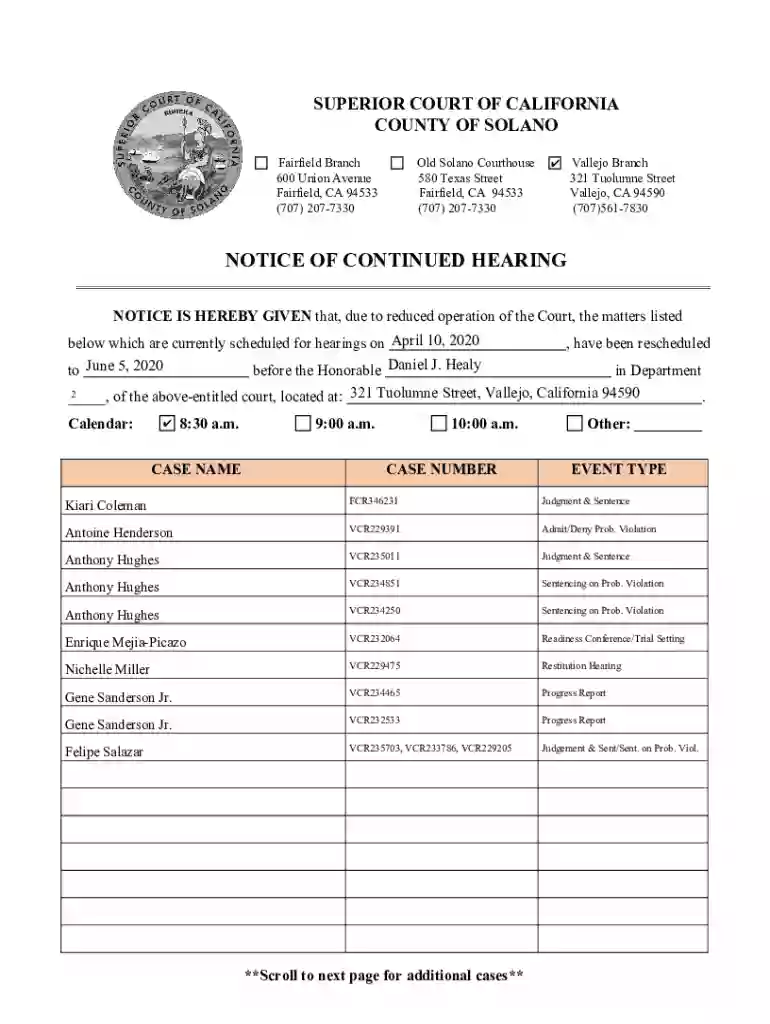
The "NOTICE OF CONTINUED HEARING - Solano County Superior Court" is a formal communication issued by the Superior Court of California, County of Solano, detailing rescheduled court hearings. This notice is crucial for parties involved in legal proceedings as it provides updated information on the timing of hearings that have been postponed, typically due to administrative changes or unforeseen circumstances affecting court operations. Understanding these notices ensures that individuals and legal representatives are informed of new hearing dates, maintaining the flow of legal processes efficiently.
The notice contains several critical elements to ensure clear communication with all involved parties:
These components are essential to ensuring all parties have comprehensive information needed to prepare for their rescheduled hearings effectively.
Effectively using the "NOTICE OF CONTINUED HEARING" involves several important steps:
Failing to follow these steps could result in missing the hearing or being inadequately prepared, which can have significant legal consequences.
After receiving the notice, several actions need to be completed to adhere to the new schedule:
By executing these steps, parties can maintain organized and effective responses to the notice.
The notice is predominantly used by parties involved in legal proceedings within Solano County, including:
These users rely on the accuracy and timeliness of the notice to uphold the integrity of ongoing legal proceedings.


Understanding key legal terms associated with court notices is vital for interpreting them correctly:
Familiarity with these terms can clarify the content and implications of the notice.
This notice is legally binding and forms part of the formal communication system within California’s judicial processes. It ensures compliance with court appointments and deadlines, reducing the risk of delays or dismissals due to absenteeism. The notice serves as an official record, demonstrating due diligence on the part of the court to keep all parties informed. Failure to adhere to the rescheduled dates outlined may lead to penalties, including fines or default judgments against unresponsive parties.
Consider a scenario where a defendant in a civil case receives the notice due to reduced operations in April 2020. The original hearing was scheduled for April 15, 2020, but rescheduled to May 20, 2020. The defendant:
By following these actions, the defendant uses the notice as a critical tool to ensure readiness for the rescheduled proceeding, preventing negative outcomes due to missing the event.
At DocHub, your data security is our priority. We follow HIPAA, SOC2, GDPR, and other standards, so you can work on your documents with confidence.